

How to Heal from Burnout: A Compassionate, Practical Guide

How do you heal from burnout when you’re exhausted, overwhelmed and still expected to keep going? If work, caring responsibilities or the demands of everyday life leave you with little time to recover, simply being told to rest may not feel like enough. Burnout recovery involves more than taking a break; it can also mean understanding what is depleting you, recognising your limits and finding sustainable ways to restore your wellbeing.
As a psychotherapist, Clinical Social Worker and trauma specialist, Azita Abdollahian helps people explore the patterns of chronic stress, emotional exhaustion and overwhelm that can make it difficult to switch off and feel like themselves again. Persistent exhaustion can affect your concentration, relationships, motivation and emotional wellbeing. It is not a personal failure, and pushing yourself harder is not always the answer. While the World Health Organization defines burnout specifically in relation to chronic workplace stress, similar symptoms can have other causes and may warrant professional assessment.
In this guide, Azita explores how to recognise the signs of burnout, practical steps that may support recovery, and how boundaries, nervous system regulation and appropriate professional support can help you move towards a more sustainable way of living. You’ll also learn when it may be helpful to speak with a GP or mental health professional to better understand your symptoms and available options. Recovering from burnout is not about becoming better at tolerating exhaustion; it’s about understanding what you need to feel well again.
Table of Contents
How to recognise burnout and understand what recovery asks of you
Why burnout can persist when the demands around you stay high
What helps burnout recovery: compare personal changes with broader support
How to begin healing from burnout with steps that fit your capacity
How counselling can support a more sustainable way forward from burnout
How to recognise burnout and understand what recovery asks of you
Recovery is usually gradual. It may mean restoring your capacity while also changing some of the demands that have been wearing it down. If you’re wondering how to heal from burnout, begin with curiosity rather than a verdict: what has changed in your energy, mood or ability to manage everyday life?
The World Health Organization describes burnout in ICD-11 as an occupational phenomenon resulting from chronic workplace stress that hasn’t been successfully managed. It involves exhaustion, greater mental distance or cynicism about work, and feeling less effective professionally. Burnout isn’t classified as a medical condition, and this guide can’t determine whether that label fits your experience. Similar difficulties can have other causes, too.
What can burnout feel like in everyday life?
You might dread opening your laptop, find routine decisions unusually difficult, or have so little energy after work that cooking or connecting with people feels out of reach. Someone else may notice irritability, forgetfulness, detachment from colleagues or difficulty keeping up with responsibilities at home. There’s no single way burnout has to look.
Rather than treating these examples as a checklist, pause and ask: what feels different from how I usually am, and what has been happening around me? You could jot down when the changes tend to show up and what was happening beforehand. Noticing a pattern can help you describe your experience without needing to diagnose yourself.
How is burnout different from ordinary stress?
Stress often describes pressure in response to demands; burnout can involve ongoing depletion and disconnection when work stress continues without enough change or support. This is a helpful distinction, not a strict dividing line. Stress and burnout can overlap, and feeling worn down doesn’t by itself confirm either one.
The WHO’s definition keeps burnout tied to the work context. For a broader overview of how the term is used, see Burnout (psychology) on Wikipedia, which discusses psychological burnout and the work of researchers such as Christina Maslach.
It can help to separate what you’re feeling from what you’re calling it. A demanding stretch at work, caring for someone or juggling several responsibilities may leave you depleted, but a clinician can help explore whether other concerns are contributing. Burnout can overlap with experiences such as anxiety or depression. Persistent changes in mood, sleep, concentration or daily functioning are worth discussing with a GP or mental health professional.
Recovery isn’t simply about becoming better at tolerating pressure. If demands stay high, rest may not be enough to rebuild your capacity. Ask yourself: what could be eased, shared or supported, even slightly? For example, could a task be postponed, could someone else take responsibility for part of it, or could expectations be clarified? The answer may take time to find, and you don’t have to work it out alone.
Why burnout can persist when the demands around you stay high
Recovery can be hard to make room for when work, caring responsibilities or personal commitments take up the time and attention you have available. Even during a pause, anticipating the next demand can make it difficult to feel that you’ve stepped away. This doesn’t mean rest has no value. It may mean the wider pattern needs attention as well.
Stress can affect how you respond to everyday situations. You may feel on edge, become more easily overwhelmed or find it harder to think through decisions. These responses differ from person to person and don’t point to one single cause of burnout. Looking at your circumstances can help you understand what is maintaining strain, rather than assuming you simply need to become more resilient.
What keeps the cycle of exhaustion going?
Sometimes the pressure comes from having too much to do. At other times, it’s uncertainty around the work: priorities keep changing, expectations aren’t clear, or there’s little say in how responsibilities are managed. You might keep agreeing to requests because saying no feels risky, or carry on without asking for help because you’re unsure what support is available. These are possibilities to consider, not assumptions about your situation.
Ask yourself: which part of the pressure is most wearing, and what makes it hard to change? You may have some influence over how a task is organised, need another person’s involvement, or face constraints that can’t shift right now. Separating what you can change from what needs support can guide your next conversation or help you decide where further help would be useful.
Why self-care alone may not be enough
Sleep, movement and quiet time can be supportive, but they can’t always resolve the conditions contributing to strain. You might make space for a walk, for example, and still return to unclear priorities or responsibilities that exceed the time available. If a self-care practice is hard to keep up, that doesn’t mean you lack commitment. It may simply not address the pressure that needs attention.
Trauma can shape how safe it feels to slow down or ask for support, but burnout doesn’t necessarily involve trauma. If you’d like more context on how past experiences may affect responses to stress, you could explore the article on trauma and nervous system dysregulation.
For workplace wellbeing, the UK National Institute for Health and Care Excellence’s guideline Mental wellbeing at work (NG212) recommends a tiered approach that includes organisational strategies as well as support for managers and individuals. This is a useful reminder that personal coping tools need not carry the whole responsibility for change. As you consider how to heal from burnout, ask what adjustment or support could make your situation more workable, even if it doesn’t solve everything at once. Individual counselling at The Project of You can help you explore those questions. You can book an individual counselling session.
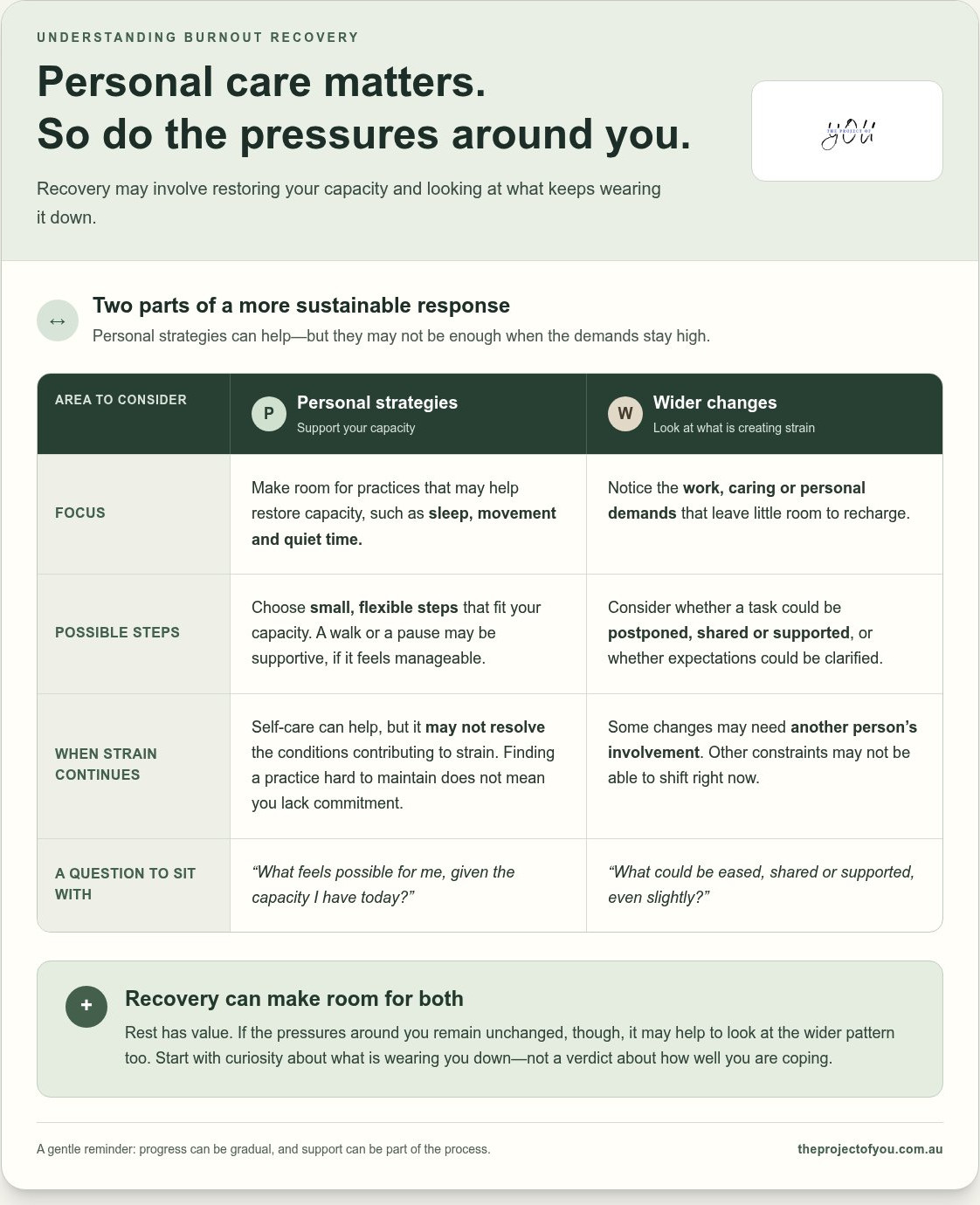
What helps burnout recovery: compare personal changes with broader support
Recovery can draw on personal supports and changes to the conditions around you. A small adjustment may create breathing room, while changes to workload, responsibilities or available support can address pressures individual effort can’t resolve alone. Neither approach has to be perfect before you begin. The aim is to find a combination that fits your circumstances and capacity.
Which small changes might support recovery?
Choose an adjustment that feels manageable, rather than building a demanding new routine. You might set a clearer stopping time, protect a pause between responsibilities or ask someone to take on a task. Notice what shifts, even slightly. If the change doesn’t help, that’s useful information, not a pass-or-fail result.
Personal changes and broader support can work alongside each other, but they have different roles:
This comparison isn’t a formula. If you have little control over a workplace or caring situation, a personal pause may still matter, even though it can’t replace wider change. Asking for broader support doesn’t mean you’ve failed to manage on your own. Learning how to heal from burnout can include recognising where individual strategies help and where more support is needed.
When might professional support be useful?
Counselling may help if distress continues, daily tasks feel increasingly difficult, or you want support to understand recurring stress patterns and consider realistic options. A trained professional can offer space to explore your needs and choices without reducing your experience to a checklist. Trauma-informed counselling can help you understand how past experiences may shape current stress, while recognising that burnout doesn’t always involve trauma.
You might ask yourself: what would make the next week a little more manageable, and who could help me explore that? If talking it through feels useful, booking individual counselling can be a way to begin that conversation.
How to begin healing from burnout with steps that fit your capacity
When your capacity is limited, a complicated plan can become one more thing to keep up with. Treat recovery as a flexible check-in: notice what is weighing on you, choose a pressure to look at, consider what support might help, then review what you learn. You don’t have to follow these steps in order. Some days, noticing is all you can manage.
What is one realistic first step?
Ask yourself which demand feels most draining right now. Is there a part of it that could be paused, reduced, shared or discussed? If none of those options feels possible, name what makes the demand difficult. That can help you distinguish what you need from what you feel expected to manage.
These prompts can help you reflect without turning recovery into another performance target:
Energy: What tends to leave me feeling most depleted, and what helps me feel a little more settled?
Boundaries: Is there a request I need time to consider before responding?
Values: What matters to me that I’d like to make a little more space for?
Support: What kind of help would feel genuinely useful, rather than adding another task?
Choose a prompt, if that’s enough for today. You might notice that a boundary needs to be clearer, or that the pressure you identified isn’t within your control to change by yourself. Either way, you’ve gained information about what could support your next step. There’s no need to judge the result by how much you accomplish.
How can you build support around recovery?
It can help to tell someone you trust what would be useful, in specific terms. For example, you could ask a family member to take responsibility for a regular task, or tell a friend you’d appreciate being heard without needing advice. If work is part of the strain and it feels appropriate and safe, consider a conversation about priorities, expectations or what might be adjusted. You decide what to share and with whom.
Support may also mean learning what helps you feel grounded. The Project of You provides Nervous System Regulation & Restoration support, which may form part of a broader approach to understanding stress and restoration. Exploring this option doesn’t commit you to a particular path. It can help you consider what feels appropriate as you work out how to heal from burnout. Find out more about nervous system regulation and restoration support.
How counselling can support a more sustainable way forward from burnout
Counselling can offer a steady space to make sense of what’s been happening, especially if it feels difficult to separate your own needs from the demands around you. With a trained professional, you can explore patterns of stress, what matters to you and which choices may be realistic in your current circumstances. The aim isn’t to assign blame or promise a particular outcome, but to help you understand your experience and consider what a more sustainable way forward might involve.
What might you explore in counselling?
You might look at where boundaries feel difficult, what happens when pressure rises, or which responsibilities leave little room for your own needs. Greater self-awareness can help you notice patterns without criticising yourself for having them. If useful, CBT may help explore how thoughts, feelings and actions relate, and whether a different response could serve you better. The process should be collaborative, respectful of your pace and attentive to emotional safety.
At The Project of You | Trauma, Couples & Relationship Therapy Australia, individual counselling is trauma-informed, with CBT among the approaches used. This doesn’t assume burnout is caused by trauma. It means approaching your experiences with care and curiosity, recognising that people’s histories and circumstances differ. Nervous System Regulation & Restoration is also part of the practice’s support, as one possible element in a broader conversation about what could help you feel more settled.
Azita Abdollahian is a qualified social worker, psychotherapist and neurofeedback trainer. You can bring whatever feels most pressing, whether that’s difficulty switching off, uncertainty about a boundary or feeling disconnected from what you need. You don’t have to arrive with a complete explanation or know exactly what to ask. “I’m not sure what’s going on, but I’m finding things hard” is a place to begin.
How can you take the next step?
Support can start with a conversation about what has felt difficult and what you hope might change. You can ask questions, share only what feels manageable and take time to find words for your experience. If you’d like further context on nervous system-focused approaches, explore nervous system regulation and restoration support as one possible area to consider.
You don’t need a perfect explanation before seeking support. For now, it may be enough to notice what feels important to discuss and approach it at your own pace.
Make room for a gentler next step
You don’t have to solve everything before you begin. Perhaps the next step is noticing what you need, giving yourself permission to ask for help or choosing a pressure to talk through. There’s no single right pace, and needing support isn’t a measure of your strength or capability.
If you’re still wondering how to heal from burnout, let the question lead you towards care rather than another demand of yourself. A conversation with a counsellor can help you consider what feels possible now, while leaving room for your needs and circumstances to change.
Book an appointment Small, supported steps can help you find your way forward. You deserve patience as you do.
Frequently Asked Questions
Is burnout the same as stress?
No. Everyday stress can build around a demanding deadline and ease when it passes; burnout is commonly used to describe more sustained exhaustion or disconnection from work. The experiences can overlap, and there isn’t a simple line that lets you identify burnout from one feeling alone. Consider how long changes have lasted and whether they’re affecting sleep, concentration or usual responsibilities. A GP can help assess ongoing concerns.
Can you recover from burnout while still working?
Some people make changes while continuing to work, but what’s realistic depends on workload, flexibility, available support and individual circumstances. Clarifying priorities or discussing an adjustment may create more room, though those options might not be available or enough on their own. Consider what could safely change and who could help you weigh up the options. Continuing in the same conditions doesn’t guarantee recovery will be possible.
How long does it take to heal from burnout?
There’s no reliable universal timeline for burnout recovery. The pace may depend on whether the pressures continue, your health, the support around you and what changes are possible. Try not to measure your progress against someone else’s experience. If exhaustion, low mood or difficulty managing daily life persists or worsens, speak with a GP or mental health professional. They can help explore what else may be contributing and what support could suit you.
What should I do if I think I am experiencing burnout?
If you’re wondering how to heal from burnout, start by noticing what has changed in your energy, mood or ability to manage ordinary tasks. Identify a current pressure you might discuss or address, and consider sharing your concerns with someone you trust. An article can’t diagnose burnout. A GP or qualified mental health professional can help explore what’s happening and consider other possible explanations. Asking for help doesn’t mean you’ve failed.
Can burnout affect relationships and family life?
It can. Exhaustion or feeling detached may affect your patience, communication and capacity to be present, though experiences differ from person to person. You might say, “I care about us, but I’m running low and need some quiet before we talk.” Try to describe your needs and stay curious about the other person’s experience. Burnout can provide context, but it doesn’t excuse hurtful behaviour or make one person solely responsible for relationship difficulties.
When should I seek professional help for burnout?
Consider speaking with a GP or mental health professional if distress continues, worsens or makes work, caring or everyday responsibilities difficult. They can help you explore what may be contributing and discuss possible next steps without assuming a diagnosis. If you feel unable to keep yourself safe or face immediate danger, call 000 in Australia. You can also contact Lifeline on 13 11 14 for crisis support.



Comments