

Can You Recover From an Emotional Affair? What Helps Couples

An emotional affair doesn’t have to mean a relationship is over. Yes, you can recover from an emotional affair, but rebuilding trust takes honesty, clear boundaries and a willingness to understand the hurt on both sides. There’s no single path or timetable; what matters is whether both partners are ready to take part in repair.
If you’re feeling shocked, angry, ashamed or unsure what to believe, those reactions deserve care, not judgement. You may be wondering whether your relationship can feel safe and close again, or whether staying together means ignoring what happened. It doesn’t. Repair can make room for accountability and difficult conversations while respecting each person’s needs and limits.
This article explores what an emotional affair can mean, how to respond in the early stages and what repair may involve. It also looks at how couples counselling can help partners slow painful conversations, understand the breach and begin working towards a more honest connection, without promising a particular outcome.
Table of Contents
1. What Is an Emotional Affair?
An emotional affair involves a private connection outside a relationship that carries intimacy or romantic energy. Secrecy, emotional reliance and crossed boundaries may matter more than whether the people meet in person. For example, daily messages can become a place to share feelings once reserved for a partner. The label matters less than the impact and the couple’s agreements.
In one account, Emma and Bob exchanged daily messages for six months while living 2,000 miles apart. They had not seen each other for 29 years since dating. Their story shows how closeness can grow through conversation, attention and shared history, even without regular face-to-face contact. A partner may experience that bond as a betrayal if it was hidden or conflicted with their relationship’s boundaries.
There is no fixed duration that defines an emotional affair. These connections may last from a few months to a year or longer, and can continue indefinitely if both people choose to maintain them. Duration alone doesn’t determine the harm. Consider whether messages were concealed, emotional or romantic needs shifted outside the relationship, and a partner’s trust or sense of safety was affected.
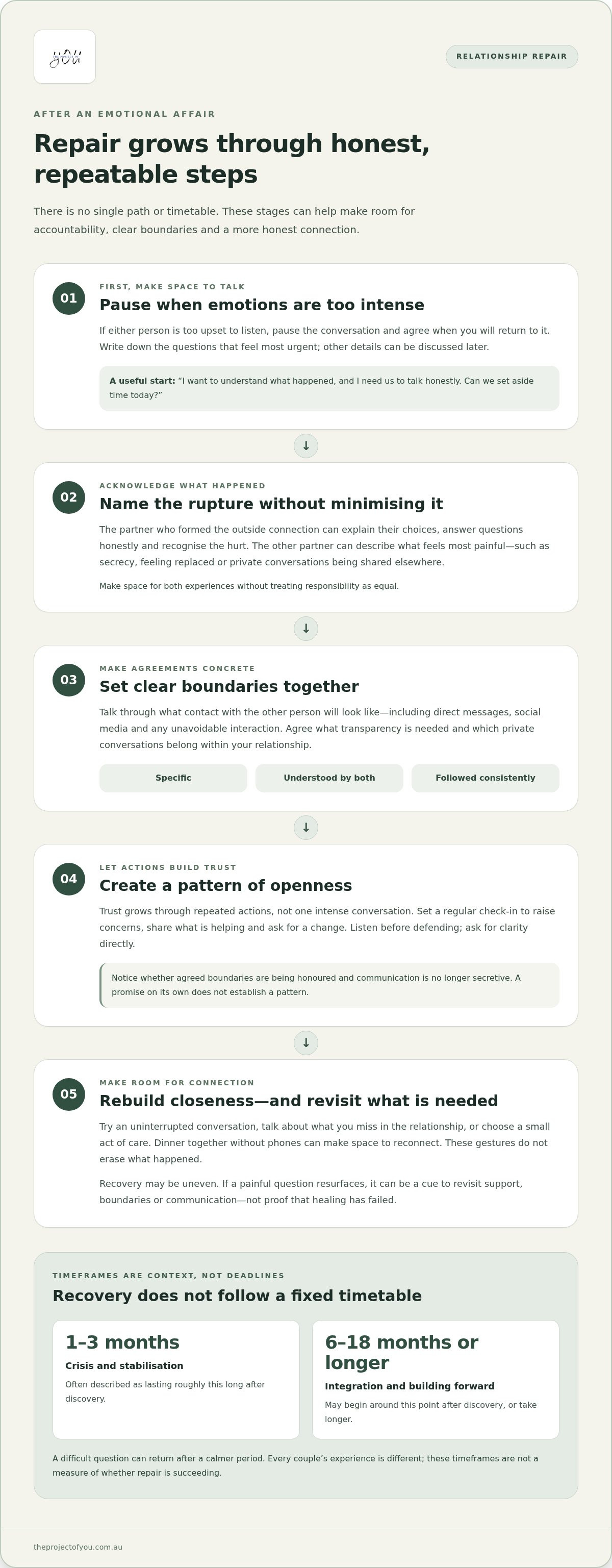
After discovery, rebuilding usually begins with a clear step: name what happened without minimising its impact. The partner who formed the outside connection can explain their choices, answer questions honestly and acknowledge the hurt. The other partner can describe what feels most painful, such as secrecy, feeling replaced or learning that private conversations were shared elsewhere. Both experiences can be heard without treating responsibility as equal.
Boundaries make repair more concrete. Partners can decide together what contact with the other person will look like, what transparency is needed and which private conversations belong within their relationship. For example, they might agree to end personal messaging and discuss any unavoidable contact openly. A boundary works best when it is specific, understood by both and followed consistently, rather than offered as reassurance and later withdrawn.
Trust grows through repeated actions, not one intense conversation. Agree on a regular check-in where each person can raise concerns, describe what is helping and request a change. The partner who caused the rupture can listen before defending themselves, while the hurt partner can ask for clarity directly. Small, reliable exchanges gradually create new evidence of openness and care.
Emotional connection needs rebuilding too, not just monitoring. Partners might set aside time for an uninterrupted conversation, share what they miss about the relationship and choose a small act of care each day. Eating dinner together without phones, for instance, can create space to reconnect. These gestures don’t erase the affair, but can help the couple notice whether warmth, curiosity and emotional safety can return.
Recovery may be uneven. The crisis and stabilisation phase after discovery is often described as lasting roughly one to three months, while integration and building forward may begin around six to eighteen months after discovery or take longer. These are not deadlines. A painful question can resurface after a calmer period, so treat setbacks as a cue to revisit support, boundaries or communication, not proof that healing has failed.
2. Responding to a partner’s emotional affair
Discovery can make ordinary moments feel uncertain: a late reply, a phone turned face down or a partner seeming distant. Before deciding what the relationship means, focus on the next safe, practical step. If either person is too upset to listen, pause the conversation and agree when to return to it. A time out can prevent an emotionally flooded discussion from becoming more hurtful.
Ask whether your partner is ready to talk rather than demanding every answer at once. One Mumsnet user said five days had passed since discovering the affair when they asked their partner to cut contact. That example isn’t a timetable for everyone. It shows how to make a direct request early while still allowing both people to explain what they need.
Try a simple opening: “I want to understand what happened, and I need us to talk honestly. Can we set aside time today?” Agree on a pause signal if the conversation becomes overwhelming, then return at the time you chose. You could write down the questions you most need answered beforehand. This can help separate urgent concerns from details to discuss later.
Ending contact with the affair partner can create a clearer boundary for repair. Talk through what that means in practice, including direct messages, social media and any unavoidable interaction. A Mumsnet commenter described ending all contact as key to attempting recovery. The partner who formed the outside connection should carry out the agreed boundary, rather than leaving the betrayed partner to monitor every exchange.
What are the signs an emotional affair has ended? Look for consistent evidence: personal contact has stopped, agreed boundaries are being honoured and communication is no longer secretive. A single promise or deleted message doesn’t establish a pattern. Notice whether actions remain open and consistent over time.
The betrayed partner may think about the affair repeatedly, question past conversations or struggle with everyday connection. That distress doesn’t reflect their character. Consider asking for specific support, such as a listening conversation or time to settle before discussing details. Individual counselling can also offer a private place to process hurt, shame or confusion without needing to protect a partner’s feelings.
Both partners can listen for the part of a difficult statement that rings true. One suggested practice is to acknowledge even the 5% that feels accurate before explaining what feels unfair. For example: “I can see why my secrecy made you feel shut out. I also want to explain what was happening for me.” This doesn’t excuse cheating; it makes room for accountability and a more useful conversation.
If talking keeps turning into accusation, silence or repeated conflict, a structured therapy conversation may help you slow the exchange and hear each other more clearly. You can book a counselling conversation when you’re ready to explore support.
3. Research on infidelity and marriage outcomes
Research offers context, not a verdict on an individual relationship. A study published in the Journal of Marital and Family Therapy found that 53% of couples who experienced infidelity were still married years later. That figure describes whether couples remained married. It doesn’t tell us whether trust returned, intimacy improved or both partners felt content with their marriage.
“Infidelity” can describe different experiences. One couple may understand it as sexual contact; another may see secret romantic messages or emotional reliance as cheating. The meaning depends partly on the couple’s agreements and the secrecy involved. A hidden conversation that one partner considered harmless may still feel like betrayal to the other. Naming the specific breach helps partners discuss its effects rather than arguing only over labels.
Why does infidelity happen? There isn’t one reason that applies to every couple. Distance, unmet needs, avoidance of difficult conversations or personal choices may form part of a relationship’s story. These factors can help partners explore what was happening before the affair, but they don’t make either person responsible for another’s decision to cross agreed boundaries. Understanding the context is different from excusing harm.
After discovery, a person may become emotionally flooded: intense fear, anger or shock can make it hard to listen, think clearly or respond calmly. This survival response may show up as rapid questioning, leaving the room or going quiet. If a conversation about messages becomes overwhelming, pause it and agree on a time to resume. A settled conversation supports clearer questions and more thoughtful answers.
Group findings also need careful interpretation. The 53% figure doesn’t predict whether a particular couple will stay together, separate or rebuild a satisfying relationship. It can, however, challenge the assumption that every marriage ends after infidelity. A more useful question for partners is what each person is willing to do now: acknowledge the harm, speak honestly, respect boundaries and participate in repair.
Some couples who seek help after infidelity stay together, but staying together alone isn’t the same as healing. One partner may want to preserve the marriage while the other needs time to understand what happened. They can clarify their immediate priorities separately, then compare them in conversation. One may need openness about ongoing contact, while the other needs a way to discuss shame without avoiding accountability.
Research helps frame possibilities; practical choices shape the next steps. Partners can track whether agreed actions are happening, notice what triggers distress and identify which conversations need support. If emotional flooding repeatedly interrupts discussions, structured infidelity recovery or marriage counselling can help make room for each person’s experience. The aim is not to force an outcome, but to understand the rupture and decide what a responsible path forward requires.
4. Working together to repair the relationship
Repair needs participation from both partners, though their responsibilities differ. The partner who crossed an agreement can take responsibility for their choices; the hurt partner can decide what they need to feel heard and respected. One person might ask for honest answers, while the other listens without interrupting or shifting blame. Rebuilding connection doesn’t require either person to hide grief or rush forgiveness.
How long does recovery from an emotional affair usually take? There’s no single timeline. One Mumsnet commenter described the first six months to a year as very difficult, while the forward-building phase may begin around six to eighteen months after discovery or last longer. Couples may stabilise, struggle again or progress steadily, so these periods aren’t deadlines.
The partner who had the affair can make amends by acknowledging specific choices, answering questions honestly and following agreed boundaries consistently. A direct apology might name the secrecy and its impact, then show change through actions, such as ending private contact and being open about unavoidable interactions. Friends may offer support, but shouldn’t be used to pass messages or minimise the other partner’s experience.
Grief can accompany repair because both people may mourn the relationship they thought they had. A shared ritual, such as setting aside a weekly conversation, can make space for what has changed and what each person hopes to build. If one partner becomes overwhelmed, pause and agree when to return. Caring for the relationship includes ordinary moments too, such as sharing a meal or checking in after work.
Can a relationship recover? It can, when both partners are willing to face what happened, respect boundaries and take part in sustained repair. A Mumsnet user said they had worked through an affair and felt glad they had done so almost 20 years later. That experience offers one possibility, not a promise or a model every couple must follow.
Open relationships and non-monogamy depend on the agreements made by the people involved. An outside connection isn’t automatically an affair in a consensually non-monogamous relationship, but secrecy or breaking an agreed boundary can still cause hurt. For instance, a couple may agree to disclose romantic connections but not emotional commitments. Hiding one would breach that agreement.
When is it better to end a relationship after an emotional affair? Consider ending it if contact continues in secret, accountability is repeatedly refused, or the relationship no longer aligns with your values and needs. You don’t need to prove your grief is serious enough. A trusted friend or individual counsellor can help you think clearly about your next step.
Try asking: “What would rebuilding require from each of us this week?” One partner might name transparency, while the other asks for a respectful way to discuss difficult feelings. If those commitments keep changing, notice the pattern. Repair is built through consistent choices, not one promise made during a painful conversation.
5. How couples therapy may support recovery
After an affair, conversations at home can become a cycle: one partner seeks clarity while the other grows defensive or withdraws. Couples counselling provides a structured setting where both people can slow the exchange. A counsellor can help each person describe their experience, name their feelings and listen for what matters beneath the words. The aim is understanding, not deciding who is the “bad” partner.
At the start, agree on what you hope a session will help you explore. One couple might want to understand how secrecy affected their connection; another may need to consider whether they both want to continue together. Naming a focus can make a difficult conversation more manageable and give each person room to share what they need.
Counselling can help partners discuss responsibility without turning every conversation into blame. The partner who had the affair can acknowledge their choices, while the hurt partner explains the impact in their own words. For example, “I felt alone when you hid those messages” gives a clearer starting point than a broad accusation. A counsellor can help each person stay with the meaning of what’s being said.
If strong feelings take over, a counsellor can help the couple recognise the shift and pause before the discussion escalates. They might agree to return to one specific topic after a break. Practising this in a session can help partners bring a calmer approach to conversations at home.
Couples counselling can help partners explore whether they can recover from an emotional affair without pushing either person towards a particular decision. Together, they can consider what each needs, what changes feel realistic and whether both are willing to participate. Counselling supports thoughtful discussion; it doesn’t require a couple to stay together.
Progress can show up in practical ways between sessions: one partner raises a concern more directly, or both return to a difficult topic with greater care. These moments help the couple notice how they communicate and what still needs attention. If only one person is taking part, individual counselling may help clarify their needs and choices.
The Project of You | Trauma, Couples & Relationship Therapy Australia: Nervous System Regulation & Restoration
The Project of You | Trauma, Couples & Relationship Therapy Australia offers Nervous System Regulation & Restoration and Individual Counselling for people seeking support after relationship hurt. If shock, anxiety or recurring conflict is making daily life difficult, individual counselling can offer space to understand your feelings and consider what you need next. Partners who want to explore repair can use that clearer understanding to approach conversations with greater care.
Recovery doesn’t require you to rush a decision or set aside your boundaries. You can seek support while deciding whether to rebuild the relationship, take time apart or focus on your own wellbeing.
If you’d like to explore support, you’re welcome to contact The Project of You.
Choose a next step that honours your needs
If you’re wondering whether you can recover from an emotional affair, begin with a more immediate question: what would help you feel steadier and clearer today? You might write down what you need to understand, speak with someone you trust or take time before making a major decision. A small, intentional step can help you reconnect with your values and sense of direction.
You don’t have to decide the whole future of your relationship in one conversation. Notice what feels important now, and give yourself room to revisit that understanding as circumstances change. Asking for support is one way to approach your next step with care.
Whatever path you choose, your needs and boundaries matter. Move at a pace that allows you to listen to yourself and make choices carefully.
Frequently Asked Questions
What Is an Emotional Affair?
An emotional affair is a close connection outside a relationship that involves intimacy or romantic energy and conflicts with the couple’s understanding of commitment. For example, someone might confide in a colleague about private worries while concealing the closeness from their partner. The key clues are context, secrecy and agreed boundaries, rather than a single universal definition. Partners can discuss what felt crossed without first agreeing on a label.
Can a Marriage Actually Survive This?
Yes, some marriages continue after an emotional affair, but staying married doesn’t automatically mean the rupture has been addressed. Partners can consider whether both are willing to be honest, understand the impact and make meaningful changes. A couple might agree to revisit their expectations around privacy and emotional closeness. Each person can also consider whether continuing together aligns with their values and emotional wellbeing.
What is emotional cheating?
Emotional cheating is a term people use when an intimate or romantic connection outside their relationship breaks an understood agreement. A secret exchange of personal messages might feel like betrayal to one partner, while another couple may have different agreements about outside friendships. Instead of relying only on the phrase, describe the specific behaviour and its effect: “I felt excluded when those conversations were hidden from me.”
Can a relationship recover after an emotional affair?
A relationship can recover if both partners want to engage with what happened and make room for change. That may include learning to discuss loneliness or disconnection without using those feelings to excuse secrecy. Partners could identify a recurring moment when they withdraw from each other and try a different response. Recovery can mean rebuilding together, or reaching a clearer, more respectful decision about the relationship.
What steps help rebuild trust after an emotional affair?
Start by agreeing on what openness means in everyday life, rather than relying on broad promises. A couple might decide how to handle contact with a person connected to the affair, what information to share and how to raise concerns without searching each other’s devices. Then review whether the agreement feels respectful and workable. Consistency matters: trust is more likely to grow when actions match stated intentions in ordinary situations.
Can couples therapy help after an emotional affair?
Couples counselling can help partners have difficult conversations with more structure and care. A counsellor may help one person express hurt while supporting the other to listen without immediately defending themselves. In a session, a couple might practise responding to a specific concern, then identify what each person needs before continuing. Couple Counselling can provide a setting to explore the breach, communication patterns and whether both partners want to work towards repair.
How can the betrayed partner cope with hurt, anger, and anxiety?
Choose one supportive action when feelings surge: step outside, breathe slowly, write down the immediate worry or speak with someone you trust who won’t pressure you to decide. If a message or reminder triggers distress, pause before responding and notice what you need in that moment. Individual counselling can also help you process the experience apart from couple conversations, especially if sleep, concentration or daily routines feel disrupted.
How do couples set boundaries to prevent another emotional affair?
Make boundaries specific to situations the couple actually encounters. Discuss what each person considers private emotional sharing with a friend, what should be disclosed about a developing connection and how either partner can raise discomfort. Agree on a response if a boundary is crossed, such as having a calm conversation or seeking support. Revisit the agreement as circumstances change, so boundaries remain mutual, clear and connected to both partners’ values.



Comments