.png)

Am I in a Toxic Relationship? A Trauma-Informed Reflection Quiz
- Azita Abdollahian

- 6 hours ago
- 13 min read
People rarely sit in my office and say, “I am in a toxic relationship.” More often, they ask, “I know they love me, so why do I feel alone?” They describe affection followed by distance and the feeling of walking on eggshells. When love and abandonment exist side by side, it can become difficult to trust your experience. If you are searching for an am I in a toxic relationship quiz, you may not be looking for a label. You may be trying to understand what is happening inside this relationship.
That search for clarity is not an accusation or a failure; it is an act of self-care. In this reflection, we will look beyond the word toxic and explore the difference between conflict, unhealthy patterns, emotional abandonment and abuse. Through a compassionate, trauma-informed lens, you will learn to recognise gaslighting, notice what your nervous system may be communicating, and consider whether accountability and repair are possible. Most importantly, these questions will help you reconnect with your inner wisdom and ask: Who have I had to become in order to belong in this relationship?
Table of Contents
What Does a 'Toxic' Relationship Actually Look Like?
Have you ever wondered if the heavy feeling in your chest is just a sign of a rough patch or something more concerning? It's common to look for an am I in a toxic relationship quiz when the internal confusion becomes too loud to ignore. A toxic relationship is a persistent pattern of behaviour that erodes an individual's sense of self and safety. While every couple faces challenges, toxicity is less about the occasional heated argument and more about a consistent lack of emotional safety and mutual respect. It is the difference between a partnership that occasionally feels difficult and one that fundamentally drains your vitality.
In a healthy dynamic, conflict is a bridge to deeper understanding. In a harmful one, it becomes a weapon. If both partners are willing to look at these patterns with curiosity, Couple Counselling can offer a safe container to explore whether repair is possible. However, when the impact of the relationship leaves you feeling chronically depleted, it's time to look closer at the underlying structure of the connection. To understand the broader context of these dynamics, it's helpful to look at What Does a 'Toxic' Relationship Actually Look Like? through a clinical lens, which identifies patterns like coercive control and emotional erosion.
The Spectrum of Relational Health
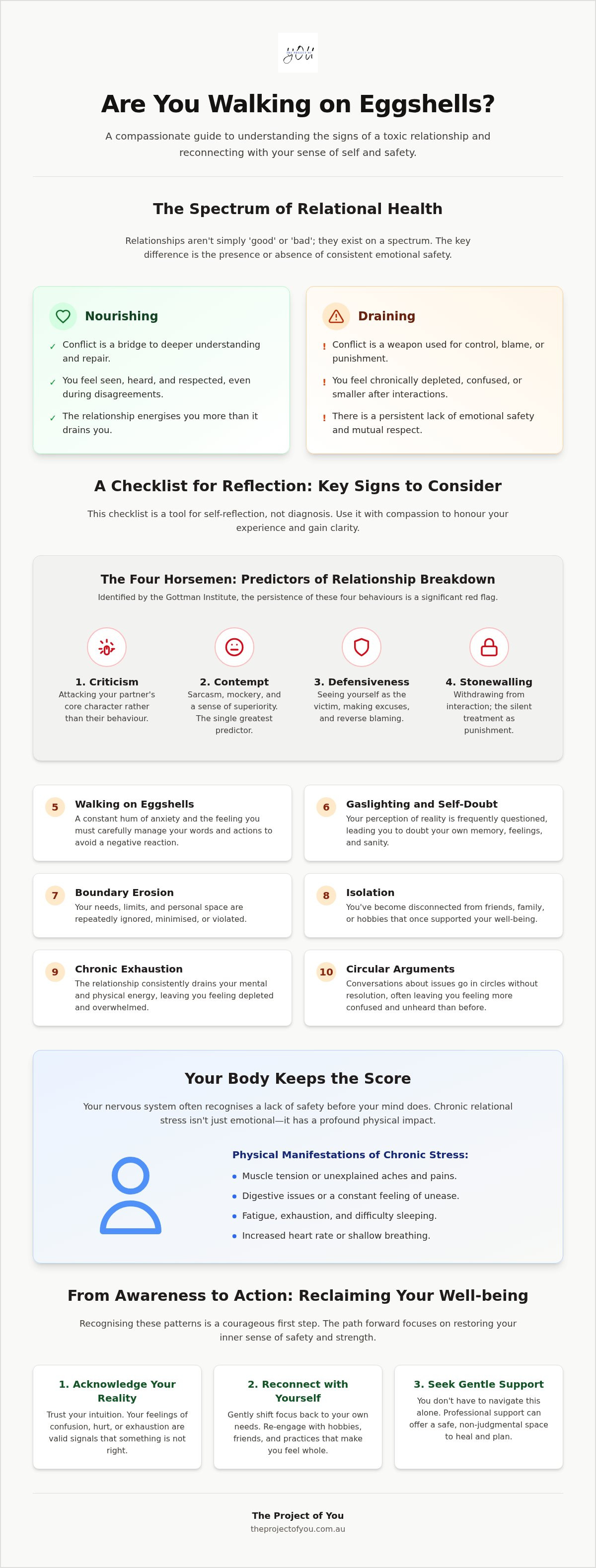
Relationships aren't binary; they exist on a scale from nourishing to draining. On one end, we find connections where both people feel seen, heard, and respected. On the other, we see dynamics that are chronically taxing. Healthy conflict involves a desire for repair and mutual growth. Toxic manipulation, however, focuses on control and blame. When you reflect on your partnership, try to move away from blaming yourself or your partner and instead look at the impact of the interaction. Does the conflict lead to a solution, or does it leave you feeling smaller and more isolated than before?
Why We Sometimes Miss the Signs
It is never your fault for not seeing the signs sooner. Often, our normal meter is set by our early life attachment styles. If we grew up in an environment where love was unpredictable or conditional, we might find relational chaos familiar rather than alarming. There is also the phenomenon of love bombing, where intense affection at the start of a relationship creates a foundation of confusion. This often leads to the boiling frog effect. Toxicity rarely starts at a boil. It begins with tiny, subtle drops in temperature until your nervous system is overwhelmed, yet you've become so accustomed to the heat that you've forgotten what cool water feels like.
The Toxic Relationship Checklist: 10 Signs to Consider
Stepping into a space of self-reflection can feel daunting, especially when you are trying to untangle the threads of a complex partnership. Instead of searching for a definitive label, think of this exploration as a way to honour your own experience. If you have been looking for an am I in a toxic relationship quiz, you are likely seeking a mirror for the patterns you've been noticing. This list is not designed to diagnose your partner. Rather, it is a tool to help you measure the health of the connection between you. Many people find it helpful to refer to The Toxic Relationship Checklist provided by health resources to identify patterns of control, dependence, or disrespect.
The Gottman Institute identifies four specific behaviours, known as the 'Four Horsemen', that often predict relationship breakdown: criticism, contempt, defensiveness, and stonewalling. While we all might slip into these occasionally, a toxic dynamic is defined by their persistence. Contempt, in particular, is a significant red flag because it involves looking down on your partner with a sense of superiority. Before these red flags appear, there are often 'yellow flags'. These are subtle moments where your boundaries are tested or your needs are quietly dismissed. Noticing these early signs allows you to address the dynamic before it becomes deeply entrenched. If you feel overwhelmed by these realisations, you can always book a session online to begin exploring these feelings in a safe, supportive space.
The Communication Checklist
Communication is the pulse of a relationship. In a healthy dynamic, conflict is a tool for growth. In a draining one, it feels like a loop that leads only to exhaustion. Consider these questions as you reflect:
Do you experience 'stonewalling', where your partner shuts down or uses silence as a way to punish you?
When you bring up a concern, do you end up apologising for how you brought it up, rather than discussing the issue itself?
Are you experiencing gaslighting, where you find yourself constantly questioning your own memory or sanity?
These patterns often signal that the emotional bridge between you has become fragile. When you are frequently searching for an
**am I in a toxic relationship quiz
**, your intuition is usually pointing toward this lack of communication safety.
The Power and Control Checklist
A partnership should be a collaboration between equals. Toxicity often thrives in the shadows of power imbalances. Reflect on your sense of agency within your daily life:
Do you have full autonomy over your social connections and financial choices?
Is 'emotional blackmail' or guilt used to sway your decisions?
When you set a boundary, is it respected, or is it treated as a challenge to be overcome?
Healthy boundaries are the guardrails of intimacy. When they are consistently ignored, your sense of safety begins to crumble. Understanding these signs is the first step toward reclaiming your path and finding your way back to yourself.
Listening to Your Body: The Nervous System Perspective
What if your body is telling you a story that your mind isn't quite ready to hear yet? While an am I in a toxic relationship quiz can help you categorise behaviours, your nervous system provides a much more immediate, visceral map of your relational safety. Polyvagal Theory suggests that our bodies are constantly scanning for cues of connection or threat. When you are in a healthy partnership, your system feels settled and open. However, in a toxic dynamic, you may find yourself trapped in a state of chronic 'survival mode', where your body is perpetually prepared for a fight, a flight, or a total shutdown.
When we talk about 'walking on eggshells', we aren't just using a figure of speech; we are describing a state of physiological hyper-vigilance. Living in this state means your body is flooded with cortisol and adrenaline as it waits for the next unpredictable shift in your partner's mood. Over time, this constant stress response becomes exhausting. You might also notice yourself 'fawning', a survival response where you instinctively over-please or appease your partner to keep the peace. A dysregulated nervous system is often the first messenger of an unsafe relationship. Recognising these internal shifts is a vital part of finding your way back to a sense of peace.
Signs of a Dysregulated System
Your body often keeps the score of emotional toxicity long before you can put words to the experience. Common physical signals include chronic fatigue, persistent digestive issues, or a 'heavy' feeling in your chest that never quite lifts. You might notice you are constantly on guard, monitoring your partner’s tone of voice or footsteps to gauge the 'weather' of the home. This hyper-vigilance often leads to a loss of 'self', where your own needs and internal compass are slowly replaced by a desperate focus on your partner’s emotional state.
Restoring Your Inner Peace
Healing begins by finding small 'glimmers' of safety outside the relationship, moments where your body can finally exhale. This might be a quiet walk in nature, a coffee with a trusted friend, or a few minutes of deep, rhythmic breathing. Reconnecting with your intuition is a process of learning to trust your body again. Exploring Nervous System Restoration can provide a structured way to move out of survival mode and back into a state of regulated calm. As you begin moving from awareness to action, remember that your body’s signals are not something to be feared; they are your most honest guides on the journey toward emotional freedom.
Moving from Awareness to Action
Gaining clarity is a profound step, yet it often brings a new wave of uncertainty. You might feel a sense of grief for the relationship you hoped for, or perhaps you feel overwhelmed by the weight of what comes next. Taking an am I in a toxic relationship quiz is often the first spark of awareness, but moving from that spark into meaningful change requires immense courage. It is okay to feel hesitant. In long-term partnerships, your lives are often deeply entwined, and the thought of shifting those foundations can feel destabilising. Be gentle with yourself as you navigate this transition.
Safety must always be your primary compass. Before you attempt to change the dynamic, apply the 'Safety First' rule. Ask yourself if it is physically and emotionally safe to express your needs or set a new boundary. If the answer is no, or if you feel a sense of dread at the thought, your priority shifts from relationship repair to creating a personal safety plan. Rebuilding your self-worth doesn't happen overnight. It is a quiet process of reclaiming the 'Project of You' through small, consistent acts of self-care, like choosing to spend time with people who make you feel seen and regulated.
As you reflect on your next steps, consider these questions without any pressure to have an immediate answer:
Does the thought of a future without this dynamic feel like a relief?
What is one small thing I can do today that is purely for my own well-being?
If I were watching someone I love in this situation, what would my heart want for them?
The Art of Setting Boundaries
A healthy boundary is never about controlling someone else's behaviour; it is a clear statement of what you will or will not participate in. For example, a boundary might be: "I am happy to discuss this with you, but I will step away if the conversation involves name-calling." When you first introduce boundaries, you may experience 'pushback' as the other person reacts to the change in the status quo. Handling this with compassion for yourself is essential. Recognise that while you cannot control their reaction, you can control your own response to it. Some boundaries are simply deal-breakers, and acknowledging that is a vital part of protecting your peace.
Seeking Professional Guidance
Sometimes, the path forward requires a steady hand to hold yours. If you are struggling to process the impact of a harmful dynamic, individual counselling can provide a confidential space to untangle your experiences and rebuild your internal compass. While couple counselling can be transformative, it is only appropriate when both partners are committed to the work and emotional safety is present. Finding a trauma-informed therapist who understands attachment can help you move past the shame and confusion, allowing you to see your situation with greater clarity and hope.
[Book a session to begin your journey of restoration](https://www.theprojectofyou.com.au/book-online)
Reclaiming the Project of You
Moving through the layers of a difficult relationship is a journey that often begins with a single, quiet question. Perhaps you found your way here after searching for an am I in a toxic relationship quiz, hoping to find a name for the weight you've been carrying. While identifying the patterns of toxicity is a vital first step, the ultimate goal is not just to survive the dynamic. It is to reclaim the version of yourself that may have been sidelined or silenced. What if this period of uncertainty is actually the beginning of a profound path toward self-discovery and restoration?
Isolation is one of the most painful side effects of a relationship that lacks emotional safety. Toxicity thrives in the dark, making you feel as though your experiences are unique or shameful. Breaking this silence is a powerful act of rebellion. Connecting with a community of others who understand the nuances of nervous system regulation and attachment can be incredibly healing. Whether it is through a shared conversation or a structured group environment, being seen by others who "get it" reminds you that you are not alone. You deserve to feel safe, seen, and celebrated in your life, not just tolerated or managed.
Reclaiming your agency is a methodical process. It involves listening to your body, setting boundaries, and choosing to prioritise your own growth. If you feel ready to explore these themes further, I invite you to learn more about my approach and the heart behind this practice by connecting with Azita Abdollahian. Healing is rarely a straight line, but with the right support, it is always possible to find your way back to a place of peace. You have already shown immense strength by seeking clarity; now, let that strength guide you toward a life that feels authentic and free.
Your Path to Restoration
There are many ways to begin the process of reconnecting with your inner wisdom. For some, the collective energy of a group can be the catalyst for change. The Healing Feminine Workshops provide a nurturing space to explore these relational patterns and begin the work of deep restoration. These sessions are designed to help you move out of survival mode and back into a state of embodied presence. If you prefer a more self-paced approach, digital resources like Self Love E-books can offer gentle guidance as you navigate your own timeline of growth and self-discovery.
The most important step you can take is the next one, no matter how small it may seem. You don't have to have all the answers today. If you recognise your own struggles in these words and feel ready to reach out, I am here to listen. Taking the first step toward a confidential chat is an act of profound self-love. It is the moment you decide that your well-being is worth the investment and that your future is a project worth pursuing with intention, curiosity, and grace.
Finding Your Path Back to Peace
You have taken a significant step today by simply being curious about your internal experience. Whether you arrived here looking for an am I in a toxic relationship quiz or to understand the physical toll of chronic stress, you now have a map to help you navigate forward. We have explored how toxicity is defined by a persistent lack of emotional safety, and how your nervous system acts as a wise, visceral messenger. Reclaiming the "Project of You" is a journey of restoration, where you move from survival into a life of authentic connection.
Healing from relational distress or navigating infidelity recovery requires more than just willpower; it needs a compassionate, evidence-informed approach. This Australian practice provides specialised trauma-informed care grounded in attachment theory, offering a non-judgmental space to process your experiences. You deserve to feel grounded and steady in your own skin once again.
[Book a confidential session with Azita today](https://www.theprojectofyou.com.au/book-online)
You don't have to carry this weight alone. There is a version of you waiting to feel seen and celebrated, and the journey toward that ease starts with one gentle, brave choice.
Frequently Asked Questions
What is the number one sign of a toxic relationship?
The most significant sign is a persistent lack of emotional safety where you no longer feel free to express your needs or feelings. It feels like your sense of self is being slowly eroded by consistent patterns of control, criticism, or contempt. This isn't just about having a bad day; it is a sustained atmosphere that leaves you feeling small, guarded, and unable to be your authentic self.
Can a toxic relationship ever become healthy again?
Transformation is possible, but it requires both partners to be fully committed to deep and often uncomfortable personal work. It usually necessitates professional guidance, such as Gottman-informed therapy, to address underlying attachment wounds and learn new ways of relating. If only one person is willing to change the dynamic, the harmful patterns are likely to remain entrenched despite your best efforts to fix them.
How do I know if I am the toxic one in the relationship?
If you are asking this question, you already possess a level of self-awareness that is often absent in truly abusive dynamics. We all have the capacity for harmful behaviours when we are dysregulated or triggered by past trauma. The key is to look at your patterns with curiosity rather than shame. Using an am I in a toxic relationship quiz can act as a mirror to help you recognise where you might be using control or defensiveness instead of vulnerable communication.
Is walking on eggshells a sign of emotional abuse?
Walking on eggshells is a primary indicator of emotional abuse and a chronically dysregulated nervous system. It means you are living in a state of hyper-vigilance, constantly scanning your partner's mood or tone of voice to avoid a negative reaction. This environment prevents true intimacy because you are forced to prioritise survival over honesty. Over time, this state of high alert becomes physically and emotionally exhausting.
What should I do if I think my relationship is toxic but I’m not ready to leave?
Your first priority is to establish a sense of internal safety and begin rebuilding your social support network. You don't have to leave immediately to start reclaiming your sense of self. Focus on setting small, firm boundaries and seek individual counselling to process your experiences in a safe environment. This allows you to gain the clarity and strength needed to make decisions about your future without feeling rushed or pressured.
How does a toxic relationship affect your physical health?
Chronic relational stress keeps your body in a state of high alert, flooding your system with cortisol and adrenaline. Over time, this constant survival mode can lead to physical symptoms such as chronic fatigue, digestive issues, and a weakened immune system. Your body often recognises the lack of safety through these physical signals long before your mind is ready to categorise the relationship as harmful.
What is the difference between gaslighting and a simple disagreement?
A simple disagreement involves two people holding different perspectives on a shared reality while still respecting each other's right to their feelings. Gaslighting is a deliberate form of emotional manipulation where one person denies your experience or memory to make you doubt your own sanity. It is about maintaining power and control by eroding your trust in your own perceptions and reality.
Where can I find support for toxic relationships in Australia?
For immediate safety and confidential support, you can contact 1800RESPECT or Lifeline on 13 11 14. For therapeutic growth and nervous system restoration, searching for an am I in a toxic relationship quiz can lead you toward specialised Australian practices like The Project of You. We provide trauma-informed individual and couple counselling designed to help you navigate these complex dynamics and find your way back to emotional well-being.


Comments