.png)

Am I the Toxic One? A Compassionate Checklist for Relationship Self-Reflection
- Azita Abdollahian

- 2 hours ago
- 13 min read
What if the behaviours you feel most ashamed of aren't proof that you’re a "bad" person, but are actually signals that your nervous system is stuck in survival mode? It's an incredibly heavy burden to carry the quiet, persistent fear: "am I the toxic one in my relationship?" You might feel like the villain in your own story, caught in a painful cycle of reactive outbursts followed by overwhelming waves of guilt. This confusion often stems from the thin line between unhealed trauma responses and intentional harm, leaving you feeling lost and unworthy of the connection you crave. Trust me, as a trauma expert and relationship counsellor, I've seen this time and time again.
I want you to take a deep breath and know that you are in a safe, non-judgemental space. We are going to explore these difficult patterns together through a compassionate, trauma-informed lens that prioritises understanding over blame. By the end of this guide, you will have a clearer picture of your specific behaviours and practical tools for nervous system regulation. We will map out a path toward reconciliation or healthy personal growth, helping you move from a place of reactivity to one of intentional, heart-centred connection.
Table of Contents
Beyond the Label: Why We Fall into Difficult Relationship Patterns
What if the word "toxic" wasn't a permanent label on your soul, but a description of the current weather in your relationship? When you sit with the heavy question, "am I the toxic one in my relationship", it's natural to feel a wave of panic or a desire to look away. But imagine we are sitting together with a warm cup of tea, looking at this with radical honesty and even deeper compassion. This is what I do with my own clients, and it has profound success. In this space, we define a toxic pattern as a repetitive cycle that erodes emotional safety and mutual respect. It is a sequence of actions, not an identity.
Many of the behaviours we now find difficult actually began as childhood survival strategies. If you grew up in an environment where your needs weren't met or your safety felt conditional, you might have learned to use manipulation, emotional withdrawal, or perfectionism to feel secure. These strategies were once your protectors; however, in adult intimacy, they often become the very things that push people away. Recognising this isn't about making excuses. It's about understanding the "why" so you can finally choose a different path toward connection.
The Difference Between a Mistake and a Pattern
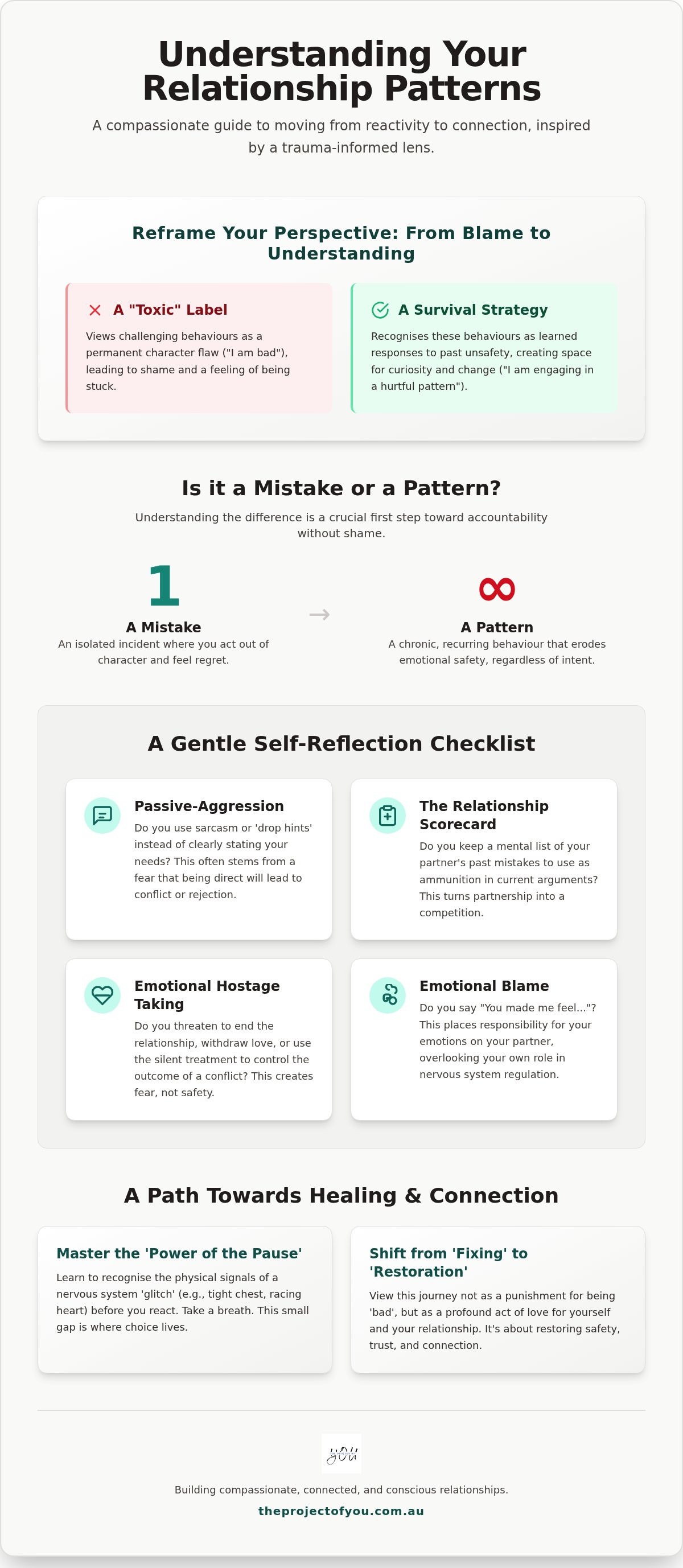
We all have moments where we lose our cool, say something we regret, or act out of character. An isolated incident is a mistake; a chronic, recurring behaviour is a pattern. While your intention might not be to cause pain, the impact on your partner is what defines the health of the connection. When certain behaviours become a consistent feature of your life, they can cross the line into psychological abuse. Acknowledging the harm you've caused, regardless of your intent, is the first brave step toward true restoration. Reframing the question from "am I a bad person?" to "am I the toxic one in my relationship because of these patterns?" allows for the possibility of genuine change.
Why Shame is the Enemy of Change
Shame is a powerful, heavy emotion that often triggers a "freeze" response in our nervous system. It tells us "I am bad", which makes accountability feel like a threat to our very existence. This prevents us from truly seeing our partner's pain because we are too busy trying to survive our own self-loathing. To change, we must move from "I am bad" to "I am engaging in behaviours that hurt people I love". This shift requires a foundation of psychological safety. At The Project of You, we believe that you can only transform what you are willing to face with kindness and curiosity. Transformation is a journey of restoration, not a punishment.
The Relationship Self-Reflection Checklist: 8 Signs to Consider
Approaching a checklist like this requires a gentle heart. It is not a scorecard for self-punishment or a way to prove you are a "bad" partner. Instead, think of it as a tool for curiosity. When you ask yourself, "am I the toxic one in my relationship", you are actually looking for the "glitches" in your connection. These patterns often show up when we feel unsafe or unheard. Recognising them is the first step toward restoration.
Passive-Aggression: Do you find yourself "dropping hints" or using sarcasm instead of stating your needs clearly? This often happens when we fear that being direct will lead to rejection.
The Relationship Scorecard: Are you keeping a mental tally of your partner's past mistakes to "win" current arguments? This turns a partnership into a courtroom where connection is the first casualty.
Emotional Hostage Taking: Do you ever threaten to end the relationship or withdraw your love just to get your way during a conflict? This creates a climate of fear rather than security.
Emotional Blame: Do you believe your partner is responsible for your internal emotional state? Saying "you made me feel this way" often ignores our own role in regulation and nervous system responses.
While some of these behaviours stem from deep-seated insecurity, it is vital to recognise when they cross the line into Emotional and verbal abuse. Awareness allows us to choose a different path.
Communication and Conflict Patterns
Conflict is a natural part of intimacy, but how we handle it matters. You might notice a tendency to "lawyer up" the moment you feel criticised; this is defensiveness, a protective shell that prevents you from truly hearing your partner. Perhaps you retreat into stonewalling, giving the "silent treatment" as a way to manage your own overwhelm. The most damaging pattern, however, is contempt. This involves looking down on your partner through eye-rolls or mocking. It erodes the very foundation of respect that every healthy relationship requires to survive. As a relationship expert, I guide my clients through these storms often.
Control and Boundaries
Control often masquerades as care. You might feel the urge to monitor your partner's phone or social circle, convincing yourself it's a "safety" measure. In reality, this is often a response to your own internal anxiety. Similarly, "loving" jealousy is rarely about your partner's actions; it is usually a mirror reflecting your own fears of inadequacy. If you struggle to hear the word "no" without feeling personally rejected or becoming manipulative, it may be time to look at your relationship with boundaries. Learning to respect a partner's autonomy is a brave act of love. If these patterns feel familiar, you might find it helpful to explore these dynamics in a safe, professional space.
Understanding the 'Why': Attachment Styles and Your Nervous System
Searching for an answer to "am I the toxic one in my relationship" often leads to a dead end of self-blame. To find a real path forward, we need to look beneath the surface at your attachment blueprint. Attachment Theory suggests that the way we were cared for as children creates a map for how we navigate intimacy as adults. These blueprints aren't our fault, but they are our responsibility to understand. When we feel a threat to our connection, our biological survival instincts take over, often resulting in unhealthy relationship characteristics that we later regret.
If you have an Anxious-Preoccupied style, your difficult patterns might look like clinginess or a need for constant reassurance. You might try to control your partner's movements because their independence feels like impending abandonment. Conversely, those with a Dismissive-Avoidant style often manifest "coldness". When things get too close or emotional, they might stonewall or withdraw to protect their autonomy. Neither style is inherently malicious. They are simply different ways of trying to feel safe in a world that once felt unpredictable. Exploring your history through individual counselling can help you uncouple these past survival strategies from your present-day choices.
The Role of the Nervous System in Conflict
During a heated argument, your brain's "smoke detector" often goes off, bypassing your logical mind. This is where we see the four stress responses: Fight (aggression), Flight (avoiding), Freeze (shutting down), and Fawn (people-pleasing). When you are pushed outside your "Window of Tolerance", you lack the physiological capacity to be kind or rational. You say things you don't mean because your body believes it is fighting for its life. Learning the art of Nervous System Restoration is about expanding this window, allowing you to stay present and calm even when things feel tense.
Trauma-Informed Self-Awareness
Our past betrayals often leave us hyper-vigilant. You might find yourself reacting to a current partner's minor mistake as if it were a major past trauma. This isn't because you are "toxic", it's because your nervous system is trying to protect you from being hurt again. It's helpful to ask: "am I the toxic one in my relationship because of what is happening right now, or am I responding to a memory?" Many of these reactions are intergenerational patterns, passed down through the ways we saw our parents navigate conflict. Breaking these cycles requires a brave, non-judgemental look at the stories we inherited about what love looks like.
Breaking the Cycle: Moving from Reactivity to Connection
Understanding the "why" behind your behaviour is a vital foundation, but transformation requires a practical "how". Moving from reactivity to connection is a skill that can be learned, much like any other form of navigation. When you begin to ask, "am I the toxic one in my relationship", you are already opening the door to a more intentional way of living. This process isn't about becoming perfect; it's about becoming aware enough to choose a different response when the pressure rises.
Step 1: Recognise the 'Glitch': Before a harsh word leaves your mouth, your body gives you a signal. Notice the heat in your chest, the clenching of your jaw, or the sudden urge to "win". These are physical signs of dysregulation.
Step 2: The Power of the Pause: Implement a "Time-Out" protocol. If you feel your heart racing, give yourself permission to step away for twenty minutes to let your nervous system settle. This isn't abandonment; it's protection for the relationship.
Step 3: Radical Accountability: Real growth happens when you apologise for the impact of your actions, regardless of your intent. Acknowledging that your words hurt your partner, even if you didn't mean them to, builds a bridge of trust.
Step 4: Needs-Based Communication: Shift your language from criticism to request. Instead of saying "you never listen", try saying "I feel lonely and I would really value ten minutes of your undivided attention".
Step 5: Seeking Professional Support: Some patterns are deeply etched into our history. Recognising when you need a compassionate guide to help unpick these threads is an act of profound strength, not weakness.
Practising Somatic Self-Regulation
In the heat of a disagreement, your logical brain often goes offline. To stay present, you must learn to communicate with your body. Grounding techniques, such as feeling your feet firmly on the floor or naming five things you can see, can pull you out of a reactive spiral. You can also try a "Vagus Nerve" reset by gently splashing cold water on your face or humming a low, steady tone. One deep breath can act as a circuit breaker, shifting the trajectory of a conversation from a collision to a moment of shared understanding.
The Art of the Repair
A healthy relationship isn't one without conflict; it's one with high-quality repair. A genuine apology must stand alone, without the word "but" attached to the end, as "but" often acts as a delete button for everything said before it. Rebuilding trust after a period of difficult behaviour takes time and consistent, small acts of care. The Gottman Institute highlights a "Magic Ratio" for stable relationships: there should be at least five positive interactions for every one negative interaction during a conflict. Focus on creating these moments of "Nervous System Restoration" together, ensuring that your connection feels like a safe harbour rather than a storm.
Cultivating a Healthy Foundation for 'The Project of You'
Choosing to look inward and ask, "am I the toxic one in my relationship", is perhaps the bravest first step you can take on the path of self-evolution. It is not an admission of being "broken", nor is it a reason to spiral into shame. Instead, see this self-reflection as a profound act of love for yourself and your partner. We are shifting the focus from "fixing" a problem to a journey of restoration. Restoration implies that beneath the layers of reactive patterns and survival strategies, there is a healthy, connected version of you waiting to be rediscovered. You are not your past behaviours, and the capacity for transformation is always within reach.
For many couples, the weight of daily life makes it difficult to find the space needed for deep change. This is where immersive healing can be transformative. Engaging in private couples retreats allows you to step away from the noise and focus entirely on the "how" of your connection. In these dedicated spaces, you can move past the surface-level arguments and begin the intentional work of nervous system restoration in a safe, supportive environment.
Reflective Questions for Your Journey
As you move forward, I invite you to sit with these questions with a spirit of curiosity rather than judgement:
What was the original "protection" my difficult behaviour was trying to provide for me?
In moments of conflict, what does my body feel like just before I react?
What would it look like to prioritise the health of the connection over the need to be "right"?
How can I show myself compassion while still taking full accountability for my impact?
What small, daily act of care could I offer my partner to begin rebuilding our foundation of trust?
Setting New Relationship Values
Transformation requires a new set of coordinates. What do safety and respect actually look like in the quiet moments of your daily life? It might mean a commitment to soft start-ups in conflict or a shared agreement to never use the relationship as a bargaining chip. Many couples find it helpful to create a formal "Relationship Agreement", a living document that outlines how you intend to handle disagreements and how you will prioritise connection. Remember to celebrate the small wins. Every time you catch a "glitch" before it becomes an outburst, you are successfully rewriting your story.
Next Steps for Deep Healing
Sometimes, the threads of our past are woven so tightly that we need specialised tools to unpick them. If you find that your reactivity is rooted in deep-seated trauma that traditional talk therapy hasn't quite reached, you might consider Psychedelic Assisted Therapy. This modality can provide a unique window into the subconscious, helping to release old blocks and foster a deeper sense of self-compassion. Additionally, resources like The Healing Feminine Workshops offer a community-centred path for ongoing growth and empowerment.
Your Path Toward Heart-Centred Connection
Transitioning from reactive survival to conscious connection is a journey of restoration, not a punishment. We have explored how your attachment blueprint and nervous system responses shape your intimacy, moving beyond the heavy shame of asking, "am I the toxic one in my relationship". By understanding the "why" behind your behaviours through evidence-informed lenses like Polyvagal Theory and the Gottman Method, you can begin to choose a different path. You are not your past patterns; you are the architect of your future growth.
At The Project of You, we provide personalised, trauma-informed care for individuals and couples across Australia. Our focus is on helping you navigate life's transitions with grace, ensuring you feel supported at every step of your self-evolution. Whether you seek to heal old wounds or build a stronger foundation, we are here to guide you toward a more regulated and connected way of being.
You have the inherent capacity to rewrite your story and foster deep, lasting intimacy. Transformation is always possible when you move forward with curiosity and kindness.
Frequently Asked Questions
Can a toxic person actually change their behaviour in a relationship?
Yes, people can absolutely transform their behaviours when they commit to the deep work of self-awareness and nervous system restoration. Since "toxic" is a label for a pattern rather than a permanent character flaw, changing the emotional environment of the relationship is possible. It requires a willingness to look at the "why" behind your reactions and a dedicated commitment to learning new tools for emotional safety.
What is the difference between being toxic and having an anxious attachment style?
Anxious attachment is an internal feeling of insecurity, while "toxic" describes the specific, harmful behaviours used to manage that insecurity. If you find yourself asking "am I the toxic one in my relationship", you might be noticing how your fear of abandonment leads to controlling or clingy actions. The attachment style is the blueprint, but the toxic pattern is the maladaptive way you are currently trying to build connection.
How do I tell my partner that I've realised I've been acting in toxic ways?
Start the conversation from a place of radical honesty and vulnerability without expecting immediate forgiveness. You might say, "I've been reflecting on my actions and I've realised that my defensiveness has been hurting you." Focus on the impact of your behaviour rather than explaining your intent. This creates a space for genuine repair and shows your partner that you are taking ownership of your personal evolution.
What should I do if I realise both my partner and I are being toxic?
Recognise that you are likely caught in a high-conflict reactive cycle where both nervous systems feel under constant threat. When both partners engage in difficult patterns, it's often a sign that the relationship's "weather" has become stormy for everyone involved. Seeking professional guidance through couples counselling can help you both identify these shared glitches and learn how to co-create a foundation of mutual respect and safety.
How long does it take to break a cycle of toxic behaviour?
Breaking a cycle is a journey of restoration rather than a quick fix, and the timeline depends on your commitment to consistent practice. It takes time for the brain and nervous system to unlearn childhood survival strategies and replace them with healthy, regulated responses. Most people begin to see a significant shift in their reactivity within a few months of intentional work and somatic regulation.
Is it possible to heal a relationship after trust has been broken by toxic patterns?
Healing is possible if both partners are willing to engage in the slow, intentional work of rebuilding emotional safety together. Trust is restored through thousands of tiny, consistent acts of repair rather than one grand gesture. By utilising the Gottman "Magic Ratio" and prioritising positive interactions, you can slowly replace old toxic patterns with a new culture of genuine appreciation and kindness.
What are the first signs that my self-reflection is actually working?
The first sign of progress is noticing the "glitch" in your body before a reactive word leaves your mouth. You might feel a tightness in your chest or a heat in your face and, for the first time, choose to take a deep breath instead of lashing out. This moment of awareness shows that your self-reflection is moving from your logical mind into your nervous system regulation.
Can I work on myself while staying in the relationship, or do I need to leave?
You can certainly work on yourself while staying in the relationship, provided there is a baseline of physical safety and a mutual desire to grow. The relationship often acts as a practical laboratory for practising new communication skills and boundaries. However, if the dynamic remains consistently harmful despite your best efforts, you may eventually need to prioritise your own restoration in a separate, safer space.


Comments