.png)

Therapy for Betrayal Trauma in Australia: A Compassionate Path to Restoration
- Azita Abdollahian

- 4 hours ago
- 13 min read
What if the crushing weight in your chest and the constant "mind movies" playing on loop aren't just signs of a broken heart, but a physiological injury to your very foundation? When the person you trusted most shatters that bond, the world can suddenly feel like a dangerous and unpredictable place. You might find yourself trapped in a cycle of hyper-vigilance, struggling with heart palpitations or insomnia, and feeling deeply misunderstood by generalist advice that fails to grasp the depth of your shock.
It's completely normal to feel as though you've lost your internal compass. This is why seeking specialised therapy for betrayal trauma in Australia is so vital; and why I provide it at my own practice. It moves beyond traditional talk therapy to address the way your nervous system has been impacted. In this article, we'll explore how trauma-informed care can help you regulate your emotional triggers and find a clear framework for your physiological responses. You'll discover practical paths toward restoration and learn how to rebuild your self-worth, providing you with the clarity needed to make decisions about your future based on safety and your own core values.
Table of Contents
What is Betrayal Trauma? Understanding the Australian Context
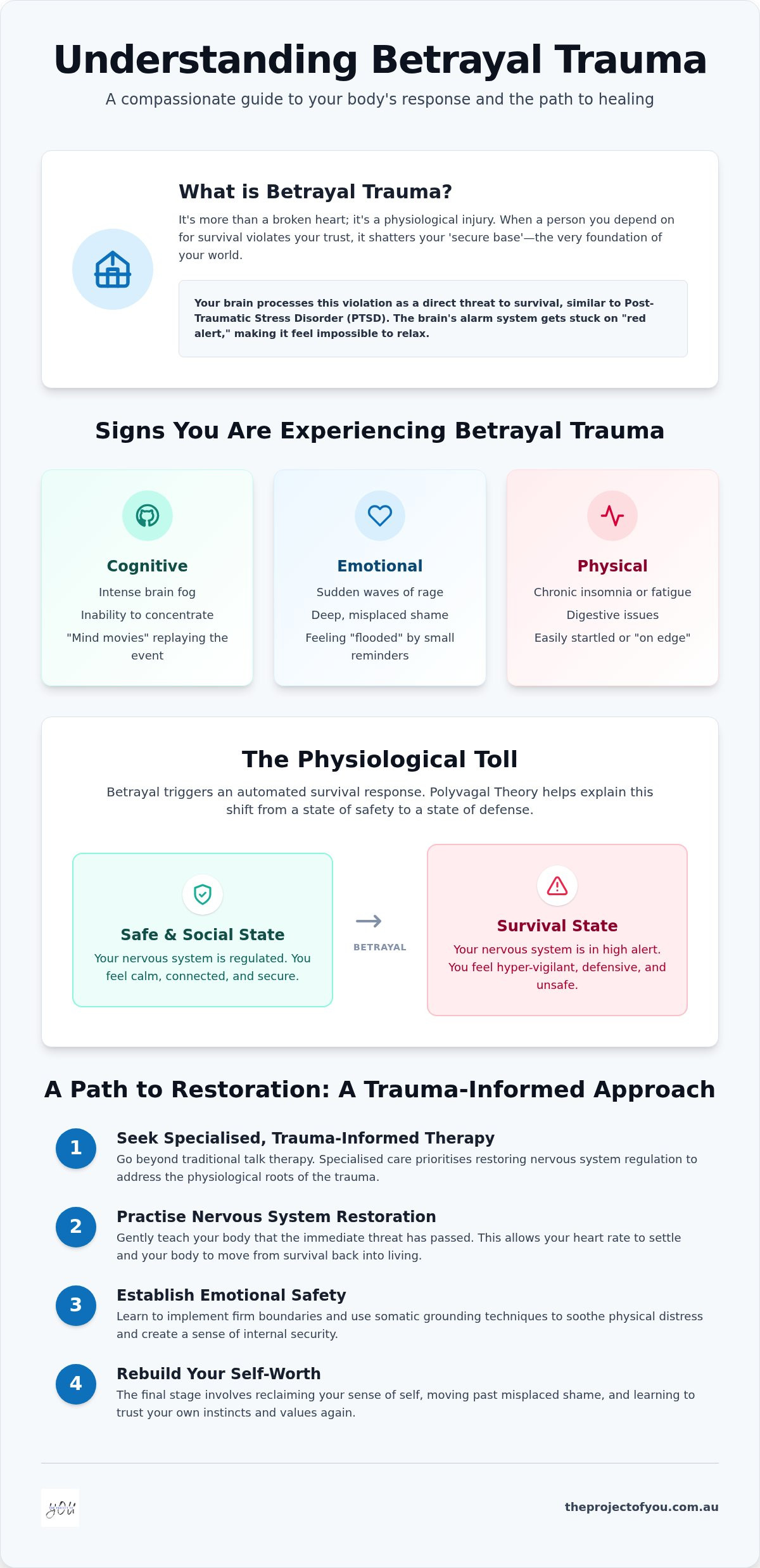
Imagine your world as a house. For years, you believed the foundation was solid, the roof was secure, and the walls were built on truth. When you discover a partner's infidelity, a secret addiction, or profound financial deception, it's as if the ground itself has liquefied. This is the essence of betrayal trauma. It occurs when a person you depend on for emotional or physical survival violates the trust you've placed in them. In the clinical study of What is Betrayal Trauma?, we understand this not just as a painful event, but as a profound shattering of your "secure base".
Currently, many people across the country are seeking therapy for betrayal trauma Australia because they've realised that the shock they feel isn't just "sadness". The impact is frequently compared to Post-Traumatic Stress Disorder (PTSD) because the brain processes the violation as a direct threat to your survival. Your amygdala, the brain's alarm system, remains stuck in a "red alert" phase, making it feel impossible to relax even in your own home. You might find yourself constantly scanning for the next lie, a state of hyper-vigilance that is exhausting and debilitating.
The Difference Between a 'Rough Patch' and Trauma
Every relationship has its seasons of disconnect, but betrayal trauma is a different experience entirely. A "rough patch" usually involves shared awareness of a problem where both partners are looking at the same reality. In contrast, betrayal involves one partner holding a secret while the other lives in a manufactured version of the truth. This is often compounded by gaslighting, where your valid intuition is dismissed as "crazy" or "insecure". This second injury creates a deep sense of self-doubt that makes "just moving on" impossible without structured support. I encounter dozens of these cases with my clients, so I understand how real and complex these experiences are.
Signs You Are Experiencing Betrayal Trauma
Your body often knows the truth before your mind is ready to accept it. That persistent "knot" in your stomach or the sudden heart palpitations you experienced before the discovery were likely your nervous system trying to protect you. Common symptoms we see in therapy for betrayal trauma Australia include:
Cognitive: Intense brain fog, an inability to concentrate on simple tasks, and "mind movies" that replay the betrayal on a loop.
Emotional: Sudden waves of rage, deep shame that feels like it's yours to carry, and feeling "flooded" by small reminders.
Physical: Chronic insomnia, digestive issues, and a persistent feeling of being "on edge" or easily startled.
As a Trauma Expert, I can tell you that validating these symptoms is a vital part of your journey. It confirms that you aren't overreacting; you are responding to a significant injury that deserves a compassionate and specialised path to restoration.
The Physiological Toll: Why Your Body Feels Under Attack
Have you ever wondered why a discovery of betrayal feels like a physical blow to the chest? It isn't just an emotional reaction; it's a profound physiological toll of trauma that shifts your entire biological state. Through the lens of Polyvagal Theory, we can see that your nervous system has likely moved out of its "safe and social" zone and into a defensive state of "fight, flight, or freeze". This isn't a choice you've made. It's an automated survival response that rewires your brain to scan for danger every minute of every day. When the person who was once your safe harbour becomes the source of your pain, your internal alarm system gets stuck on high alert, creating a biological storm that is difficult to calm alone.
This constant state of "red alert" often leads to a debilitating shame-trauma cycle. You might feel a deep sense of shame that isn't yours to carry, yet your body holds onto it, impacting your self-esteem and your ability to trust your own instincts. In our approach to therapy for betrayal trauma Australia, we focus on "Nervous System Restoration". This is the process of gently teaching your body that the immediate threat has passed, allowing your heart rate to settle and your digestive system to return to its natural rhythm. It's about moving from a place of survival back into a place of living.
The Role of Attachment Theory in Betrayal
When betrayal occurs, it shatters the attachment bond that provides us with a sense of belonging and security. This often creates an "anxious attachment", where you might find yourself caught in the attachment paradox: a painful, confusing urge to seek comfort from the very person who caused the injury. John Bowlby's research into attachment highlights that humans are biologically programmed to seek a "secure base" in their primary relationships for emotional regulation and survival. This explains why the loss of that base feels like a threat to your very existence.
Nervous System Regulation vs. Traditional Talk Therapy
Many of my clients find that simply "venting" about the betrayal in standard counselling sessions can be re-traumatising, and as a trauma expert I agree. Retelling the story without the right support can keep your system stuck in the trauma loop. This is why we advocate for "bottom-up" healing, which addresses the body's signals before trying to process the experience logically. By building somatic awareness, you can learn to recognise the early signs of a trigger and use grounding techniques to stay present. If you're feeling overwhelmed by these physical responses, you may find it helpful to speak with a specialist who understands how to navigate this delicate process of restoration.
Navigating Recovery: Comparing Therapy for Betrayal Trauma in Australia
Finding the right support can feel like trying to find a compass in a storm while your world is still spinning. Many people initially turn to standard relationship counselling, but traditional methods often focus on communication skills that assume both partners are on level ground. When you're dealing with the profound shock of a broken bond, you need something more specific. Specialised therapy for betrayal trauma Australia recognises that you aren't just having a disagreement; you're recovering from a biological injury. While generalist advice might suggest "moving on" or "forgiving and forgetting," trauma-informed care honours the time your nervous system needs to feel safe again.
What should you look for in a therapist? In Australia, the titles "counsellor" and "therapist" aren't legally protected, so it's vital to check for registration with professional bodies like PACFA or the ACA, or AHPRA for psychologists. Beyond credentials, ask if they are specifically trauma-informed. Do they understand the physiological "storm" we explored earlier? Intensive formats, such as private retreats, are becoming an increasingly sought-after option for Australians. These immersives provide the dedicated space for accelerated breakthroughs that 50-minute weekly sessions often struggle to achieve, allowing for deeper restoration in a shorter timeframe.
Individual vs. Couples Therapy: Which Comes First?
It's a delicate balance. While you might feel an urgent need to fix the relationship immediately, individual stability is the foundation upon which any joint work must be built. If active deception is still occurring, joint sessions can actually cause more harm. However, once a baseline of safety is established, Couple Counselling can facilitate "pro-dependence," a healthy way of leaning on each other while you heal. This transition from individual work to joint sessions must be paced intentionally to ensure neither partner feels flooded or unheard.
Innovative Modalities for Deep Healing
Modern therapy for betrayal trauma Australia now includes a range of evidence-informed tools to help you reclaim your life. Cognitive Behavioural Therapy (CBT) can be incredibly helpful for managing those intrusive "mind movies" that haunt your quiet moments. For those facing treatment-resistant trauma, the Australian clinical landscape is evolving to include Psychedelic Assisted Therapy, offered under strict clinical guidelines for deep-seated distress. Ultimately, the goal is "Nervous System Restoration," creating a sustainable foundation for long-term health that lives in your body, not just your thoughts.
Rebuilding the Self: Practical Steps for Emotional Restoration
Using my expertise in the area of healing and personal development, at The Project Of You restoration is a gentle, intentional process of reclaiming the pieces of yourself that may have felt lost in the wake of discovery. While the initial shock often leaves you feeling scattered, the path forward involves a methodical reconstruction of your internal world. This journey begins with establishing a baseline of safety. Without a sense of security in your own environment, your nervous system cannot move out of its defensive state. When you engage in therapy for betrayal trauma Australia, we prioritise these foundational steps to ensure you have a solid platform from which to heal.
Once safety is anchored, the work shifts toward honouring the profound grief that accompanies betrayal. You aren't just grieving the loss of a partner's loyalty; you're often mourning the version of the relationship you believed existed and the sense of identity you held within it. Processing this loss is vital for reconstructing a narrative that doesn't centre on your partner's choices. By cultivating deep self-compassion, you can begin to dismantle the internalised shame that so often follows betrayal, allowing you to recognise that their actions were never a reflection of your worth.
Setting Boundaries as a Tool for Safety
With my clients I've noticed that boundaries are frequently misunderstood as punitive measures, but in the context of trauma, they are actually essential tools for self-preservation. They help you define what you need to feel safe in your own home and your own skin. Communicating these needs isn't about "policing" your partner; it's about protecting your peace. When you feel a wave of anxiety rising, try asking yourself this reflective question: "What does my nervous system need right now to feel 1% safer?" Sometimes the answer is as simple as a quiet room, a firm "no" to a difficult conversation, or a moment of physical grounding.
Digital Resources for Independent Growth
For many, the first steps toward recovery happen in the quiet moments between therapy sessions. Self Love E-books can provide a gentle, low-pressure starting point for those who aren't yet ready for deep-dive clinical work. These resources, combined with consistent journaling, allow you to track your triggers and celebrate the small victories of regulation. For those seeking the strength of community, The Healing Feminine Workshops offer a supportive space to connect with others who truly understand the complexities of this experience. Reclaiming your essence is a journey, and having the right tools makes the path much clearer.
A Sanctuary for Healing: Why Choose The Project Of You?
When you're in the middle of a life-altering storm, you don't just need a map; you need a steady hand to hold the compass. Azita Abdollahian founded The Project of You with a vision that transcends traditional talk therapy, focusing instead on the deep, biological work of Nervous System Restoration. We believe that for true healing to take root, your body must first be convinced that the immediate threat has passed. Our approach is often described as the "cup of tea" philosophy. It's a space defined by warmth, curiosity, and profound empathy, yet it remains firmly anchored in clinical expertise and evidence-informed practice. Here, you aren't just another case file; you're a human being seeking to reclaim an essence that betrayal has temporarily obscured.
Choosing the right path for therapy for betrayal trauma Australia means finding a practitioner who understands the intricate dance between attachment and the nervous system. We don't just look at the actions that caused the injury; we look at the person left in the wake of those actions. By prioritising emotional safety and somatic regulation, we help you move from a state of constant "red alert" back into a life of purpose and presence. Whether you're seeking individual clarity or a way to rebuild a shattered bond, our goal is to act as your compassionate guide through the complexities of restoration.
The Power of Intensive Retreats
Why wait months for a breakthrough that could happen in days? For many Australians, a weekend of focused, immersive work can equal six months of weekly therapy. At a Private Couples Retreat, you have the rare opportunity to step out of the triggers of your daily environment and focus entirely on the work of repair. Similarly, what you can expect at a Nervous System Retreat is a sanctuary designed for deep regulation. By removing the distractions of work, family, and home life, you allow your system the space it needs to finally exhale and begin the process of genuine reconstruction.
Commencing Your Journey
Taking that first step toward support can feel daunting, but we've made the process as gentle as possible. You can book an initial session online with complete confidence, knowing you're entering a trauma-sensitive space where your experience is validated without judgment. We are committed to providing the highest standard of care, grounded in the latest research from Polyvagal and Attachment theories. Remember, the shock you've experienced is significant, but it doesn't have to be the end of your story. Healing is not just a distant hope; it is your birthright, and we're here to help you find your way back to yourself.
Your Path Back to Wholeness and Peace
Reclaiming your life after the profound shock of betrayal is a journey that requires patience, gentleness, and the right support. We've explored how your body responds to this injury and why traditional talk therapy might not always be enough to soothe the "red alert" state of your nervous system. By focusing on restoration rather than just management, you can begin to move from survival back into a place of genuine connection and self-worth. You deserve a space where your experiences are validated and your biological responses are understood without judgment.
Finding specialised therapy for betrayal trauma Australia is the first step toward calming the biological storm and rebuilding your sense of safety. Azita Abdollahian, a qualified Social Worker and Psychotherapist, provides an evidence-informed approach grounded in Attachment Theory. As a specialist in Nervous System Restoration, she offers a sanctuary where you can process your grief and reconstruct a narrative that honours your truth. This process isn't about rushing to a finish line; it's about building a foundation that allows you to feel secure in your own skin once more.
You don't have to navigate this path alone. There is a way through the fog, and a brighter, more grounded version of yourself is waiting on the other side. Healing is possible, and your restoration starts with a single, courageous step toward the support you deserve.
Frequently Asked Questions
Is betrayal trauma a real medical diagnosis in Australia?
Betrayal trauma is not currently a standalone medical diagnosis in the Australian clinical landscape, but its symptoms are widely recognised and often treated under the framework of Post-Traumatic Stress Disorder (PTSD). While you won't find it listed as a specific category in the DSM-5, the physiological and psychological impact is clinically valid and deeply understood by specialists. Most practitioners use this term to describe the specific shattering of trust that occurs in primary relationships, ensuring your experience is treated with the seriousness it deserves.
How long does it typically take to recover from betrayal trauma?
Recovery timelines vary significantly for everyone, though many clinical experts suggest that the path to full restoration often takes between eighteen months and three years. This isn't a fixed rule; rather, it reflects the time the nervous system requires to move from a state of constant alarm back to felt safety. Your journey may be faster or slower depending on the support you receive, your commitment to somatic practices, and whether active deception has truly ceased within the relationship.
Can a relationship truly survive infidelity and betrayal?
Many relationships can and do survive betrayal, provided both partners are committed to building an entirely new foundation based on radical transparency and shared accountability. It's often helpful to think of the "old" relationship as having ended, allowing space for a new, more resilient bond to emerge through intentional work. Survival depends on the offending partner's willingness to acknowledge the pain caused and the betrayed partner's ability to eventually find safety within the connection again.
What should I do if my partner refuses to acknowledge the trauma?
If your partner refuses to acknowledge the impact of their actions, your priority must shift entirely toward your own individual safety and nervous system regulation. You cannot force another person to see a reality they are not ready to face, but you can choose to seek therapy for betrayal trauma in Australia for yourself. Focusing on your own restoration allows you to find your internal compass and make decisions about the relationship from a place of clarity rather than reactive fear.
How do I know if a therapist is truly 'trauma-informed'?
A truly trauma-informed therapist will prioritise your physical and emotional safety before ever asking you to "dive deep" into the painful details of the betrayal. They should be able to explain the physiological aspects of your experience using evidence-informed frameworks like Polyvagal Theory or Attachment Theory. You'll know you've found the right fit if they focus on regulating your nervous system and respect your pacing, rather than just offering general communication tips or standard advice.
Is it normal to feel like I’m 'going crazy' after discovering an affair?
Feeling as though you are "going crazy" is a very common and normal response to the profound disorientation caused by betrayal and the effects of gaslighting. When your reality is suddenly called into question, your brain struggles to make sense of the conflicting information, leading to intrusive thoughts, "mind movies," and intense hyper-vigilance. This isn't a sign of mental illness; it's a sign that your survival system is working overtime to protect you from further perceived harm.
What is the difference between a counsellor and a betrayal trauma specialist?
While a generalist counsellor offers broad emotional support, a betrayal trauma specialist has advanced training in the specific physiological and attachment-based injuries caused by broken trust. They understand that standard relationship advice can sometimes be re-traumatising if it doesn't account for the shattered nervous system. Seeking specialised therapy for betrayal trauma in Australia ensures your treatment addresses the specific cognitive triggers and physical symptoms that generalist care might unintentionally overlook.
Can I attend a retreat alone if my partner is not ready for therapy?
You can absolutely attend a retreat alone, and for many, this is the most empowering way to begin the journey of reclaiming your sense of self and essence. Focusing on your own restoration allows you to anchor your nervous system and find your way back to stability without the added complexity of joint work. Whether you choose a women's retreat or individual counselling, your healing is not dependent on your partner's readiness to change or participate in the process.


Comments