.png)

Ketamine-Assisted Therapy in Australia: A Compassionate Guide to Healing and Restoration
- Azita Abdollahian

- 5 hours ago
- 12 min read
What if the sense of safety you’ve been searching for isn't found by trying harder to control your thoughts, but by finding a therapeutic approach that helps you relate to your experiences in a different way?
It can be frustrating to understand your anxiety, trauma or burnout intellectually while still feeling the effects in your body. You may have spent years in traditional talk therapy and gained valuable insight, yet continue to experience chronic stress, emotional overwhelm or a sense of disconnection from yourself. At the same time, exploring an emerging treatment such as ketamine-assisted therapy can bring understandable questions about safety, control, effectiveness and what the experience actually involves.
As a psychotherapist, trauma expert and founder of The Project Of You, Azita Abdollahian takes a trauma-informed and evidence-informed approach to emerging mental health treatments. Her focus is not on presenting ketamine as a quick fix, but on helping people understand how emerging therapies may fit within a broader therapeutic process that includes appropriate clinical assessment, preparation, psychological support and integration.
In this guide, Azita explores ketamine-assisted therapy in Australia, including what the treatment involves, how it fits within the Australian healthcare system, the role of qualified medical professionals, and why psychological preparation and integration are important considerations.
We'll also explore what current research suggests about ketamine and mental health, including its relationship with depression and neuroplasticity, while addressing the questions and limitations you should understand before considering this emerging therapeutic approach.
If you're curious about ketamine-assisted therapy but want information without the hype, this guide will help you understand the process, the potential benefits and the importance of appropriate professional support.
Emerging therapies deserve curiosity—but they also deserve careful clinical oversight, realistic expectations and a therapeutic framework that puts your safety first.
Table of Contents
Understanding Ketamine-Assisted Therapy in the Australian Context
Imagine a door that has been stuck for years, despite your best efforts to push it open. Traditional therapy often provides the tools to understand why the door is jammed, but sometimes the nervous system remains in a state of high alert, keeping the bolt firmly in place. This is where ketamine assisted therapy Australia offers a different way forward. It isn't just about the medicine itself; it's a carefully woven hybrid of pharmacological support and intensive psychotherapy designed to help you find your way back to a sense of ease.
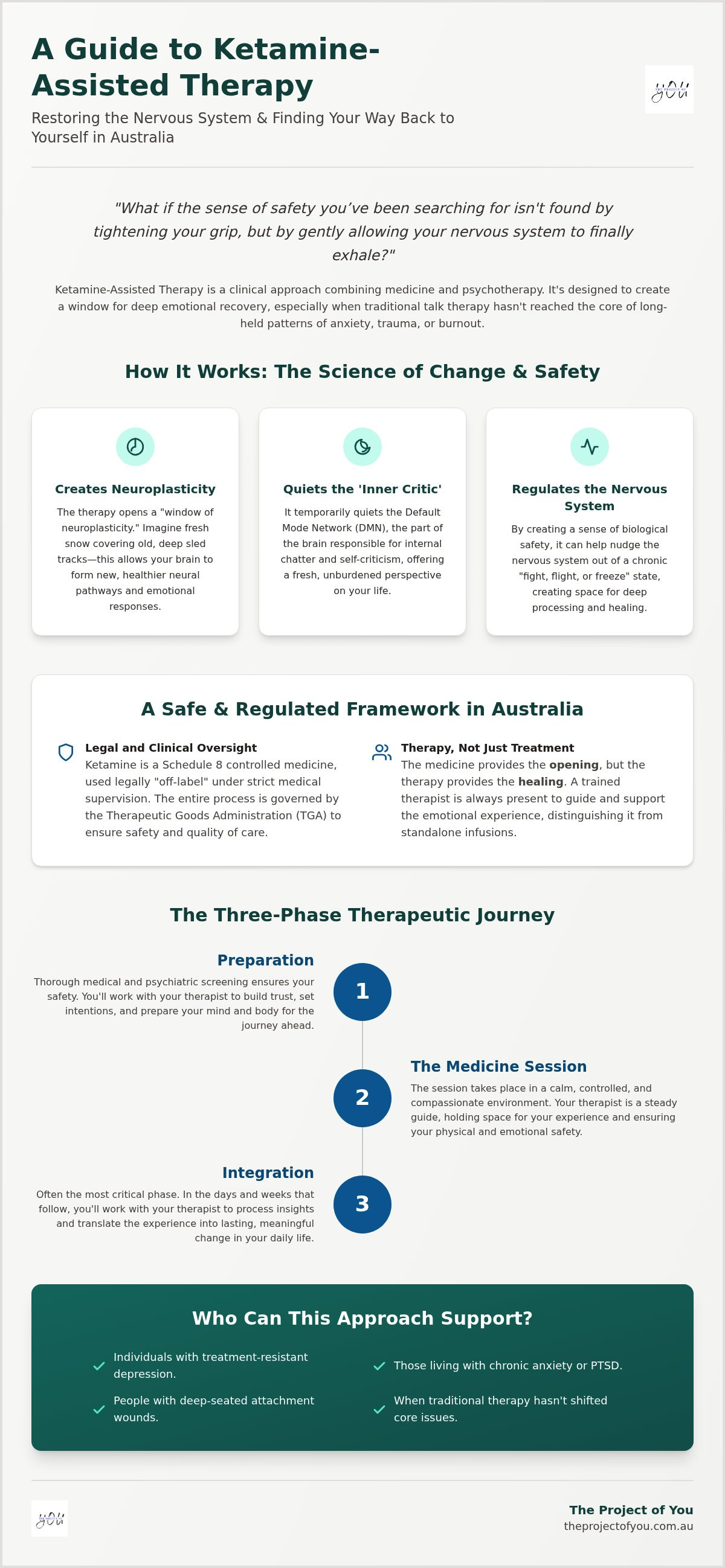
In Australia, ketamine is classified as a Schedule 8 controlled medicine. This means it's legal for medical use but held under strict regulatory oversight. While some people associate ketamine with its history as an anaesthetic or its reputation in recreational settings, the clinical application is worlds apart. Within the Ketamine-Assisted Psychotherapy model, the medicine is administered in a calm, compassionate, and highly controlled environment. It's often used "off-label" for treatment-resistant depression or complex trauma, providing a pathway for those who haven't found relief through standard treatments.
The Difference Between Ketamine Treatment and Ketamine Therapy
It’s helpful to distinguish between the purely medical model and the "assisted therapy" approach. Some clinics offer ketamine infusions as a standalone treatment, focusing primarily on the chemical impact on the brain. However, at The Project of You, we believe the medicine provides the "opening," while the therapy provides the "healing." In this model, your therapist acts as a steady, compassionate guide. They don't just monitor your vitals; they hold space for your emotional experience, helping you process the insights that emerge. This Psychedelic Assisted Therapy ensures that the experience isn't just a fleeting moment of relief, but a foundation for long-term restoration.
Is it Safe? Navigating the Clinical Framework
Safety is the cornerstone of any therapeutic journey. Before you even begin, a thorough medical screening and psychiatric oversight are mandatory to ensure your body and mind are ready for the process. Every session occurs in a monitored space where you're never left alone. The Therapeutic Goods Administration (TGA) maintains rigorous standards to ensure the quality and safety of medicines used in Australian clinical practice. This structured framework allows you to let go of the need to "stay in control" and instead trust in the professional care surrounding you.
The Science of Change: Neuroplasticity and Nervous System Regulation
Have you ever felt like your mind is stuck on a loop, repeating the same heavy thoughts or anxious patterns despite your best efforts to change? In the context of ketamine assisted therapy Australia, we often talk about a "window of neuroplasticity." Think of your mind like a snowy hill where you've been sledding for years. Those deep, icy ruts that always pull you in the same direction are suddenly covered by a fresh snowfall. This blank canvas gives you the freedom to carve a brand new path. This isn't just a metaphor; it's a biological shift where the brain becomes more flexible, allowing for profound Nervous System Restoration.
One way this happens is by temporarily quieting the Default Mode Network, or DMN. This is the part of your brain responsible for that constant internal chatter and your "default" way of seeing yourself. When the DMN takes a back seat, you gain a rare opportunity to see your life from a fresh perspective, unburdened by the usual self-criticism. It's like resetting a computer that's been frozen on a single, glitchy screen, allowing the system to run smoothly once again.
Ketamine and the Polyvagal Theory
For many living with trauma, the body exists in a constant state of "freeze" or "fight-flight." You might feel perpetually on edge or, conversely, completely numb and disconnected. This is where the science of ketamine assisted therapy Australia meets Polyvagal Theory. By creating a temporary sense of biological safety, ketamine helps nudge the nervous system out of survival mode. It provides a quiet, protected space where you can begin to process difficult emotions without being overwhelmed. You can explore more about how trauma dysregulates your nervous system to understand why this shift is so vital for long-term healing.
Breaking the Cycle of Rumination
Depression often feels like a prison of negative self-talk that you can't quite think your way out of. Research, including UNSW research on ketamine safety, highlights how this medicine interacts with glutamate, a key chemical messenger in the brain. By boosting glutamate activity, ketamine helps the brain grow new synaptic connections. These are the physical bridges that allow for healthier thought patterns and emotional resilience. If you feel ready to explore how this "reset" could support your own journey, you might consider how we can support your path toward restoration.
The Therapeutic Journey: Preparation, Experience, and Integration
Healing is rarely a straight line; it's more like a carefully guided expedition into the landscape of your own inner world. When you embark on ketamine assisted therapy Australia, you aren't just a passive recipient of a medical procedure. Instead, you're an active partner in a collaborative process. The foundation of this journey is the "Therapeutic Alliance," the deep bond of trust and safety between you and your therapist. This relationship serves as your anchor, ensuring that as you explore difficult emotions or new perspectives, you're never alone. We view this arc of care as a three-phase model where the medicine is the catalyst, but the therapeutic container is what allows for true restoration.
Step 1: Preparation and Setting the Internal Compass
Before any medicine is administered, we spend time together setting your internal compass. Preparation is about more than just logistics; it's about building the "emotional resources" you need to navigate the experience with grace. We work on intention setting, asking questions like, "What part of my heart is ready to be seen?" or "What weight am I ready to put down?" By focusing on "Set and Setting," we ensure your mindset is curious and your physical environment feels like a sanctuary. This phase creates the psychological safety necessary for your nervous system to let down its guard.
Step 2: The Medicine Session (The Experience)
The medicine session itself is a quiet, internal experience held in a comfortable and supportive space. You’ll typically use eye shades and a curated playlist of music to help you turn your attention inward. While the experience is deeply subjective, your therapist remains present throughout the entire session. They're there to provide grounding, offer a reassuring word if needed, and ensure you feel physically and emotionally secure. This isn't about losing control; it's about having a safe enough container to let the medicine quieten your usual defences, allowing fresh insights to emerge naturally.
Step 3: Integration (Weaving the Insights into Daily Life)
Integration is where the magic of the "plasticity window" meets the reality of your daily life. In the days following your session, your brain is more flexible, making it the perfect time to establish new habits, set healthier boundaries, or soften old self-judgments. We use this time to make sense of the images, feelings, or thoughts that arose during your experience. Integration might involve somatic work to release tension held in the body, reflective journaling, or ongoing individual counselling to ensure these new paths become permanent parts of your landscape.
Who Can Benefit? Navigating Trauma, PTSD, and Anxiety
Not everyone finds that standard talk therapy reaches the deepest parts of their pain. Sometimes, trauma is so deeply etched into the body’s survival architecture that words alone can't quite touch the root. In the Australian healthcare landscape, ketamine assisted therapy Australia is increasingly valued for its ability to support those who feel "stuck" in persistent cycles of anxiety, hyper-vigilance, or emotional numbness. It’s particularly effective for complex PTSD and developmental trauma, where early life experiences have shaped a person’s core sense of safety. KAT is often more effective for this "stuck" trauma because it bypasses the analytical mind and speaks directly to the limbic system, where traumatic memories are stored as sensory experiences rather than coherent stories. Being truly trauma-informed during this process means creating a therapeutic space where your nervous system feels safe enough to finally let go of its defensive posture.
Ketamine for Treatment-Resistant Depression and Burnout
Clinically, "treatment-resistant" is a term used when at least two different standard interventions haven't led to the significant relief you deserve. This can feel like hitting a series of dead ends, often leading to a sense of profound hopelessness or chronic burnout. Burnout is more than just being overworked; it’s a state of nervous system collapse where the "battery" can no longer hold a charge. By providing a biological "pause" button, ketamine assisted therapy Australia offers a fresh starting point for those who have felt they’ve tried everything. It allows for a softening of the heavy clouds of depression, creating enough space to begin the real work of restoration. You can learn more about our specific approach to PTSD Therapy in Australia and how we support this journey.
Healing Attachment and Relational Wounds
Our earliest relationships often set the blueprint for how we navigate intimacy and conflict. If those blueprints were formed in environments that felt unpredictable or unsafe, we naturally build high walls to protect ourselves. These attachment wounds can manifest as a constant fear of rejection or a tendency to shut down during difficult conversations. KAT can help gently soften these internal barriers, making it easier to access feelings of self-compassion and curiosity. This internal shift can be a powerful adjunct to couples counselling, as it helps each partner move out of a reactive state. What if you could view your partner with curiosity instead of defensiveness? Imagine the change in your relationship if you both felt safe enough to be truly seen.
Finding Your Path: Integrative Care with The Project of You
Choosing a path toward healing is an act of profound courage, especially when you’ve spent years feeling as though your nervous system is stuck in a state of survival. At The Project of You, Azita Abdollahian brings her expertise as a clinical social worker and psychotherapist to ensure that ketamine assisted therapy Australia is delivered with a deep commitment to emotional safety. We don't see you as a set of symptoms to be managed, but as a whole person with a unique story and an inherent capacity for restoration. Our approach to Psychedelic Assisted Therapy is built on the belief that the medicine is simply the key that unlocks the door; the real work of transformation happens within the safe, nurturing relationship between you and your guide.
The "Project of You" philosophy is rooted in the idea of restoration rather than "fixing." We understand that many of the barriers to healing are built on foundations of shame, grief, or a lack of self-compassion. By creating a space where these feelings can be explored without judgment, we help you soften the internal critics that often keep you stuck. This process is designed to help you move from a place of constant hyper-vigilance toward a more regulated, connected life. It's about finding your way back to a version of yourself that feels grounded, resilient, and capable of experiencing joy once again.
A Holistic Approach to Restoration
We believe that deep healing often requires a multi-layered approach. While KAT can provide a powerful opening, we often integrate this work with our immersive Nervous System Retreats for those who feel ready for deeper, more focused work. Having a therapist who understands both the clinical science of neuroplasticity and the delicate nuances of the human heart is vital. Our practice is consistently evidence-led and heart-centred, ensuring that every step of your journey is grounded in professional authority and intuitive empathy. We’re here to help you navigate the transitions of your life with grace and intentionality.
How to Get Started with The Project of You
Your journey is entirely unique, and it requires a plan that is as personalised as your own life experience. We encourage you to reach out for an initial consultation where we can explore together whether this path is the right fit for your current needs. We’ll sit with your questions, honour your fears, and begin to map out a structured way forward that feels safe and manageable for you. If you feel a quiet pull toward this possibility of change, please visit our contact page to make a confidential inquiry. You don't have to navigate this transition alone; we are here to walk beside you as you create a new path toward a brighter, more regulated future.
Embracing a Future of Emotional Safety
The path toward healing is rarely about finding a quick fix; it’s about creating the right conditions for your nervous system to finally feel safe. We have explored how ketamine assisted therapy Australia serves as a biological catalyst, opening a window of neuroplasticity that allows you to move beyond the heavy ruts of trauma and chronic anxiety. By combining clinical science with a heart-centred therapeutic alliance, you can begin to weave new patterns of self-compassion and resilience into the fabric of your daily life.
Led by Clinical Social Worker Azita Abdollahian, our trauma-informed and evidence-based approach ensures you are supported at every step of this journey. Whether you are navigating the depths of burnout or seeking to heal long-standing attachment wounds, there is a way forward that honours your humanity. You don't have to carry the weight of the past alone. A more regulated and connected life is possible when you have a steady guide by your side.
Explore Psychedelic-Assisted Therapy with The Project of You Take a gentle breath and imagine what life might look like when you finally feel at home within yourself. We are here to help you navigate that transition with grace and professional care.
Frequently Asked Questions
Is ketamine-assisted therapy legal in Australia?
Yes, ketamine is legal in Australia for medical use as a Schedule 8 controlled medicine. It is strictly regulated by the Therapeutic Goods Administration (TGA) to ensure safety and quality standards. Only registered psychiatrists are authorised to prescribe the medication for conditions such as treatment-resistant depression. While the medicine itself is legal, it must be administered within a clinical setting under professional supervision to comply with Australian health regulations.
What does a ketamine-assisted therapy session actually feel like?
A session typically feels like a gentle, internal journey where your usual sense of self becomes more fluid. Most people describe a feeling of deep relaxation and a temporary "distance" from their everyday worries or self-criticism. You might experience vivid imagery or a dream-like state while remaining aware of your surroundings. It is a quiet, introspective experience supported by music and eye shades, designed to help your nervous system finally let go.
How many sessions of KAT are typically required for trauma?
The number of sessions varies depending on your unique needs, but most protocols involve an initial series of four to six medicine sessions. These are spaced out to allow for essential integration work between each experience. At The Project of You, we focus on a personalised arc of care. We don't just look at the medicine sessions; we prioritise the preparation and integration phases to ensure long-term nervous system restoration.
Do I need a referral from my GP for ketamine-assisted therapy?
Yes, you generally need a referral to a psychiatrist who specialises in ketamine assisted therapy Australia. Because ketamine is a Schedule 8 medicine, a specialist must conduct a thorough medical and psychiatric screening to ensure it is a safe path for you. Once you are approved for treatment, your therapist works alongside the prescribing doctor to provide the psychological support and integration sessions that are vital for your recovery.
Can I get a Medicare rebate for ketamine therapy in Australia?
Medicare rebates are currently available for the associated psychiatric consultations, but the actual administration and monitoring costs are often paid for out-of-pocket. While esketamine is PBS-subsidised for specific conditions, many other forms of the therapy are not yet covered. It is important to note that The Project of You does not offer bulk billing. We recommend checking with your private health fund to see if they provide any additional coverage.
What is the difference between ketamine and other psychedelic therapies?
Ketamine is a dissociative anaesthetic, whereas substances like psilocybin are classic psychedelics. Biologically, ketamine works primarily on the glutamate system to promote neuroplasticity. Within the Australian healthcare system, it has a more established legal framework for clinical use than other psychedelic therapies. It offers a shorter duration of action, making it a manageable and highly effective tool for deep emotional recovery and nervous system regulation within a standard clinical session.
Is ketamine-assisted therapy safe for people with a history of addiction?
Ketamine can be safe for those with a history of addiction when it is administered within a strict clinical framework. The therapeutic setting and dosage are very different from recreational use. A thorough psychiatric screening is essential to assess your unique history and risk factors. When used as part of a structured, trauma-informed program, it can actually help address the underlying emotional pain and dysregulation that often drive addictive behaviours.
How do I know if I am "ready" for this type of therapeutic experience?
Readiness is often a quiet sense of curiosity balanced with a desire for change. You might feel ready if you have reached a plateau in traditional talk therapy or if your nervous system feels perpetually stuck in burnout. It is normal to feel a mix of hope and apprehension. An initial consultation is the best way to explore your readiness, as it allows us to discuss your goals and ensure you feel safe.


Comments