.png)

Parenting Counselling Australia: A Trauma-Informed Guide to Family Healing
- Azita Abdollahian

- 4 hours ago
- 12 min read
What if the "bad" behaviour you're struggling to manage in your child is actually a mirror reflecting your own overwhelmed nervous system? It's a confronting thought, yet it's one that offers a path toward deep healing rather than just another list of discipline techniques. Many parents across the country find themselves reliving their own childhood traumas through their children, leading to a cycle of chronic exhaustion and burnout. If you've been searching for parenting counselling Australia, you likely know the heavy weight of feeling like a failure when your patience finally snaps and the disconnect from your partner feels wider than ever.
At The Project Of You, we understand that you want more than just a quiet house; you want a home filled with genuine connection and emotional safety. Azita Abdollahian is a trauma expert, and she created this guide to show you how nervous system regulation and attachment-based therapy can transform your parenting journey and bring peace back to your Australian home. We'll look at the science of why we react the way we do, how to foster a secure attachment with your child, and practical ways to find calm and confidence in your role. You'll learn to move from reactive survival into a space of intentional, compassionate connection.
Table of Contents
Why Parenting Can Feel Overwhelming: Understanding the Parental Nervous System
When we talk about parenting counselling Australia, we're really talking about creating a safe harbour for you to explore your own internal landscape. It's a gentle process of looking at the 'why' behind your reactions rather than just the 'what' of your child's behaviour. Many parents arrive at our sessions feeling like they've reached the end of their tether, yet they don't realise that their struggle is often a biological response rather than a lack of willpower or love.
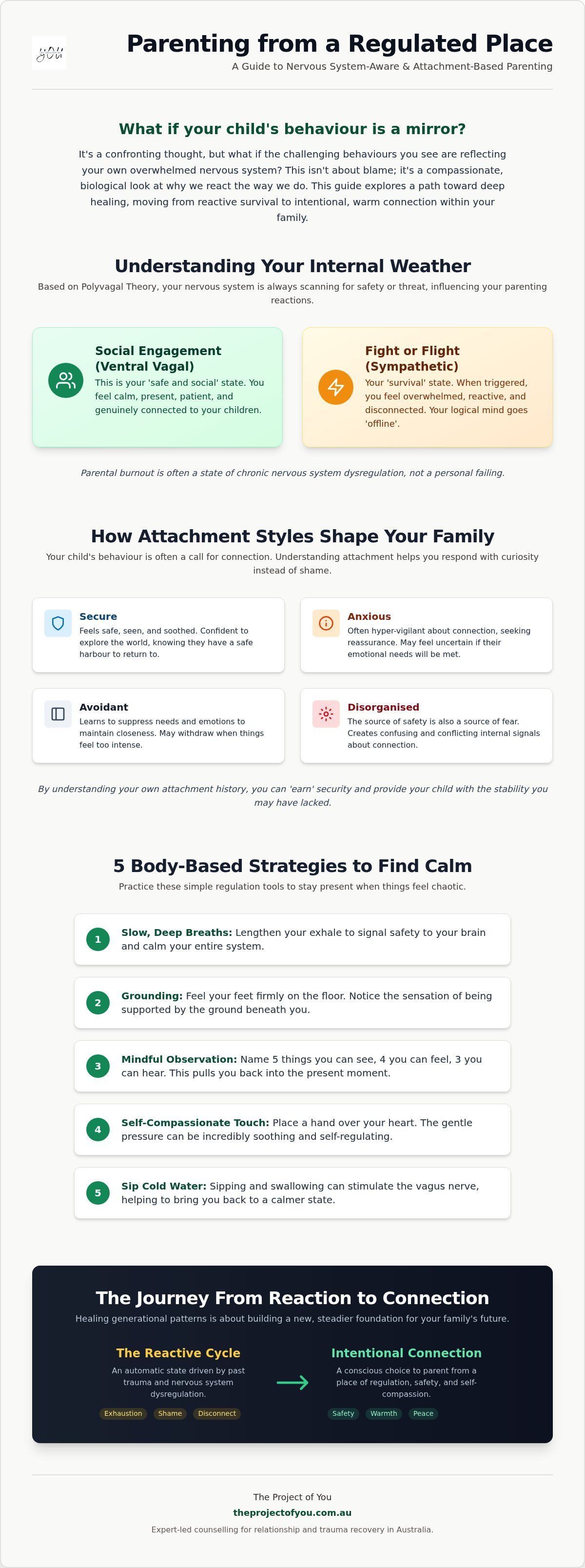
Your nervous system acts as a silent guardian, constantly scanning your environment for safety or threat. This is the core of Polyvagal Theory. When you're in a state of social engagement, you feel calm, patient, and connected. However, when your child's screaming or defiance begins, your system can quickly shift into a 'fight or flight' state. This isn't a choice you make; it's your body trying to protect you from what it perceives as an overwhelming stressor.
Parental burnout is a state of chronic nervous system dysregulation. Feeling 'triggered' by your child's behaviour is often a sign of unmet needs or past trauma rather than a failure of character.
The Biology of a 'Triggered' Parent
Have you ever wondered why a toddler's meltdown can make you feel like you're under actual physical attack? That's your brain's survival centre, the amygdala, taking over and pushing your logical mind offline. In these moments, reacting from a place of fear becomes the default setting, making it nearly impossible to respond with the calm you desire. This is why 'self-care' often feels like just another chore on a long list. If your system is stuck in high-alert, your body doesn't feel safe enough to actually rest or receive care.
Breaking the Cycle of Generational Patterns
Most of us parent from a 'default' setting established in our own upbringing. If you grew up in an environment where safety was conditional, your nervous system learned to stay vigilant. Identifying these patterns is the first step toward change. By integrating Attachment theory into our work, we can see how these early experiences influence your current parenting style. Finding a path out of these reactive cycles often requires Nervous System Restoration, allowing you to build a new, steadier foundation for your family's future with self-compassion and grace.
The Role of Attachment Theory in Parenting Counselling
What if your child’s behaviour is a call for connection rather than a challenge to your authority? This gentle shift in perspective is at the heart of attachment-based parenting counselling Australia. Secure attachment isn't just a clinical term; it's the emotional glue that holds a family together. It provides children with the confidence to explore the world and the safety to return when things get tough. While many sources of Australian parenting guidance offer excellent tips on behaviour management, we look deeper into the invisible threads of connection between you and your child.
In our sessions, we often find that a parent's own history dictates their present reactions. If you didn't experience a secure base growing up, you might find certain parenting moments particularly draining or confusing. Processing this history allows you to 'earn' security. This means you can provide your child with the stability you might have lacked, breaking generational cycles through awareness and self-compassion. It's about moving from a place of 'doing' parenting to 'being' a parent who is emotionally available.
Understanding Your Attachment Style
There are four primary ways we bond: secure, anxious, avoidant, and disorganised. An anxious attachment might lead you to feel hyper-vigilant about your child's mood, while an avoidant style might cause you to pull away when emotions get too 'loud' or intense. Imagine an avoidant parent facing a toddler's tantrum; their internal system might scream for distance to feel safe again. It's helpful to reflect: how was emotion handled in the house you grew up in? Was it welcomed, or was it something to be hidden? Understanding these defaults helps us respond with curiosity rather than shame.
Creating a 'Safe Haven' and 'Secure Base'
In attachment theory, you serve two vital roles. You are the 'Safe Haven' where your child returns for protection when they are hurt or scared. You are also the 'Secure Base' from which they head out to learn and grow. Signalling safety during a conflict can be as simple as lowering your voice, softening your gaze, or staying physically present without being intrusive. This isn't about being a perfect parent; it's about being 'good enough' and repairing the bond when it inevitably breaks. If you find that tension with your partner is making this harder, you might explore Choosing Couples Counselling to strengthen the parental unit. If you're ready to explore these patterns in a supportive space, you can book an initial consultation to begin your family's healing.
Choosing the Right Support: Helplines vs. Therapeutic Counselling
Finding the right path for your family often starts with a single, brave question: what kind of support do I actually need right now? In Australia, the landscape of help is broad, ranging from immediate crisis lines to deep, therapeutic partnerships. While both serve a purpose, understanding the difference between a 'hotline' and a 'holding space' is essential for your long-term healing. One provides a temporary map, while the other helps you rebuild the road itself.
When to Call a Helpline
Helplines are your first-response team. They are perfect for immediate safety concerns, quick developmental questions, or when you need a calm voice during a midnight meltdown. State-based services like Parentline provide vital access to local resources for school or health issues. They offer a moment of relief in acute stress, but their scope is naturally limited to the present moment. For many, this is the first step when searching for parenting counselling Australia, providing a necessary bridge to safety when you feel you've reached your limit.
The Benefits of Clinical Parenting Counselling
Clinical parenting counselling Australia, by contrast, offers a consistent therapeutic relationship designed for deeper restoration. This is where we move beyond managing a child's behaviour to exploring the roots of family distress, such as complex trauma, grief, or the fallout from infidelity. By working with a qualified Clinical Social Worker like Azita, you gain a partner who understands the nuances of the human condition and the biology of stress.
Processing generational trauma to stop reactive cycles and 'triggered' responses.
Developing customised strategies based on Gottman and Attachment theories.
Creating a secure 'holding space' for your own emotions so you can better hold your child's.
Restoring intimacy and alignment with your partner regarding parenting styles.
At The Project of You, we focus on providing high-touch, specialised care that goes beyond standard talk therapy. Please keep in mind that we don't offer Medicare Bulk Billing; instead, we prioritise a level of depth and availability that allows for true, transformative work. This approach ensures you aren't just another number in a system, but a person being held in a safe, professional, and compassionate space. For those seeking trauma-informed care resources, organisations like Emerging Minds provide wonderful foundational information that complements the intensive work we do in our sessions.
Practical Strategies for Regulating Your Nervous System
When you're in the thick of a parenting struggle, your logical mind often goes offline. You might know exactly what the books say to do, yet find yourself shouting or withdrawing anyway. This happens because your nervous system has moved into a survival state where thinking your way out is no longer an option. In the field of parenting counselling Australia, we distinguish between 'top-down' regulation, which involves using your thoughts to calm down, and 'bottom-up' regulation, which uses the body to signal safety to the brain. When you're flooded, the body must lead the way.
Learning to weave micro-moments of regulation into your busy Australian day can prevent the slow build-up of stress that leads to an evening explosion. These aren't just 'tips'; they're biological resets that we teach and refine during our sessions at The Project of You, tailored to your specific triggers and family dynamics.
Somatic Tools for the 'Heat of the Moment'
If you feel that familiar heat rising in your chest or a sudden urge to run away, try these five body-based steps to return to the present:
The Long Exhale: Breathe out for twice as long as you breathe in. This simple act stimulates the vagus nerve, sending an immediate signal to your brain that you aren't in physical danger.
Feet on the Floor: Press your heels firmly into the ground. Notice the texture of the carpet or the coolness of the tiles. This physical connection helps pull you out of a racing mind.
The 5-4-3-2-1 Senses: Quickly name five things you can see, four you can touch, three you can hear, two you can smell, and one you can taste.
Gentle Movement: Roll your shoulders or slowly turn your head from side to side. Rhythmic movement tells your system it's safe to soften.
Compassionate Touch: Place a hand on your heart or your belly. This self-touch can release oxytocin, providing a moment of internal warmth when things feel cold and chaotic.
Co-regulation occurs when a parent remains anchored in their own calm, providing an external nervous system that a distressed child can eventually mirror and lean into for safety.
Building Long-Term Resilience
True healing isn't just about surviving the meltdowns; it's about building a system that doesn't redline so easily. This requires setting boundaries that protect your energy, allowing you to parent from a place of choice rather than depletion. We also look for 'glimmers', which are the opposite of triggers. These are tiny moments of safety, like the sun on your back or a quiet cup of tea, that help restore your system over time. For those moments of quiet reflection, our Self Love E-books offer a gentle way to explore these concepts at your own pace.
How Parenting Counselling at The Project of You Supports Family Restoration
Choosing to step into parenting counselling Australia is an act of profound love, not just for your children, but for the person you're becoming through the fire of parenthood. At The Project of You, Azita Abdollahian brings the expertise of a qualified Clinical Social Worker together with a deeply human, 'cup of tea' warmth. We believe that family restoration doesn't happen through rigid rules or shame-based discipline. Instead, it happens when we create a space where you feel safe enough to be vulnerable, curious, and entirely honest about the challenges you face.
Our approach is intentionally trauma-informed. This means we never look at your struggles as character flaws. We see them as survival strategies that simply aren't serving your family anymore. Whether you're navigating the fallout of an affair, managing the invisible load of modern parenting, or trying to heal your own childhood wounds, we provide a steady, non-judgemental presence to guide you through the transition. Our work focuses on three core pillars:
Regulating the parental nervous system to reduce reactive outbursts.
Fostering secure attachment through consistent emotional presence.
Building a shame-free environment where every family member feels seen and heard.
A Personalised Path to Healing
In your first session, our primary goal is to establish a sense of safety. We'll explore your family's unique story with a spirit of curiosity rather than judgement. By integrating evidence-based tools like Cognitive Behavioural Therapy (CBT) and the Gottman Method, we provide practical ways to improve communication and emotional intimacy within your home. We honour and support all family structures across Australia, recognising that every home has its own rhythm and needs. Our focus remains on high-touch, specialised care that prioritises your long-term growth over quick, temporary fixes.
Beyond the Therapy Room
Sometimes, an hour a week isn't enough to break through years of built-up tension. For families and partners seeking a more immersive experience, our Private Couples Retreats offer a dedicated time to focus entirely on restoration. These intensives allow you to step away from the noise of daily life and do the deep work of nervous system regulation in a supportive, beautiful environment. We also offer various workshops designed to foster connection and self-compassion for those earlier in their journey.
If you feel ready to move from a place of survival into a space of intentional connection, you can Book Online to start your journey with parenting counselling Australia. Remember, healing yourself is the greatest gift you can give your child. By doing this work, you aren't just changing your own life; you're changing the legacy you leave behind.
Beginning Your Journey Toward a Calmer Home
Healing the heart of your family starts with the gentle realisation that your struggles are not a character flaw. Your nervous system is simply doing its best to keep you safe, often using old maps that no longer fit your current life. By understanding the biology of your stress and the power of secure attachment, you can move from a state of reactive survival into a place of intentional, warm connection with your children. You have already taken a significant step by exploring how trauma-informed parenting counselling Australia can offer a shame-free path toward restoration.
As a qualified Clinical Social Worker and Psychotherapist specialising in Nervous System Restoration, I am here to walk beside you. We will use evidence-based care to help you find your steady centre, ensuring your home becomes a true sanctuary for every family member. You don't have to carry the invisible load of generational patterns alone. Transformation is possible, and it begins with a single moment of curiosity about your own healing.
Book a compassionate parenting counselling session with Azita today The path ahead is one of supported growth and self-compassion. You have everything you need within you to create the secure, loving environment your family deserves.
Frequently Asked Questions
What exactly happens in a parenting counselling session?
A session is a compassionate space designed to help you explore the roots of your reactions. We look at your internal landscape and how your nervous system responds to your child's behaviour. Using evidence-based methods like CBT and Gottman theory, we develop practical strategies to foster emotional safety. It's less about fixing the child and more about supporting you to become a regulated, steady anchor for your entire family.
How many sessions will I need to see a difference in my family life?
Healing is a continuous journey rather than a destination. While some parents feel a shift in perspective after just a few sessions of parenting counselling Australia, deeper restoration of generational patterns typically takes longer. We move at a pace that feels safe for your nervous system. Many families find that consistent support over several months allows for the integration of new, secure attachment behaviours and lasting emotional resilience.
Can parenting counselling help if my partner isn't willing to attend?
Absolutely, as changing your own internal state naturally shifts the family dynamic. When you learn to regulate your nervous system and respond with curiosity instead of reactivity, it creates a powerful ripple effect. Your partner and children will often subconsciously mirror your new-found calm. Individual sessions provide a vital holding space for you to do your own work, which can ultimately lead to a more peaceful home.
Is parenting counselling only for people in crisis or with 'bad' children?
No, it's a proactive tool for any parent seeking a deeper, more secure attachment with their child. You don't need to be in a state of burnout or crisis to benefit from therapeutic support. Many parents use these sessions to understand their own upbringing or to navigate transitions with more grace. It's about moving from survival into a space where your family can truly thrive and grow together.
What is the difference between a parenting coach and a clinical counsellor?
While a coach often focuses on external behaviours and future goals, a clinical counsellor looks at the internal roots of your experience. As a qualified Clinical Social Worker, Azita integrates trauma-informed care and nervous system restoration into the process. We explore the why behind the struggle, addressing deep-seated attachment styles and emotional safety. This holistic approach ensures that family changes are sustainable and grounded in real psychological healing.
Can I get a Medicare rebate for parenting counselling at The Project of You?
The Project of You does not offer Medicare Bulk Billing. We focus on providing high-touch, specialised care that prioritises your specific needs and long-term restoration. While the Better Access initiative provides rebates for individual mental health treatment with a Mental Health Treatment Plan, these rebates generally don't apply to joint family or couples sessions. We recommend checking with your private health fund to see if you are eligible for any extras cover.
How do I know if my own trauma is affecting my parenting?
You might notice that your reactions to your child feel out of proportion or that you're reliving difficult moments from your own childhood. If you frequently feel triggered or stuck in a state of chronic exhaustion, it's often a sign that your past experiences are influencing your present. Parenting counselling Australia provides a safe environment to explore these connections with self-compassion, helping you separate your past from your child's future.
Do you offer online sessions for parents living in rural Australia?
Yes, we provide national support across Australia through secure online counselling. Distance should never be a barrier to accessing trauma-informed care. Whether you're in a remote regional area or a busy suburb, you can access our individual and parenting sessions from the comfort of your own home. This allows you to do the deep work of nervous system restoration in a space where you already feel safe and supported.


Comments