.png)

Conscious Uncoupling Counselling: A Compassionate Guide to Ending with Integrity
- Azita Abdollahian

- 1 day ago
- 12 min read
What if the end of your marriage didn't have to be a battleground, but could instead serve as the foundation for a healthy new chapter? When a partnership dissolves, it often feels as though your entire world is fracturing, leaving you trapped in a cycle of high-conflict anxiety and nervous system burnout. You likely want to protect your children from the fallout and find a way to breathe again without the weight of betrayal or resentment. It's a heavy burden to carry alone. Engaging in conscious uncoupling counselling offers a structured, compassionate path through this storm, prioritising emotional safety over legal warfare.
At The Project Of You, we understand that you're seeking a way to close this chapter without destroying the foundation of your family's future. This guide will help you navigate the end of your relationship with intention, protecting your well-being and your children's stability. We'll explore how to regulate your nervous system, foster a functional co-parenting dynamic, and find the emotional closure necessary for true healing. You'll discover how to transform a painful ending into a respectful evolution that honours your past while securing your future.
Table of Contents
What is Conscious Uncoupling Counselling?
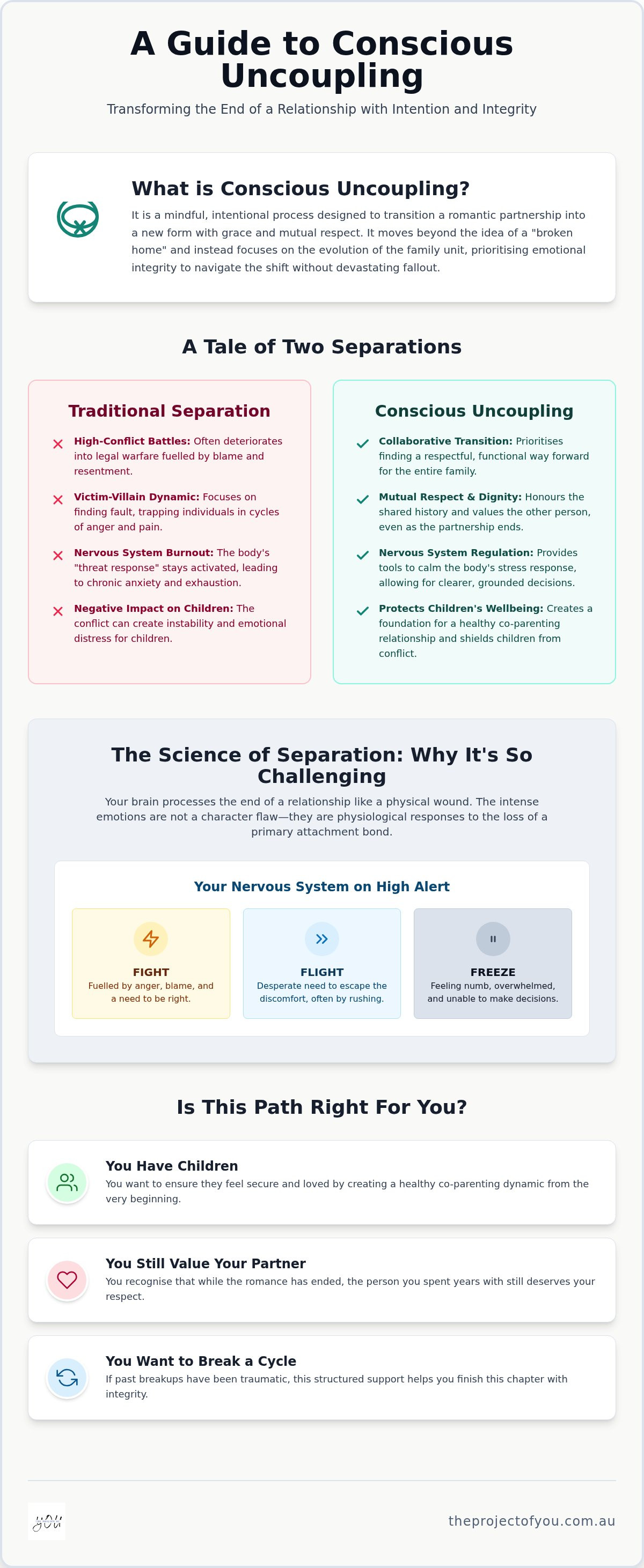
Traditional narratives often paint the end of a marriage as a failure, a jagged rupture that leaves only bitterness and regret in its wake. But what if we looked at it differently? At her practice, Azita Abdollahian - relationship counsellor and trauma expert- has been exploring Conscious uncoupling counselling: a mindful, intentional process designed to transition a romantic partnership into a new form with grace. It moves beyond the idea of a "broken home" and instead focuses on the evolution of the family unit. By prioritising emotional integrity and mutual respect, partners can navigate this shift without the devastating fallout typically associated with separation. This therapeutic approach provides a safe "container" where both individuals can process their grief while taking shared responsibility for the future.
The Philosophy of Intentional Endings
The way we choose to leave a relationship often dictates how we begin our next chapter. When a split is fuelled by blame, the nervous system remains in a state of high alert, making it difficult to find peace or parent effectively. Conscious uncoupling challenges the "victim-villain" dynamic that so often dominates legal battles. Instead of looking for someone to fault, we foster curiosity about the relationship's patterns. We honour the history you built together. Your shared experiences don't lose their value just because the romantic bond has changed shape. This philosophy invites you to step out of the reactive "threat response" and into a space of collaborative transition.
Who is this Approach For?
This isn't a "one-size-fits-all" solution, but it's particularly transformative for those who want to preserve the dignity of everyone involved. You might find this path helpful if:
You have children: You want to ensure they feel secure and loved, creating a healthy co-parenting dynamic from the very beginning.
You still value your partner: You recognise that while the romantic spark has ended, the person you spent years with still deserves your respect.
You want to break a cycle: If your past breakups have been marked by trauma or betrayal, this structured support helps you finish with integrity.
Professional support is vital because the intensity of a breakup can easily overwhelm our ability to think clearly. In our work together at The Project of You, we use clinical social work expertise to hold space for the complex emotions that arise. It's like having a steady guide while you navigate a dense forest. You don't have to have all the answers right now. The conscious uncoupling counselling process helps you slow down, breathe, and make decisions from a place of groundedness rather than panic. This intentionality is what protects your family's future and your own mental health. If you feel ready to explore this path, you can book a session online to begin the conversation.
The Science of Separation: Nervous System and Attachment
Have you ever wondered why even a mutual separation can leave you feeling physically ill or uncontrollably anxious? Your nervous system is hardwired for connection. When that connection is severed, your body enters a state of high alert survival mode. Within the framework of conscious uncoupling counselling, we look at these reactions not as character flaws, but as physiological responses to the loss of a primary attachment bond. Your brain processes social rejection in the same pathways as physical pain. This is why a breakup can feel like a genuine wound.
Polyvagal Theory and the Breakup Response
When a relationship ends, your nervous system often cycles through fight, flight, or freeze responses. You might find yourself trapped in a "fight" state, fuelled by anger and blame, or a "flight" state, where you feel a desperate need to rush the legal process just to escape the discomfort. Some individuals enter a "freeze" state, feeling numb and unable to make even simple decisions. Chronic stress during this time impairs the prefrontal cortex, the part of your brain responsible for logic and long-term planning. This is why Nervous System Restoration is a cornerstone of our work. By grounding your physiology, you can move from a state of reactive dysregulation to one of calm clarity.
Attachment Styles in Transition
Your attachment style, formed in early childhood, acts as a blueprint for how you handle the end of a partnership. These styles often clash during uncoupling, creating unnecessary friction. Recognising these patterns can foster curiosity instead of resentment:
Anxious Attachment: You may experience an intense fear of abandonment, leading to "protest behaviours" like constant texting or seeking immediate reassurance.
Avoidant Attachment: You might "deactivate" by emotionally shutting down or becoming dismissive as a way to manage the pain of the rupture.
Disorganised Attachment: You may find yourself oscillating between a desperate need for closeness and a fearful withdrawal.
Understanding that your partner's coldness or clinging is likely a cry for safety can change the entire tone of your separation. In our sessions, we prioritise creating psychological safety so that these attachment wounds don't dictate your future. When you feel safe, you can make decisions that honour your integrity and your family's needs. If you find yourself stuck in a cycle of reactivity, you may wish to book a session online to explore how somatic support can ground your transition and help you find your way back to yourself.
Conscious Uncoupling vs. Traditional Separation
Imagine the difference between a courtroom battle and a quiet, intentional conversation about the future of your family. Traditional separation often prioritises legal victories and the distribution of assets over the emotional well-being of the individuals involved. This adversarial approach can lead to a significant emotional rupture, leaving both partners trapped in a cycle of blame and resentment. In contrast, conscious uncoupling counselling focuses on healing and long-term nervous system health. It asks you to look past the immediate hurt to consider how you want to feel five years from now.
There is a common myth that uncoupling is a "Zen Divorce" where pain is somehow bypassed or ignored. This couldn't be further from the truth. Ending a partnership involves significant grief, regardless of the method you choose. The difference lies in how you hold that pain. We view this process as a harm-reduction model. By choosing an intentional ending, you aren't avoiding the struggle; you're simply choosing not to let that struggle traumatise you or your children for years to come. It's about moving toward a functional future rather than staying stuck in the wreckage of the past.
Reframing the Narrative of Failure
Societal stigmas often label ended marriages as "broken homes," but a family isn't broken just because the romantic bond has changed its form. You can celebrate what you built together—the years of support, the children you've raised, and the growth you've shared—while acknowledging that the current structure no longer serves your evolution. Uncoupling is a courageous act of integrity that honours the truth of your situation rather than taking the path of least resistance through high-conflict legal battles. This shift in perspective allows you to step out of the "failed" narrative and into one of transition and self-respect.
Protecting the Children through Intentionality
Children are incredibly sensitive to the physiological state of their parents. When you are in a state of chronic nervous system dysregulation, your children often mirror that anxiety, feeling a sense of instability in their own world. Through conscious uncoupling counselling, you and your partner can work toward creating a unified "story" of the separation. This clarity is vital for your children's sense of safety. It helps reduce the "loyalty binds" that occur when children feel they must choose a side or hide their love for one parent to appease the other. By regulating your own response, you provide a steady anchor for them during the storm. If you feel the weight of this transition is becoming too much to carry alone, you might consider how couple counselling can provide the structure needed to protect your family's emotional future.
Practical Strategies for an Intentional Uncoupling
Moving from the theoretical understanding of a respectful separation into the lived reality of one requires a map. While the emotional weight remains, having structured steps can prevent you from feeling lost in the fog of grief. Conscious uncoupling counselling provides the framework to turn these intentions into tangible actions, ensuring that your integrity remains intact even when your heart is heavy. It's about creating a path forward that honours both where you've been and where you're going.
Step 1: The "No-Blame" Zone. Commit to a shared agreement where initial discussions are stripped of finger-pointing. This isn't about ignoring the past, but about prioritising a functional future.
Step 2: Regulate Before You Relate. Never enter a difficult conversation while in a state of "fight or flight." Use breathwork or grounding exercises to settle your nervous system first.
Step 3: Establish Compassionate Boundaries. Clearly define how and when you will communicate. This might mean no late-night texts or agreeing to only discuss logistics via email for a time.
Step 4: Craft a Relationship Legacy. Take time to acknowledge what worked. By honouring the "legacy" of the good years, you make it easier to let go of the pain.
Step 5: Facilitated Support. Seeking professional couples counselling can provide a neutral space to navigate the most complex transitions.
Communication Techniques for High-Stress Moments
When tensions rise, our language often becomes a weapon. To keep the space safe, try using "I" statements, such as "I feel overwhelmed when we discuss the house right now," rather than "You always push me." If you feel your pulse quickening, employ the "Pause and Regulate" method. Simply say, "I'm starting to feel flooded, let's take twenty minutes to settle before we continue." Setting time-limited discussions, perhaps thirty minutes once a week, prevents the separation from consuming every waking moment of your life.
Creating Rituals of Closure
Rituals provide a symbolic container for the transition. You might choose to have a final meal together to mark the end of the domestic partnership, or hold a closing conversation where you both express gratitude for the lessons learned. Writing a letter of release can be profoundly healing; even if you never send it, the act of putting your grief and release onto paper helps move the energy through your body. As you begin organising the physical separation of your space, do so with mindfulness, acknowledging that each item moved is a step toward your new, independent path.
How The Project of You Supports Your Transition
Azita Abdollahian, a clinical social worker and neurofeedback trainer, brings a unique trauma-informed lens to relationship transitions. At The Project of You, we believe that your physiology is just as important as your psychology during a split. By choosing conscious uncoupling counselling, you aren't just managing a legal change; you're engaging in a deep process of Nervous System Restoration. We integrate traditional clinical psychotherapy with somatic healing to ensure you aren't just talking about your pain, but actually moving it through your body. This holistic approach helps you find your way back to a state of ease and safety.
Sometimes, the weekly pace of standard therapy isn't enough to break through years of entrenched patterns. This is where our private couples retreats or relationship intensives can be life-changing. These immersive experiences allow you to fast-track emotional clarity in a safe, held environment, away from the distractions of daily life. It's an opportunity to do the heavy lifting of conscious uncoupling with expert guidance by your side, ensuring you transition from "partner" to "individual" with your dignity and health intact.
A Compassionate Space for Australians
Navigating a high-stakes ending requires more than just good intentions; it requires a neutral, expert third party who understands the complexities of the human heart. Azita acts as a steady anchor, helping you maintain a regulated nervous system even when the conversations feel impossible. This partnership ensures that you don't make permanent decisions based on temporary emotional flooding. If you feel you need a steady hand to guide you through this transition, we invite you to contact Azita to discuss how we can support your unique journey.
Beyond the Uncoupling: The Project of You
Through the lens of conscious uncoupling counselling, the end of a relationship is often the start of the most important project you'll ever undertake: yourself. We view this transition as a catalyst for deep self-discovery rather than a dead end. By healing current wounds and understanding your attachment style, you pave the way for healthier future connections. You might find our Self Love E-books helpful as you navigate this period of restoration and growth. This isn't just about ending well; it's about beginning again with a clearer sense of who you are and what you deserve.
Embracing Your Evolution with Grace
Choosing to end a partnership with intention is a profound act of self-love and family protection. We've explored how regulating your physiology can shift the narrative from one of failure to one of growth. By honouring your shared history and setting clear, compassionate boundaries, you create the psychological safety needed for everyone involved to begin the healing process. This transition is not about erasing the past, but about building a stable foundation for your future.
Professional conscious uncoupling counselling offers the structured support required to navigate this transition without losing your sense of self. Azita Abdollahian, a Clinical Social Worker with over 20 years of experience, provides a trauma-informed, evidence-based approach specialising in Nervous System Restoration. This expert guidance ensures you move forward with clarity rather than staying stuck in reactive patterns of blame or anxiety. It's a way to ensure that even in endings, you remain aligned with your highest values.
Book a Conscious Uncoupling Session with Azita You deserve to move into your next chapter with your integrity intact. While the path ahead may feel uncertain, remember that supported growth leads to lasting ease. You have the strength to create a functional, respectful future for yourself and your family. We are here to walk beside you as you find your way home to yourself.
Frequently Asked Questions
Is conscious uncoupling only for people who are still on good terms?
No, you don't need to be on amicable terms to begin this journey. In fact, many couples seek conscious uncoupling counselling precisely because they are struggling with high conflict or emotional dysregulation. The process is designed to help you move from a place of reactive blame toward a state of mutual respect. By focusing on nervous system restoration, we create the safety needed to navigate difficult conversations, regardless of how much tension currently exists between you.
How long does the conscious uncoupling counselling process typically take?
The duration of the process is deeply personal and varies based on your unique circumstances and emotional needs. While some couples find clarity in a few intensive sessions or a private retreat, others may benefit from a series of sessions over several months. We prioritise the quality of healing over a rushed timeline. The goal is to ensure both partners feel grounded and ready to transition into their new lives with a sense of completion.
Can I do conscious uncoupling if my partner is not interested?
Yes, you can absolutely engage in this work as an individual. While it's ideal for both partners to participate, you can still focus on your own healing and nervous system regulation. By uncoupling consciously on your own, you break the cycle of reactive patterns and gain the emotional clarity needed to manage the transition with integrity. This individual work often shifts the dynamic of the separation, making the process smoother for everyone involved, including your children.
How does this approach help our children deal with the separation?
This approach prioritises the emotional safety of the entire family unit. When parents are able to regulate their own nervous systems, children experience less anxiety and instability. By creating a unified story of the separation and avoiding the victim-villain dynamic, you reduce the loyalty binds that often cause children distress. This intentionality models healthy emotional processing, showing them that even difficult transitions can be handled with grace, respect, and enduring love for the family.
What is the difference between uncoupling and traditional mediation?
Traditional mediation primarily focuses on the legal and logistical aspects of separation, such as asset division and formal parenting plans. In contrast, conscious uncoupling counselling addresses the underlying emotional and physiological rupture. We look at attachment styles and nervous system regulation to ensure the internal transition is as stable as the external one. While mediation handles the "what" of the split, we focus on the "how," providing the emotional foundation required for a successful, long-term co-parenting relationship.
Can we still use this method if there has been infidelity or betrayal?
Yes, this method is highly effective for navigating the complex emotions following infidelity or betrayal trauma. At The Project of You, we specialise in infidelity recovery and attachment trauma. The process involves acknowledging the pain and rupture without getting stuck in a cycle of permanent blame. We focus on somatic healing and nervous system restoration to help you move through the betrayal toward a place of emotional closure and personal peace, regardless of the cause of the split.
What happens if we start the process and decide we want to stay together?
The goal of this process is clarity and integrity, and sometimes that clarity leads to a renewed commitment to the relationship. If, through the work of regulation and honest communication, you both decide you wish to stay together, the tools you've learned will serve as a powerful foundation for a healthier partnership. We support the evolution of your relationship in whatever form is most authentic and safe for both individuals, whether that means uncoupling or finding a new way forward together.
Is conscious uncoupling legally binding in Australia?
No, this is a therapeutic process rather than a legal one. While it aligns with the no-fault principles of the Family Law Act 1975, it doesn't replace the legal requirements for divorce or formal property settlements. To be eligible for divorce in Australia, you must still be separated for at least 12 months and one day. Engaging in conscious uncoupling counselling provides the emotional support to reach agreements with integrity, which you can then formalise through your chosen legal professionals.


Comments