.png)

Feeling Distant From Your Husband? How to Reconnect

What if the silence growing between you and your husband isn't a sign that the love has disappeared, but a sign that your nervous systems are trying to protect you? If you're searching for what to do when you feel distant from your husband, you likely recognise the heavy ache of sitting in the same room while feeling worlds apart. It's exhausting to walk on eggshells or worry that the emotional spark has vanished, leaving only a quiet sense of isolation in its place.
I want you to know that there is a hopeful path back to each other, and it begins with understanding your biological need for safety. Yes, safety. At my clinic The Project Of You, I tell my clients that the distance is often an adaptive survival response rather than a personal failure. When we feel overwhelmed or unheard, our bodies can retreat into a state of shutdown to avoid further pain. You aren't alone in this, and your relationship can find its rhythm again.
In this article, we will explore how your nervous system and your attachment style, which is your internal blueprint for seeking closeness, influence your relationship. We'll look at practical, evidence-informed ways to regulate your stress response and foster a calmer, more connected home where you both feel truly seen and understood.
Table of Contents
Understanding the Distance: Is it a Lack of Love or a Protective Response?
Many women sit across from me in my practice, sharing the same heavy weight: they feel like they are living with a stranger. This experience of distance is remarkably common in long-term partnerships. It often isn't a sign that the love has died; rather, it's a sign that your relationship has moved into a protective phase. Understanding what to do when you feel distant from your husband begins with looking beneath the surface of your daily interactions and exploring the biological roots of connection.
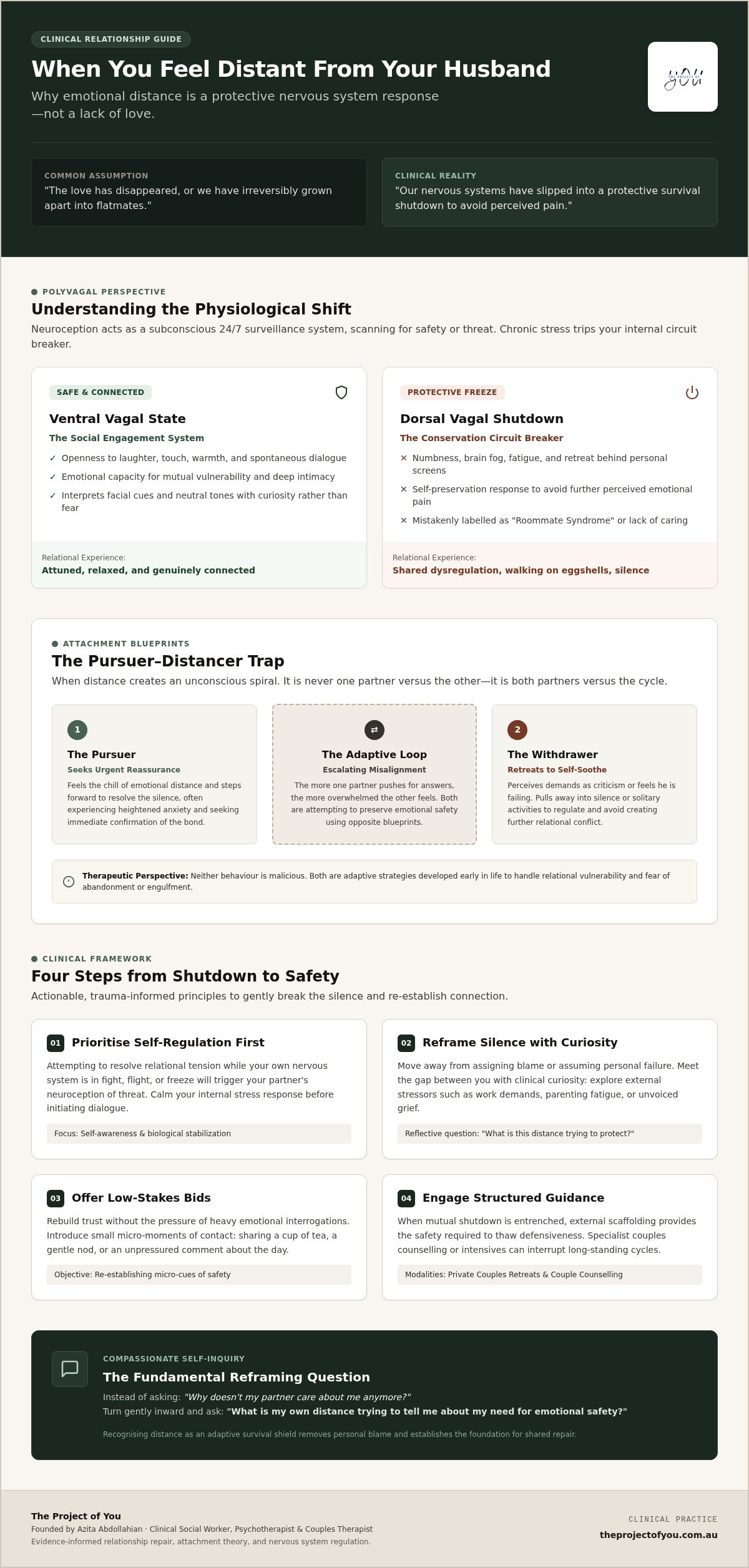
Your nervous system acts like a 24/7 surveillance system, constantly scanning your environment for signs of safety or threat. When life becomes overwhelming, your body may choose "distance" as a clever way to protect itself from perceived conflict or the sting of emotional rejection. We often label this "Roommate Syndrome", viewing it as a lack of effort or a loss of interest. From a physiological lens, however, it is actually a state of shared dysregulation. You aren't simply being "lazy" about your connection; your bodies may be too tired or too guarded to engage in the vulnerability that intimacy requires.
The Polyvagal Lens: Why Your Body Shuts Down
In Polyvagal Theory, we speak about the "Ventral Vagal" state, which is our home base for social connection, warmth, and playfulness. When we feel safe, we can easily access our "social engagement system" to laugh, talk, and touch. However, if chronic stress or unresolved tension builds up, our system might slip into a "Dorsal Vagal" state. This is a withdrawal response, often felt as numbness, brain fog, or a desire to hide behind a screen. It is like a circuit breaker tripping to prevent an electrical fire; your body shuts down to conserve energy and avoid further pain.
Neuroception is the subconscious process through which our nervous system scans the environment for cues of safety or peril without our conscious mind being involved. If your neuroception registers a "threat", such as a sharp tone or a cold shoulder, it might trigger a withdrawal to keep you safe. This is why understanding adult attachment styles is so helpful, as it explains why one partner might pursue for connection while the other shuts down to find safety.
Reframing Disconnection as a Signal, Not a Sentence
Instead of judging the silence in your home, I invite you to meet it with curiosity. Disconnection is a signal, not a life sentence. It is often the result of "threats" to intimacy that have nothing to do with your husband's character or your own, such as the relentless grind of work stress, the physical exhaustion of parenting, or the quiet weight of unresolved grief. If you feel stuck in this shutdown, specialised couple counselling can provide the structure needed to begin the thaw.
When you are wondering what to do when you feel distant from your husband, start by asking yourself this reflective question: "What is my distance trying to tell me about my need for safety?" Recognising that your body is trying to protect you can help you move from a place of blame toward a shared project of repair and reconnection.
The Role of Attachment Styles in Creating Emotional Gaps
Attachment styles act as a subconscious blueprint for our relationships, often formed in the early years of our lives. When you are wondering what to do when you feel distant from your husband, it's helpful to view your interactions through this lens. These patterns aren't fixed identities; they are adaptive strategies for connection that we developed to navigate our world. Even when a behaviour feels like it's pushing a partner away, it usually stems from a deep-seated desire to protect the self or preserve the bond in the only way the person knows how.
When One Pursues and the Other Withdraws
This dynamic is often called the "Anxious-Avoidant Trap". One partner, feeling the chill of distance, moves toward the other to seek reassurance. This "pursuer" often feels an urgent need to resolve the silence. In response, the "withdrawer" feels overwhelmed or criticised, retreating further to self-soothe. If your husband pulls away, it might be because he feels he is failing you and doesn't know how to fix it. Shifting your perspective is vital. It isn't you versus him; it's both of you versus the cycle. By focusing on healthy relationship strategies, you can begin to identify these moments before they spiral into total shutdown.
Identifying Your Own Attachment Needs
Rebuilding closeness requires a gentle look at your own triggers. What specific moments make you feel the most disconnected? Recognising these patterns allows you to move toward "earned secure attachment". This is the process of developing a sense of internal safety that wasn't present in childhood, often achieved through self-awareness and dedicated support. You can explore more about attachment based therapy Australia to see how these old blueprints can be rewritten.
When you feel stuck and aren't sure what to do when you feel distant from your husband, looking inward can be a powerful place to start. Understanding the "why" behind the gap is the first step toward closing it. If you're ready to explore these patterns in a safe, guided space, you might find that starting your journey of self-discovery provides the clarity you need to move forward with hope.
Regulating Your Own Nervous System First
If you are searching for what to do when you feel distant from your husband, the most effective starting point isn't a conversation with him, but a check-in with yourself. We often try to bridge the gap while our own nervous system is in a state of high alert or total shutdown. In therapy, we call the shared dance of calming each other "co-regulation". However, you cannot co-regulate with another person if you haven't first achieved self-regulation. When your body is in survival mode, your brain perceives even neutral comments as attacks, making genuine connection impossible.
To shift your system into a state of receptivity, try the "physiological sigh". Take a deep breath in through your nose, followed by a second short "sip" of air at the top, then a long, slow exhale through your mouth. This simple act signals to your brain that the immediate danger has passed. You might also try sensory grounding: find five things you can see, four you can touch, three you can hear, two you can smell, and one you can taste. These tools help you anchor back into the present moment, moving you away from the "all or nothing" thinking that often accompanies relationship distress.
Moving from "Survival" to "Safety"
Start by identifying where that distance lives in your body. Does it feel like a tight band around your chest or numb, heavy limbs? Learning how to regulate nervous system responses involves making small, intentional choices throughout your day. I often suggest the "cup of tea" approach. This isn't just about the drink; it's about the warmth in your hands and the rhythmic steam, which act as gentle signals of safety to your brain. By lowering your internal alarm, you create space for a different kind of interaction.
The Power of Somatic Awareness
Somatic awareness goes beyond traditional talk therapy by addressing the physical sensations of stress. The body keeps the score of every tense dinner and every silent car ride. Before you attempt to use communication tips for couples, find micro-moments of calm. This might be a thirty-second pause in the hallway or a deep breath before opening the front door. This long-term path of Nervous System Restoration allows you to respond from a place of clarity rather than reactivity. When you understand what to do when you feel distant from your husband, you realise that your own peace is the foundation for his.
Creating Emotional Safety: Small Steps Toward Reconnection
Emotional safety is the quiet, steady confidence that you can be your authentic self without fear of judgment or rejection. It is the invisible container that holds a marriage together. When this safety is present, vulnerability feels possible. When it is missing, your nervous system remains on guard, and you both retreat into the protective shells of the "roommate syndrome" we discussed earlier. If you are wondering what to do when you feel distant from your husband, the path back starts with lowering the drawbridge through small, intentional acts of warmth.
Reconnection doesn't require a grand gesture or a dramatic overhaul of your life. Instead, it relies on what the Gottman Institute calls "bids for connection". These are the tiny building blocks of intimacy that happen every day. A bid is any attempt for attention, affirmation, or affection. It could be as simple as a sigh, a comment about the sunset, or a brief touch on the arm as you pass each other in the kitchen. How we respond to these moments determines the temperature of the relationship.
Recognising and Responding to Bids
Every time your husband makes a bid, you have a choice. You can turn toward him by acknowledging the bid, turn away by ignoring it, or turn against him by responding with irritability. Turning toward is a powerful way to signal safety. It tells his nervous system, "I see you, and you matter to me." Even if you are busy, a simple "That's interesting, tell me more later" can prevent a sense of rejection. I invite you to try a practical exercise: spend just one day purely looking for your husband's bids. You might be surprised at how often he is reaching out in his own quiet way.
Communicating Your Needs with Compassion
When you feel the weight of distance, it is natural to want to "protest" for connection. However, this often comes out as criticism, such as "You never talk to me" or "You're always on your phone." These "harsh start-ups" almost always trigger a defensive withdrawal. Instead, try a "softened start-up" by using "I" statements. Focus on your own experience. "I've been feeling a bit lonely lately and I'm missing our chats" is much easier for a partner to hear than a list of their faults. Curiosity is another vital tool. Asking "What has life been like for you lately?" invites him back into the conversation without the pressure of an interrogation. If you find yourselves stuck in the same circular arguments, seeking couples counselling can help you learn to speak the same emotional language again.
Moving Forward Together: When to Seek Professional Guidance
While self-regulation and small bids for connection are vital tools, there are times when the emotional chasm feels too vast to cross without a guide. If you have been searching for what to do when you feel distant from your husband but find yourselves trapped in a cycle of total silence, chronic resentment, or the painful aftermath of infidelity, professional support isn't a sign of failure. It is a brave commitment to the relationship. Recognising that some patterns are too deeply ingrained to untangle alone is the first step toward a new way of being together.
Distance is a crossroads, not a dead end. It signals that your current way of relating has reached its limit and that you both deserve a new map for your journey. Seeking help allows you to move from a place of survival and isolation toward a shared project of repair, where both partners feel safe enough to be vulnerable again.
The Benefits of Intensive Support
For many couples, the standard 50-minute weekly session can feel like just as they are getting to the heart of the matter, the clock runs out. This is why a Private Couples Retreat can be so transformative. These intensives provide a neutral, trauma-informed space where you can share the "unspeakable"—those hidden hurts or fears that usually trigger a nervous system shutdown. By dedicating several days to the process, you bypass the inertia of daily life and create a container for deep, focused healing. Integrating Nervous System Restoration into this process ensures that you aren't just talking about your problems; you are actively training your bodies to feel safe in each other's presence once more.
Taking the First Step Toward Repair
Initiating a conversation about therapy often feels daunting. You might worry that your husband will see it as an attack or a final warning. Instead, try framing the suggestion as an act of love and value. You might say: "I've been feeling quite distant from you lately, and I value us too much to stay this far apart. I'd love for us to explore some professional support together so we can find our way back to the closeness we used to have." This approach moves away from blame and invites him into a partnership of growth. When you are ready to begin this work, you don't have to carry the weight alone.
[Book an initial consultation to explore your path back to each other.Finding Your Way Back to Closeness
Reclaiming the intimacy you once shared is a journey that begins with a single, gentle step. We've explored how the silence in your home is often your body's way of seeking safety, rather than a sign that your love has failed. By understanding your attachment needs and prioritising your own nervous system regulation, you create the emotional space needed for a genuine thaw. Knowing what to do when you feel distant from your husband empowers you to move from the isolation of "roommate syndrome" toward a marriage where you both feel seen and understood.Led by Azita Abdollahian, an experienced Clinical Social Worker and Psychotherapist, our practice offers evidence-based Gottman and Attachment-informed methods. We provide a nurturing, safe environment for complex relationship healing. You don't have to navigate this transition alone.Explore our Private Couples Retreats for a deep path back to connection](https://www.theprojectofyou.com.au/book-online) There is always hope for a calmer home and a deeper, more resilient bond. By meeting this distance with curiosity instead of judgement, you open the door to a future defined by belonging and genuine emotional ease.
Frequently Asked Questions
Is it normal to feel distant from my husband after having children?
It is entirely normal to feel a shift in closeness after children arrive. Your nervous systems are often in a state of high alert, prioritising the safety and needs of a vulnerable infant over romantic connection. This survival mode can leave both partners feeling touched out and emotionally drained. Reconnecting requires moving from purely functional co-parenting back into a space of shared play and rest where you can see each other as partners again.
Can a marriage survive if we have been distant for years?
Many marriages survive and even thrive after years of emotional distance. If you are wondering what to do when you feel distant from your husband for a long period, recognise that this gap is often a protective habit of the nervous system rather than a loss of love. While the path back may require more intensive support, such as a Private Couples Retreat, the capacity for repair is often much higher than it feels when you are in the thick of the silence.
How do I tell my husband I feel distant without starting a fight?
The key is to use a softened start-up that focuses on your own feelings rather than his perceived failures. Instead of saying "You never spend time with me", try saying "I've been feeling a bit lonely lately and I'm missing our connection." This invites him into a conversation rather than triggering a defensive fight or flight response. Choosing a time when you are both relatively calm and regulated makes it far more likely that he will hear your heart.
What if I am the only one trying to bridge the distance?
It is common for one partner to lead the repair process, and this can still be highly effective. When you change your own steps in the relationship dance by regulating your nervous system or responding differently to conflict, the other person is often forced to shift their response too. However, if you feel consistently alone in the effort, it may be time to suggest professional support to explore the underlying attachment blocks and emotional safety needs together.
How long does it take to feel close again after a period of disconnection?
There is no set timeline for reconnection, as every relationship has its own unique rhythm of repair. For some, small daily shifts in communication can bring warmth back within weeks. For others with deep-seated distance, it may take months of intentional work and possibly an intensive retreat to feel a consistent sense of safety. The goal is not a quick fix but a sustainable restoration of your emotional bond through steady, compassionate practice.
Is distance a sign that we are no longer compatible?
Distance is rarely a sign of incompatibility; it is usually a sign of dysregulation. When you are wondering what to do when you feel distant from your husband, it is helpful to remember that most conflict is perpetual and rooted in personality differences. These differences only become deal-breakers when the relationship lacks emotional safety. Once you both feel secure and understood, those same differences often become manageable or even complementary parts of your shared life together.
How does my own childhood trauma affect my marriage today?
Your childhood experiences create the blueprint for how you handle closeness and conflict today. If you grew up in an environment where emotions were unsafe or unpredictable, your nervous system might automatically shut down as an adult when relationship tension rises. Recognising these old survival strategies allows you to move toward earned secure attachment. Specialised trauma-informed therapy can help you untangle these past wounds from your current marital interactions, allowing for deeper healing and connection.


Comments