.png)

Feeling Disconnected from Your Partner: A Guide to Reclaiming Intimacy

Disconnection and reconnection are a natural ebb and flow in relationships, but what if the heavy silence growing between you isn't actually a sign that the love has disappeared, but rather a signal that your nervous systems have moved into a state of self-protection? It's a painful paradox to be sitting on the same lounge, perhaps even brushing shoulders, while feeling disconnected from partner and wondering where the person you once knew has gone. You might feel a profound sense of loneliness or an aching anxiety about what this distance means for the future of your relationship.
At The Project of You | Trauma, Couples & Relationship Therapy Australia, we understand that this drift is often a protective response rather than a permanent fracture. In this guide, we will explore the biological roots of emotional distance and the "roommate phase" that many Australian couples experience. Through Azita Abdollahian's expertise in healing and trauma recovery, you'll learn evidence-based somatic and emotional strategies designed to lower defensiveness and soften the edges of conflict. By understanding the root causes of the gap, you can begin to build a bridge back to one another with curiosity and hope, reclaiming the intimacy that currently feels just out of reach.
Table of Contents
Understanding the "Roommate Phase": What Feeling Disconnected Actually Means
The "roommate phase" is a term many Australian couples use to describe the unsettling feeling that they've become mere co-habitants rather than lovers. It's often characterised by a heavy sense of emotional withdrawal. You might still care deeply for one another, yet the warmth has been replaced by a functional, almost clinical, efficiency. This isn't necessarily a sign that the love has died. Instead, it's frequently a signal that you've stopped prioritising the emotional currency of your relationship. When you find yourself feeling disconnected from partner, it's easy to assume the relationship is failing, but often it is simply a sign that the connection needs a new map.
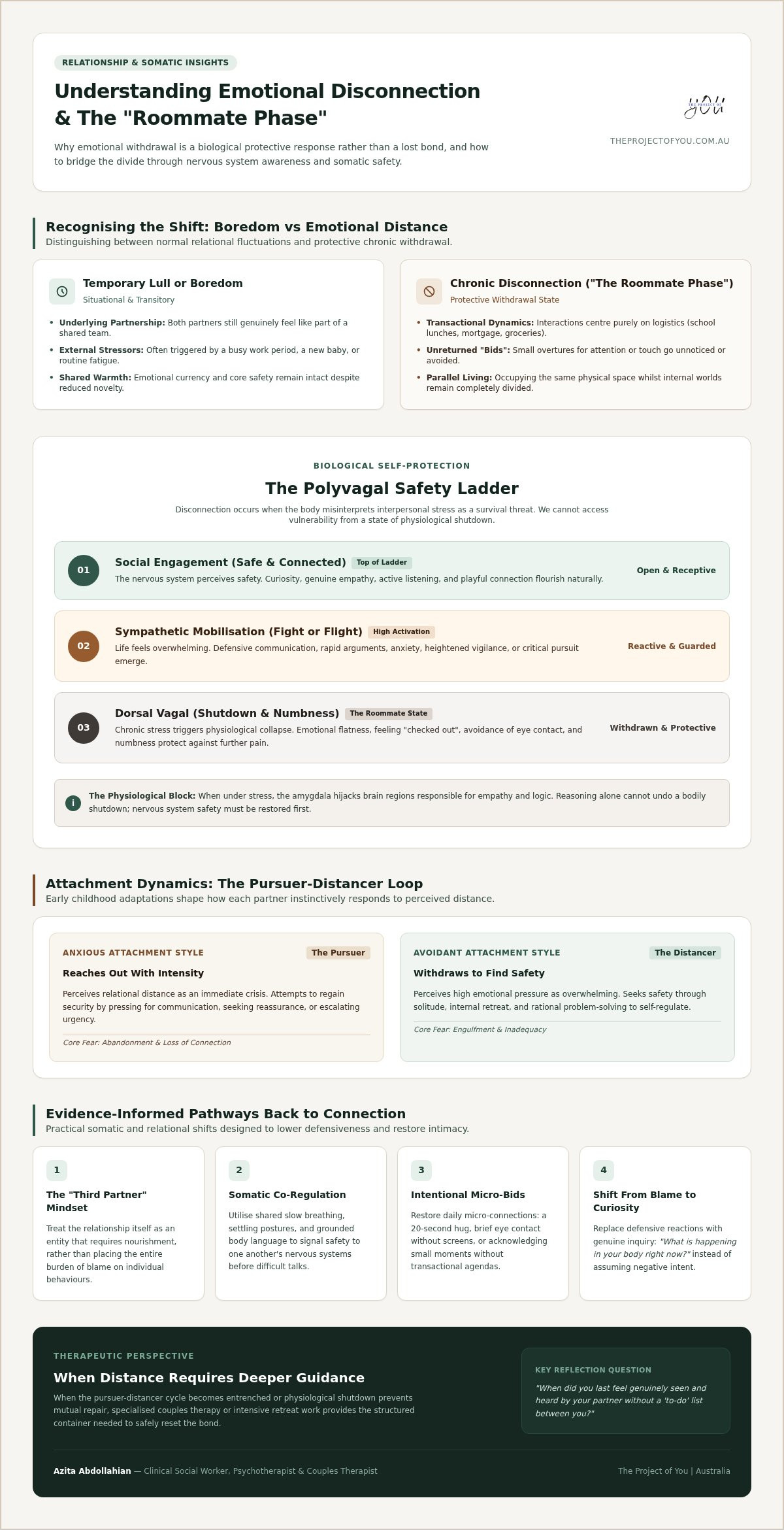
It's vital to distinguish between a temporary lull, perhaps caused by a stressful period at work or a new baby, and a chronic state of feeling disconnected from partner. In a temporary lull, you still feel like a team. In chronic disconnection, the communication becomes purely transactional. You talk about school lunches, the mortgage, or the grocery list, but you avoid eye contact and stop making "bids" for attention. These bids are the small attempts we make to connect, like sharing a funny thought or asking for a hug. When these go unreturned, the distance widens.
Please know that you aren't alone in this. Many couples across Australia move through natural cycles of connection and distance. The goal isn't to have a perfect, unchanging bond. It's about developing the awareness to notice when the drift has become too wide to bridge without intentional effort. Recognising the shift is the first step toward repair.
Is it Boredom or Emotional Distance?
There's a significant difference between the natural loss of "newness" in long-term intimate relationships and a genuine loss of emotional safety. Boredom often means you need a new hobby or a weekend away. Emotional distance, however, feels like you're living parallel lives. You might be in the same room, but your internal worlds are miles apart. This often happens in busy households where the "doing" of life takes precedence over the "being" with each other. Reflect for a moment: When did you last feel genuinely seen or heard by your partner without a "to-do" list between you?
The Impact of Attachment Styles
Our early experiences often dictate how we handle distance as adults. If one of you has an anxious attachment style and the other is more avoidant, you might find yourselves stuck in a "pursuer-distancer" loop. One person reaches out more intensely when they feel a gap, while the other pulls away to find safety in solitude. These patterns are rarely about the present moment; they are echoes of how we learned to seek security as children. Understanding these dynamics is a core part of exploring your history through our blog and resources, helping you move from frustration to a shared curiosity about why you both react the way you do.
The Science of Safety: Why Your Nervous System Shuts Down
Imagine your nervous system as a ladder. At the top, you're in a state of "social engagement" where you feel safe, curious, and connected. When life feels overwhelming, you might slide down into fight-or-flight. But if the stress becomes chronic, you may drop to the very bottom: the "Dorsal Vagal" state. This is where your body chooses to shut down to protect you from perceived pain. When you are feeling disconnected from partner, you aren't usually choosing to be cold. Instead, your nervous system has likely moved into this numb, "checked out" state because it no longer feels entirely safe to stay open and vulnerable.
Your body is incredibly wise, but it can be overprotective. It often misinterprets relationship conflict, such as a partner’s withdrawal or a sharp remark, as a literal threat to your physical survival. This physiological response is why Nervous System Restoration is the essential foundation for any lasting intimacy. We cannot expect to feel close to someone while our internal alarm system is screaming for us to hide or retreat.
When "Talk Therapy" Is Not Enough
You cannot reason your way out of a physiological shutdown. When you're in a state of high distress, the amygdala effectively hijacks the parts of your brain responsible for empathy and logic. This makes it almost impossible to "hear" your partner’s perspective or offer a soft response. Neuroception is the body’s subconscious surveillance system that constantly scans your partner’s tone, posture, and facial expressions for cues of safety or danger.
The Role of Trauma in Disconnection
If you have a history of betrayal trauma or childhood experiences where your needs weren't met, current moments of feeling disconnected from partner can feel like an emergency. Past wounds act like a lens that magnifies present distance. Clinical research confirms that emotional safety is the primary predictor of relationship stability and longevity. Beyond emotional comfort, the health benefits of strong relationships are profound, impacting everything from your immune system to your cardiovascular health. If your system has been stuck in survival mode, you might consider how to begin a supported journey toward regulation and repair.
Breaking the Pattern: Moving from Blame to Curiosity
When you are feeling disconnected from partner, the mind often defaults to a place of blame. It feels safer to point at their flaws or withdrawals than to sit with the raw ache of loneliness. However, blame acts as a reinforced wall rather than a window. What if you viewed your relationship as "The Third Partner"? This is a separate entity that exists between you, requiring its own unique nourishment and care. By shifting the focus from "what you are doing wrong" to "how can we support the relationship", you move back into a space of partnership. Curiosity is the essential tool for this transition. Instead of asking "Why are you doing this?", which often feels like an interrogation, try asking "What is happening for you right now?". This simple shift invites your partner to share their internal world rather than defending it.
To reduce the immediate defensiveness that often blocks connection, we can use "softened start-ups". This clinical technique involves starting a conversation with a gentle tone and focusing on your own feelings rather than your partner's perceived failures. It is the difference between saying "You never listen to me" and "I've been feeling a bit lonely lately and I'd love to just sit and chat with you." This approach signals safety to the other person's nervous system, preventing the shutdown described earlier.
Identifying Destructive Communication Patterns
Psychological research has identified four specific communication patterns that can predict the breakdown of a bond. You might recognise these in a typical kitchen-bench conversation at the end of a long day. Criticism sounds like, "You're so selfish, you always forget to pick up the milk." Contempt is more corrosive, perhaps a sarcastic comment or an eye-roll that suggests you feel superior to your partner. Defensiveness often follows, such as, "I only forgot because you didn't remind me and I'm exhausted." Finally, stonewalling occurs when one person simply shuts down, looks at their phone, or walks away. Spotting these signs early allows you to pause and choose a more regulated path before the feeling disconnected from partner becomes a permanent state.
The Power of Vulnerability and Emotional Intimacy
Vulnerability is the bridge that allows you to cross the gap created by emotional distance. It is the act of showing your true self, including the parts that feel messy or "not enough". For a dysregulated nervous system, being vulnerable can feel incredibly dangerous. If your body is stuck in a protective state, sharing your heart feels like lowering your shield in the middle of a battle. Yet, intimacy cannot exist without this risk. It requires a slow, intentional process of building enough safety to be seen again. Reflect for a moment on this: What is the one thing you are afraid to tell your partner right now?
Somatic Strategies: Practical Ways to Reconnect Today
While communication tools are helpful, sometimes the distance feels too wide for words alone. When you find yourself feeling disconnected from partner, your body often enters a state of "functional freeze" before your mind can even process the rift. This is where somatic strategies become powerful. They bypass the analytical brain and speak directly to the nervous system. By focusing on physical sensations and shared presence, you can begin to melt the icy wall that words sometimes fail to penetrate.
One of the most profound tools for repair is co-regulation. This is the process where one person's calm nervous system helps to settle the other's distress. It's not about fixing their problem, but rather offering a steady, grounded presence that signals safety to their body. When one partner remains regulated, it creates an invitation for the other to step out of survival mode and back into connection.
Consider the simple power of a 20-second hug. This duration is the "sweet spot" required for your body to release oxytocin, a hormone that lowers blood pressure and reduces cortisol. It allows both bodies to physically realise they are safe in each other's arms. Similarly, micro-connections, those 30-second moments of shared attention, act as essential maintenance for your bond. Eye-gazing exercises can also build a tolerance for intimacy without the pressure of conversation. Try sitting comfortably and looking into each other's eyes for just one minute. It may feel vulnerable or even awkward at first, but it signals to your system that you are present and safe.
Daily Rituals of Connection
Creating small, predictable rituals provides a sense of emotional structure. Instead of an interrogation like "How was your day?", try a gentle emotional check-in: "How is your heart feeling today?". These moments work best when you practise "turning towards" small bids for connection. If your partner points out something in the garden or mentions a news story, they are inviting you into their world. Validating those small moments builds the bridge back to intimacy. A 10-minute "no-device" zone each evening allows space for these bids to be heard without digital noise.
Using Somatic Awareness to Lower Defensiveness
Before you can connect with your partner, you must connect with yourself. Start noticing your body signals when you feel the distance growing. Is your heart racing? Is your jaw tight? These are signs of dysregulation. You can use self-soothing techniques like the "butterfly hug", where you cross your arms and tap your shoulders rhythmically, or deep belly breathing to settle your own system. Learning to navigate these internal states is a skill you can refine through our Self Love E-books. When you are regulated, you are far more capable of reaching out with kindness rather than reacting from fear.
When to Seek Professional Support for Your Relationship
There are moments in every long-term partnership where the tools you have simply don't feel like enough. You might find yourself feeling disconnected from partner even after trying to implement new communication habits or somatic exercises. This doesn't mean your relationship is beyond repair. Instead, it often indicates that the patterns of withdrawal or conflict have become "stuck" in your physiological responses. When disconnection becomes chronic, the support of a trauma-informed therapist can provide the map you need to find each other again. This outside perspective is invaluable for identifying the subtle, subconscious ways your nervous systems are triggering one another into self-protection.
It can be helpful to recognise the signs that your relationship has reached a point where external support is the most compassionate choice:
You have tried various self-help strategies but continue to repeat the same painful cycles.
The sense of loneliness persists even when you are physically together in the same room.
One or both of you feels a growing sense of hopelessness or anxiety about the future of the bond.
The "roommate phase" has shifted from a temporary lull into a permanent, defensive way of living.
There is a beautiful possibility that lies on the other side of this struggle. Many couples who commit to the process of repair find that their "second relationship" with the same person is far stronger than the first. This new version of your bond is built on a foundation of genuine self-awareness and mutual regulation. It's a journey from surviving together to truly thriving together, where the distance you feel now becomes the catalyst for a deeper, more resilient intimacy.
The Difference Between Counselling and Retreats
While traditional weekly sessions are a wonderful way to maintain relationship health, some deep-seated attachment issues benefit from a more immersive experience. A Private Couples Retreat offers a dedicated space away from the triggers of your daily environment. In a standard hour of therapy, you might just be reaching a point of vulnerability when the session ends. Retreats allow you to stay in that space of connection for days at a time, providing a powerful circuit breaker for years of distance. This safe, neutral environment is essential for navigating difficult conversations without the usual pressure of home life.
Taking the First Step Toward Healing
If you're considering professional support but feel unsure how to approach a hesitant partner, remember that curiosity is your best ally. Frame the suggestion as a commitment to your shared future rather than a list of what's going wrong. It's also vital to select a practitioner who understands Nervous System Restoration. This ensures your therapy addresses the biological roots of feeling disconnected from partner rather than just the surface-level symptoms. If you're ready to explore how we can help you reclaim your intimacy, I invite you to take that first step today.
Book a discovery call with Azita to explore how we can support your journey.
Finding Your Way Back to Each Other
The journey from feeling disconnected from partner to a state of secure intimacy is not a straight line, but it is a path you can navigate with the right map. By recognising that withdrawal is often a protective response from your nervous system, you can stop the cycle of blame and begin to prioritise emotional safety. Small, somatic practices like co-regulation and intentional "turning towards" each other act as the building blocks for a more resilient partnership.
Led by Azita Abdollahian, a Clinical Social Worker and Psychotherapist, our trauma-informed and evidence-based clinical approach focuses on long-term Nervous System Restoration. We understand that your relationship is a living entity that deserves dedicated care and professional expertise to thrive once more. It's possible to move past immediate obstacles and see the inherent potential within your bond.
You don't have to carry the weight of this loneliness alone. There is a version of your relationship waiting to be discovered that is deeper and more honest than the one you knew before. We are here to help you find your way back to one another with grace.
Frequently Asked Questions
Is it normal to feel disconnected from my partner after many years?
It is entirely normal to experience periods of drift in long-term relationships. These cycles often reflect the natural ebb and flow of life's demands, such as parenting or career stress. Rather than viewing this as a failure, consider it a signal that your relationship needs a little more nourishment. When you understand that distance is often a protective response, you can begin to navigate your way back to each other with more compassion.
Can a relationship survive if one partner has totally checked out?
Survival is possible if you can shift from blame to curiosity about the "checked out" state. Often, what looks like total indifference is actually a nervous system in a "Dorsal Vagal" shutdown, which is a biological way of coping with chronic stress. Reclaiming intimacy starts by creating enough safety for that partner to slowly emerge from their protective shell. It requires patience and often the guided support of a trauma-informed therapist.
How do I tell my partner I feel disconnected without starting a fight?
The key is to use a "softened start-up" that focuses on your internal experience rather than their behaviour. Try saying, "I've been feeling a bit lonely lately and I'm missing our connection," instead of accusing them of being distant. This invites your partner to hear your heart without feeling the need to defend themselves. It creates a space where curiosity can replace the usual defensive walls that lead to conflict.
What is the difference between a rough patch and the end of a relationship?
A rough patch is usually a temporary state where you still share a common goal, even if the path feels rocky. You might be feeling disconnected from partner, but the fundamental desire to repair remains. A relationship is often at its end when contempt becomes the primary language and one or both partners refuse to engage in any form of repair. If there is still a spark of curiosity, there is always hope.
How long does it typically take to reconnect after a long period of distance?
There is no set timeline for reconnection because every couple's journey is unique. Some find that a "circuit breaker" like a private retreat can fast-track the process by providing concentrated time for somatic healing. For others, it involves a slower integration of daily rituals and emotional check-ins. The focus should be on the quality of the connection you are building rather than how quickly you can reach a specific destination.
Does feeling disconnected always mean someone has been unfaithful?
Disconnection is rarely a direct indicator of infidelity. While a breach of trust can certainly cause a rift, many couples find themselves feeling disconnected from partner simply because their nervous systems have moved into a state of self-protection or "functional freeze." Busy schedules, unresolved grief, or past trauma are much more common culprits. It is important to explore the distance with curiosity before jumping to conclusions that might create further defensiveness.
Can individual therapy help if my partner refuses to go to couples counselling?
Individual therapy is a powerful tool for relationship change because you are part of an interconnected system. When you learn to regulate your own nervous system and understand your attachment style, you naturally change the way you interact with your partner. This shift can often invite a "distancing" partner to feel safer. It potentially opens the door for them to join you in couples counselling or a relationship intensive later on.
What is the "pursuer-distancer" dynamic and how do we stop it?
This dynamic is a common attachment loop where one partner pursues for reassurance while the other withdraws to find safety. To stop it, you must both recognise the pattern as the problem rather than blaming each other. When the pursuer can learn to self-soothe and the distancer can share their need for space gently, the cycle begins to soften. It is about moving from a place of fear into a shared space of safety.


Comments