.png)

Healing the Anxious Heart: A Compassionate Guide to Anxious Attachment Therapy
- Azita Abdollahian

- 4 hours ago
- 13 min read
Anxious Attachment Therapy: Understanding Your Need for Reassurance and Connection
What is anxious attachment, and why can it make relationships feel so emotionally exhausting?
If you find yourself constantly worrying that your partner will leave, checking your phone for messages, needing frequent reassurance, overthinking changes in their behaviour, or feeling a tightness in your chest when you sense distance, you may be experiencing an anxious attachment style. These reactions are not a sign that you are “too needy,” “too much,” or difficult to love. They can be deeply connected to the way your nervous system learned to respond to uncertainty, disconnection and perceived rejection.
Anxious attachment is a relational pattern often characterised by a strong fear of abandonment, heightened sensitivity to changes in connection, and a persistent need for reassurance. For some people, these patterns develop through childhood experiences where love, attention or emotional safety felt inconsistent, unpredictable or difficult to access. Over time, the nervous system can learn to stay alert for signs that connection may be lost.
At The Project Of You, Azita Abdollahian approaches anxious attachment through a trauma-informed, relationship-focused lens. Anxious attachment therapy is not about fixing something that is wrong with you. It is about understanding the experiences and protective patterns behind your reactions, developing greater emotional regulation, and learning how to create healthier and more secure relationships.
Through therapy, you can begin to recognise your attachment triggers without shame, understand why your body reacts so strongly to perceived disconnection, communicate your needs more effectively, establish healthy boundaries, and develop a greater sense of security within yourself.
The goal isn't to stop needing people or become completely independent. Secure attachment means being able to experience closeness without losing yourself and experience space without automatically interpreting it as rejection or abandonment.
In this guide, we’ll explore what anxious attachment is, what causes it, the common signs and relationship patterns to look for, and evidence-based strategies that can help you move towards greater emotional and relational security.
If you've spent years feeling untethered in your relationships, there is another way. You can learn to feel safer in connection, more grounded within yourself, and more secure in love.
Table of Contents
Understanding the 'Anxious Heart': What is Anxious Attachment?
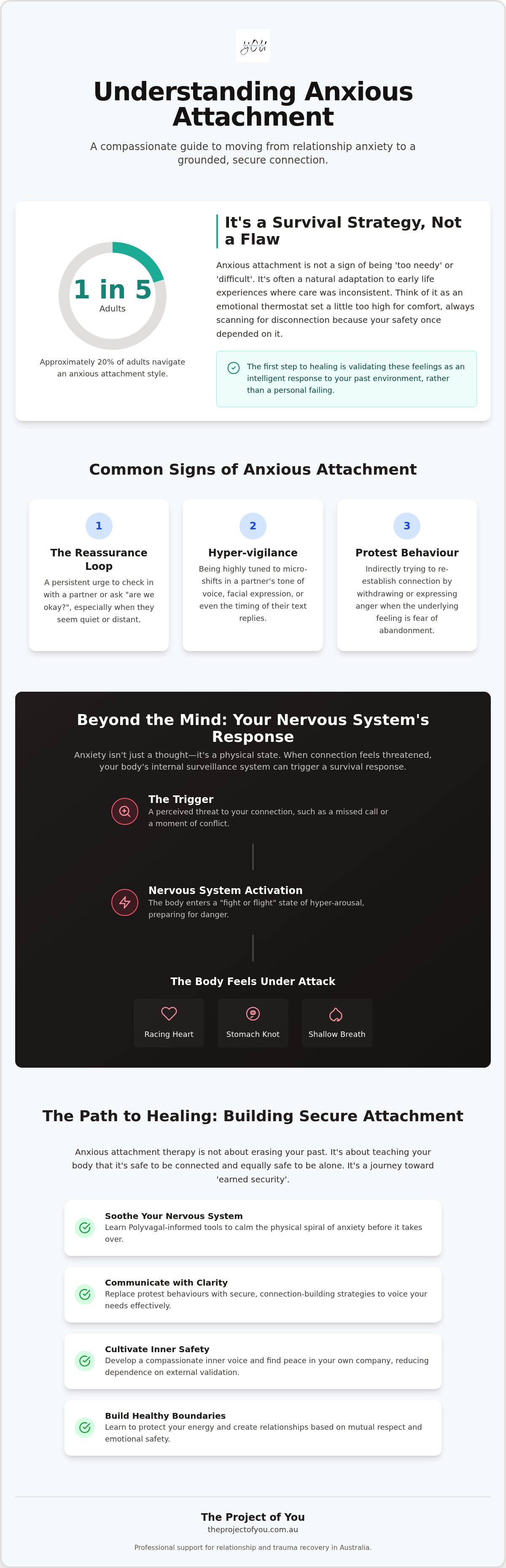
What if the way you love isn't a mistake, but a masterpiece of survival? Many people who seek anxious attachment therapy arrive feeling burdened by a sense of being "too much" or "too needy." In reality, what we call anxious attachment is often a natural adaptation to early environments where care was inconsistent. Think of it as having an emotional thermostat set a few degrees too high. Your system is exceptionally good at detecting shifts in connection because, at one point, your safety depended on it. Research into Attachment in adults suggests that these patterns aren't fixed character traits; they are learned strategies for seeking proximity and protection.
There is a profound difference between being "needy" and having a healthy, human longing for connection. We are social creatures. Our nervous systems are designed to co-regulate with others. When that longing feels frantic or painful, it's usually because your internal alarm system is trying to protect you from the grief of disconnection. Approximately 20% of adults navigate this style of relating. Validating these feelings as a survival strategy, rather than a character flaw, is the first step toward finding peace.
Common Signs You Might Be Navigating Anxious Attachment
Living with an anxious heart often means your internal radar is always scanning for "drifts" in the relationship. You might recognise these common experiences:
The Reassurance Loop: Feeling a persistent urge to check in or ask if everything is okay, especially when a partner seems quiet or preoccupied.
Hyper-vigilance: Being highly tuned to micro-shifts in a partner's tone of voice, facial expressions, or the speed of their text replies.
Protest Behaviour: Attempting to re-establish connection through indirect means. This might look like withdrawing to see if they notice, or expressing anger when what you actually feel is a deep fear of being left.
The Origins of Insecurity: How Our Early Years Shape Our Adult Love
These patterns usually take root in childhood through an experience called inconsistent caregiving. This is the "sometimes there, sometimes not" dynamic. When a caregiver is occasionally warm and responsive but at other times distracted or unavailable, a child learns they cannot rest. They learn to "turn up the volume" on their needs to ensure they aren't forgotten. It's an exhausting way to live, but it was an intelligent response to their environment at the time.
At The Project of You, Azita Abdollahian invites you to view your younger self with deep compassion. That child wasn't difficult; they were simply trying to stay connected in the only way they knew how. By understanding these origins, we can begin to turn down the thermostat and build a sense of safety from the inside out.
Beyond the Mind: How Anxious Attachment Lives in Your Nervous System
Have you ever noticed that when a conflict starts, your brain seems to go offline? You might know logically that your partner isn't leaving, but your body is screaming otherwise. This is the core of why anxious attachment therapy must go deeper than just changing your thoughts. It requires a shift in your physiology. To find lasting peace, we have to look at the nervous system and how it stores the memory of past insecurities.
Polyvagal Theory is essentially the science of feeling safe in your own skin. It explains that our bodies have an internal surveillance system that is constantly scanning for cues of danger or safety. For those with an anxious heart, this system is often stuck in a state of hyper-arousal. This is the physical engine behind the anxious "spiral." It is not a lack of willpower; it's a body that is working too hard to keep you safe.
The Survival Response: Why Your Body Feels 'Under Attack' During Conflict
When you perceive a threat to your connection, your body enters a "fight or flight" response. Your heart races, your breath becomes shallow, and you might feel a hollow "void" or a knot in your stomach. It feels like a physical attack because, to your primal nervous system, the threat of social isolation is a threat to survival itself. This reaction is often an echo of past experiences. You can learn more about How Trauma Dysregulates Your Nervous System to understand why these triggers feel so intense and overwhelming in the present moment.
Bottom-Up vs. Top-Down Healing: Why You Need Both
Most traditional approaches use "Top-Down" healing. This involves using the mind to influence the body, much like standard talk therapy or CBT. While these are valuable tools, they often fail when the body feels under threat. When your survival brain takes over, the logical part of your brain actually shuts down to save energy. You can't "think" your way out of a panic response that has already gripped your chest.
"Bottom-Up" healing starts with the body. By using somatic experiencing, neurofeedback, or breathwork, we calm the physical sensations first. This creates the space for the mind to eventually think more clearly and engage in Attachment-Based Therapy. At The Project of You, we prioritise Nervous System Restoration to help you return to a baseline of calm. If you feel ready to move beyond just talking and start healing from the body up, you might find it helpful to explore our therapeutic options.
Evidence-Informed Therapies for Healing Anxious Attachment
When we look at the landscape of anxious attachment therapy, we see a beautiful tapestry of methods designed to bring you home to yourself. Healing isn't a one-size-fits-all process. It requires a blend of approaches that honour both your mental patterns and your physical safety. In our work, we draw on several evidence-informed modalities to help you move from a place of chronic worry to one of steady confidence. These include:
Attachment-Based Therapy: This involves "re-parenting" the inner child. We look at the parts of you that felt untethered in the past and provide the consistent, compassionate witness you needed then.
The Gottman Method: This approach focuses on building a "Sound Relationship House." It provides practical tools for secure communication, helping you and your partner turn toward each other rather than away during moments of stress.
Cognitive Behavioural Therapy (CBT): CBT helps organise the mental clutter of catastrophic "what-ifs." By identifying the specific thoughts that trigger a spiral, we can reduce their power over your daily life.
Nervous System Restoration: At The Project of You, we anchor all our work in physiological regulation. We believe that for the mind to change, the body must first feel safe.
Building Earned Secure Attachment: Yes, Change is Possible
You might wonder if you're stuck with an anxious style forever. The answer is a hopeful no. Through consistent anxious attachment therapy, many people achieve what we call "Earned Secure Attachment." This means that even if you didn't start life with a secure base, you can build one within yourself as an adult. The therapeutic relationship acts as a training ground. Here, you experience a reliable, boundaried, and safe connection that models what is possible in your outside world. It's a journey of moving from a place of searching for safety to becoming your own source of it.
Specialised Approaches for Couples and Individuals
Individual therapy is often the first step in finding your own centre again. It's a space to explore your history without the immediate pressure of a partner's reactions. However, if you are currently in a relationship, Couples Counselling can be an incredibly powerful way to create a "we-space" of safety. In this setting, we focus on trauma-informed care to ensure that neither partner feels blamed or re-traumatised. We foster curiosity about the "dance" between you, helping both individuals express their needs without fear. Whether you choose individual work, intensives, or workshops, the goal remains the same: restoring a sense of agency and ease in your life.
Practical Strategies to Soothe Your System and Build Security
Moving from the understanding of your nervous system into the daily rhythm of life requires practical, gentle tools. When you engage in anxious attachment therapy, the goal isn't just to talk about your fears, but to build a toolbox of responses that work in the heat of the moment. Before we dive into specific techniques, take a moment to sit with these reflective questions:
What does safety feel like in my body right now?
If my anxiety had a voice, what is it trying to protect me from?
How might I respond to this fear if I were my own best friend?
What is one small thing I can do to anchor myself in this moment?
Somatic Grounding: Anchoring Yourself in the Present Moment
When the 'anxious spiral' starts, your brain is convinced you're in danger. Somatic grounding pulls you back to the 'here and now.' A powerful adaptation of the 5-4-3-2-1 technique involves naming five things you can see, four you can touch, three you can hear, two you can smell, and one thing you love about yourself. This shifts your focus from internal panic to external reality.
Deep, diaphragmatic breathing is another essential tool. By slowing your exhale, you send a direct signal to your Vagus nerve that the 'threat' has passed. For many, physical pressure like a weighted blanket or simply placing a hand on your heart can provide the sensory input your system needs to feel held. These aren't just distractions; they are biological signals of safety that help you regulate when your partner isn't available to help.
Reframing the Narrative: From 'I'm Needy' to 'I Value Connection'
Shame is a heavy weight that often accompanies anxious attachment. We often label ourselves as 'needy' or 'difficult,' but what if you reframed that? Instead of 'I'm needy,' try 'I am someone who deeply values connection and intimacy.' This shift removes the sting of judgement and allows you to express your needs with dignity. It's a small change in language that makes a massive difference in how you view your own heart.
Learning to use 'I' statements is a key part of anxious attachment therapy. Instead of saying 'You're ignoring me,' which often triggers a partner's defensiveness, try 'I’m feeling a bit disconnected right now, and I’d love a few minutes of your time.' This is the heart of co-regulation. It’s about asking for what you need without falling into 'protest behaviours' like anger or withdrawal. Similarly, setting boundaries isn't a threat to intimacy; it’s a tool for it. Saying 'no' when you're overwhelmed protects the relationship from resentment and ensures that when you do say 'yes,' it’s from a place of genuine security.
Book a session to begin your healing journey
Finding Your Path: Professional Support at The Project of You
Finding your way back to a sense of security is not a path you have to walk alone. At The Project of You, Azita Abdollahian brings a compassionate, expert-led approach to anxious attachment therapy, acting as a steady guide through the complexities of your inner world. As a Clinical Social Worker and neurofeedback trainer, Azita draws upon her deep expertise in clinical social work to blend rigorous evidence-informed practice with intuitive empathy. What if the support you’ve been searching for is simply waiting for you to take the first step? Whether through individual counselling or intensive workshops like 'The Healing Feminine,' our aim is to help you move through transitions with grace and restore the joy that comes from a regulated nervous system.
We believe in a collaborative journey of self-discovery. This means you are an active participant in your own development, supported by a practitioner who understands the neurobiological roots of your anxiety. By focusing on "bottom-up" healing, we help you create a foundation of physiological safety that allows your relationships to flourish. It's about moving past immediate obstacles to see the inherent potential within you, ensuring you feel heard, understood, and supported at every step of the process.
Why a Therapeutic Retreat Might Be Your Turning Point
Sometimes, the noise of daily life makes it difficult to hear the quiet signals of your own body. Stepping away from your usual triggers allows for a level of deep restoration that is often hard to achieve in hourly weekly sessions. Our Nervous System Retreats are designed to provide that exact space for reflection and repair. By immersing yourself in a trauma-informed environment, you can accelerate the healing of long-standing patterns and find a sense of stillness. There is also a unique power in community. Sharing this journey with others in our group workshops reminds you that your struggles don't make you "difficult"; they simply make you human.
Taking the Next Step: Counselling and Beyond
Choosing to seek support is an act of profound self-compassion. If you're wondering what to expect from your first session, imagine a space where you are truly heard, without judgement or clinical coldness. It’s a collaborative conversation where we begin to map out your specific path toward safety while navigating the complexities of anxious attachment therapy. For those who prefer to start at their own pace, our digital resources, such as our Self Love E-books, provide gentle guidance you can access from the comfort of home. When you feel ready to explore a more intentional way of living, we invite you to take that courageous next step.
Book Online
Your Path Toward Earned Security
What if you could finally rest in your relationships? We've explored how your anxious heart was shaped by an intelligent need for survival and how your nervous system holds the key to your restoration. By moving beyond just talking about your fears and instead focusing on physiological safety, you can begin to transform the way you connect. Anxious attachment therapy isn't just about managing symptoms. It's about building a lasting foundation of security that allows you to thrive.
Imagine a life where conflict doesn't send you into a physical spiral and where your worth isn't tied to a partner's immediate response. At The Project of You, Azita Abdollahian provides evidence-informed, trauma-sensitive care focused on nervous system restoration and trauma recovery. Our compassionate, non-judgemental Australian practice is here to walk alongside you. You have already begun the work by seeking to understand your heart with curiosity. You deserve to feel truly seen and safe.
Begin your journey to secure connection – Book a session with The Project of You today The journey toward earned security starts with a single step toward yourself. We look forward to supporting you as you create a life of ease and deep connection.
Frequently Asked Questions
What is the best therapy for anxious attachment?
The most effective approach for anxious attachment therapy is usually a blend of attachment-based work, the Gottman Method, and nervous system regulation. While talk therapy helps you understand your history, somatic or "bottom-up" approaches help calm the physical alarm bells that ring during conflict. By addressing both the mind and the body, you can create a more holistic path to feeling safe and secure in your relationships.
Can anxious attachment ever be fully cured?
Attachment styles aren't diseases to be cured, but patterns that can be transformed into "Earned Secure Attachment." This means that while you'll always have your history, you can learn to respond to triggers with a sense of grounded security. Through consistent work, the frantic urge for reassurance fades, replaced by a steady inner confidence. You don't lose your capacity for deep love; you simply lose the chronic fear of being left.
How long does it take to heal anxious attachment in therapy?
Healing is a deeply personal journey, so there is no fixed timeline for seeing results. Some people feel a shift in their physical anxiety after just a few sessions of nervous system restoration, while rewiring long-standing relational patterns often takes several months of consistent work. Immersive experiences, such as retreats or intensives, can often accelerate this process by providing a concentrated space for deep restoration away from daily triggers.
Is anxious attachment a form of trauma?
Anxious attachment is frequently a response to relational or developmental trauma, specifically the experience of inconsistent caregiving. When your early environment was "sometimes safe, sometimes not," your nervous system learned to stay in a state of high alert to ensure your needs were met. Recognising this as a survival strategy rather than a character flaw helps remove the shame often associated with feeling "needy" or "difficult" in adult love.
How do I explain my anxious attachment to my partner?
Try explaining it as an internal alarm system that is a bit too sensitive. You might say, "Sometimes my system detects a small shift in our connection and goes into a survival mode that feels like panic." Using "I" statements helps your partner understand your internal experience without feeling blamed. This fosters curiosity rather than defensiveness, allowing you both to work together on restoring safety when things feel wobbly.
What happens in a nervous system restoration session?
These sessions focus on moving your body from a state of hyper-arousal into a place of physiological calm. Unlike traditional talk therapy, we might use neurofeedback, guided somatic grounding, or breathwork to help "reset" your Vagus nerve. The goal is to teach your body what safety actually feels like so that you can access that calm even when you aren't in the therapy room. It's about restoring your system's natural balance.
Can I do anxious attachment therapy if my partner won't join me?
You can absolutely engage in anxious attachment therapy on your own. In fact, finding your own "centre" and learning to regulate your own nervous system is often the most powerful way to change a relationship dynamic. When you stop reacting from a place of panic, the "dance" between you and your partner naturally shifts. Individual counselling provides a safe space to focus entirely on your own healing and growth.
Do you offer Medicare bulk billing for therapy sessions?
No, The Project of You does not offer Medicare bulk billing for therapy sessions. We provide a private, expert-led service that focuses on specialised trauma recovery and nervous system restoration. While this means there is an out-of-pocket cost, it allows us to offer a highly tailored and immersive level of care that isn't always possible within the constraints of the bulk-billing system. We're happy to discuss our session structures with you.


Comments