

Feeling like a bad mother: ways to challenge harsh self-judgment

What if one difficult moment with your child isn’t the whole story of your parenting? If you’re feeling like a bad mother, exhaustion, stress or a day that didn’t go as planned can make harsh self-judgements feel convincing. But a painful thought isn’t proof that you’re failing. As a psychotherapist and mother herself, Azita Abdollahian reminds her clients; "Yelling when you’re overwhelmed doesn’t, by itself, mean you’re abusive; frequent harsh verbal discipline can affect a child and is worth taking seriously."
It makes sense to feel guilty or worried when you’ve acted in a way you regret. Rather than shame yourself, look at what happened, repair the connection where you can and consider what support might help.
In this article, you’ll learn how self-compassion and questioning all-or-nothing thoughts can soften self-criticism, and how to write and read compassionate statements that feel believable. We’ll also explore the difference between guilt about an action and shame about who you are, and consider what yelling may mean. Begin with curiosity about one moment, rather than a verdict on yourself.
Table of Contents
1. Self-compassion and challenging all-or-nothing thinking
A short night can make a difficult parenting moment feel like evidence of failure. After broken sleep, a child refusing breakfast or getting dressed may trigger the thought, “I can’t do anything right.” Stress can make self-critical thoughts feel convincing, but that thought describes a hard moment, not your overall ability to parent.
Maternal guilt and self-doubt can arise in everyday situations: losing patience, needing time alone or comparing your home with someone else’s. Some mothers replay each interaction, wondering whether they sounded warm enough or noticed every need. This self-monitoring can turn attentiveness into pressure, leaving little room to notice the connection that’s already there.
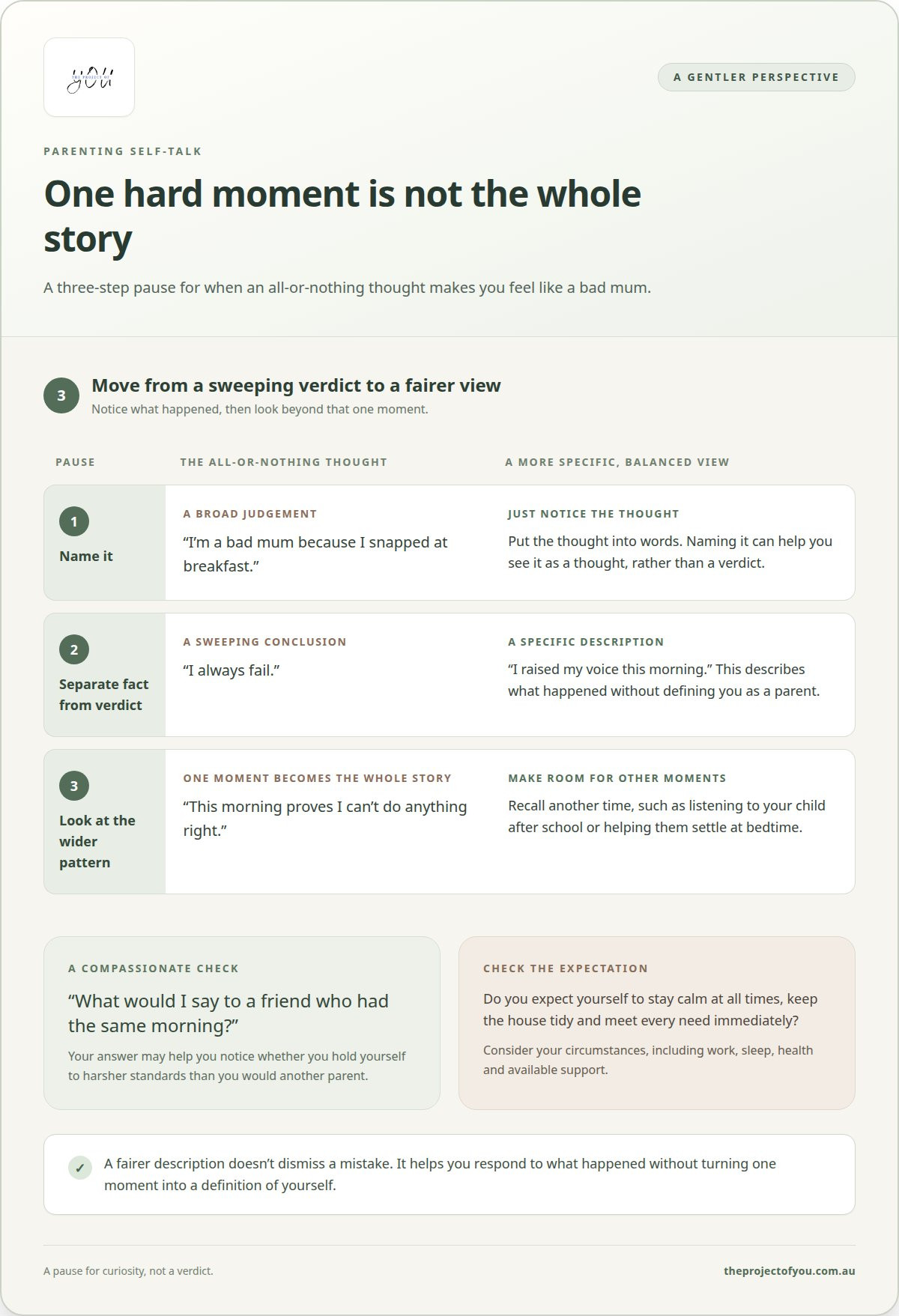
Try this three-step pause when an all-or-nothing thought appears:
Name the thought: “I’m a bad mum because I snapped at breakfast.”
Separate fact from verdict: “I raised my voice this morning” is specific; “I always fail” is a broad judgement.
Look at the wider pattern: Recall another moment, such as listening to your child after school or helping them settle at bedtime.
This doesn’t dismiss a mistake. It helps you respond to what happened without turning one moment into a definition of yourself. Ask, “What would I say to a friend who had the same morning?” Your answer may show whether you hold yourself to harsher standards than you would another parent.
Consider where those standards came from. Perhaps you expect yourself to stay calm at all times, keep the house tidy and meet every need immediately. Ask whether that expectation fits your circumstances, including work, sleep, health and available support. Donald Winnicott’s idea of the “good enough mother” offers another perspective: parenting doesn’t require a perfect response every time.
In Australia, a GP, maternal and child health nurse or community health service can help connect you with public mental health support. Ask about free or low-cost options in your area, and explain if cost is a barrier.
Partners and family can offer practical help without correcting or judging. They might take over dinner, listen without rushing to reassure you, or say, “You had a hard moment, and I can see how much you care.” A specific offer gives a tired mother more room to rest and reconnect.
Self-compassion takes practice. Choose one recurring thought, write down evidence for and against it, then replace the sweeping verdict with a fairer description. For example: “I felt overwhelmed at breakfast, and I can repair that moment with my child.”
2. Effects of negative thoughts on emotions, body and behaviour
A thought such as “I’m failing my child” can quickly bring shame, embarrassment or hopelessness. If it returns after a hard morning, it may colour the rest of the day, even when you later share a laugh or offer comfort. The thought can feel like a verdict instead of one response to a stressful moment.
Emotional strain can show up physically, too. You might feel hollow, heavy, tired or unmotivated, then find it harder to begin a simple task like making lunch. Notice what happens after a critical thought: name the feeling, identify the body sensation and observe the urge that follows. Do your shoulders tense, do you withdraw, or do you try to fix everything at once?
Guilt can also shape parenting behaviour. A mother worried about upsetting her child may say yes to every request, avoid setting limits or take the child’s disappointment as proof she has caused harm. But a boundary can be caring: “I know you’re upset; the screen is off now.” Your child’s distress matters, but you don’t have to resolve it by taking on that distress yourself.
Constant self-blame can make it harder to stay emotionally available. You may be beside your child while replaying a mistake or anticipating the next one. Choose one small point of connection, such as listening to a story without checking your phone. If a moment has gone poorly, repair can begin with a calm explanation and an apology that doesn’t ask your child to comfort you.
Yelling can happen when stress and frustration build faster than a parent can regulate them. Yelling when overwhelmed is not, by itself, abuse; frequent harsh verbal discipline can have negative effects. The pattern matters. If you notice your voice rising, pause if it’s safe, take a breath and return to the conversation when you can speak more steadily.
After an intense exchange, check in with yourself: “What am I feeling? What is my body doing? What am I urged to do next?” A clenched jaw and the urge to leave, for example, may signal overwhelm. That information can help you choose a response, such as asking another adult to step in or pausing briefly before reconnecting.
If guilt or anxiety is making connection and boundaries difficult, speaking with a counsellor can help you explore the pattern and practise ways to respond. You can book a counselling session when you’re ready to talk it through.
3. Writing down and reading compassionate statements aloud
Choose one moment that brings up mum guilt, such as losing patience during the school run. Write what you’re telling yourself in your phone’s notes app or on paper. Then create a kinder statement that still feels believable: “I was overwhelmed this morning, and I’m trying to reconnect with my child.” Compassion isn’t pretending everything went well; it’s treating yourself fairly as you decide what to do next.
Read your statement aloud in a warm, gentle tone, as if speaking to someone you care about. Notice your response: do your shoulders ease, do you feel awkward, or do you want to reject the words? You don’t need to force yourself to believe a sentence immediately. If “I’m a wonderful mother” feels too far away, try something grounded, such as, “I deserve support while I learn from this moment.”
Keep a few statements where you’ll see them, such as beside your bed or in a phone note. Examples include:
“One difficult interaction doesn’t tell the whole story of my parenting.”
“I can apologise and try again after I’ve had a hard moment.”
“My child and I both have feelings, and I can make space for them.”
Choose one sentence that fits the situation, rather than repeating words that feel hollow. Reading it aloud can help you slow down and notice what you need next, whether that’s a pause, a glass of water or a conversation with someone you trust.
Social comparison can make this practice harder. A photo of a spotless kitchen or carefully packed lunch doesn’t show the whole household: perhaps the toys are out of frame, or someone else helped. If you catch yourself thinking, “Everyone else manages better,” name the comparison and return to one detail from your own day, such as your child asking you to read a book.
Fear of judgement may lead you to hide a messy lounge or avoid mentioning a difficult morning. Instead, choose one safe person and share something specific: “I’m struggling with bedtime and could use someone to listen.” You don’t have to share private details with everyone. The aim is to loosen the belief that every parent is coping perfectly except you.
If you fear you might hurt yourself or your baby in Australia, treat that fear as urgent. Place your baby somewhere safe, such as their cot, move away if you can do so safely, and call emergency services or go to an emergency department. Ask a trusted adult to stay with you while help is arranged.
4. How do I stop feeling like a bad parent?
Start by identifying what the guilt is responding to. If you spoke sharply at bedtime, guilt may point to an action you wish to change. If your conclusion is “I’m a terrible mum”, that shifts from regret about something you did to shame about who you are. The distinction matters: one can guide a repair, while the other can make every parenting challenge feel like proof of personal failure.
Guilt can come from real mistakes, but also from impossible expectations. You might believe a good parent never feels irritated, always cooks from scratch or keeps children happy. Consider where that rule came from and whether you’d apply it to a friend caring for a toddler after a sleepless night. A more realistic perspective makes room for both your values and the limits of an ordinary day.
Some guilt is useful. If you forgot a school note and your child felt disappointed, acknowledge the impact, apologise and set a reminder for next time. Once you’ve taken a meaningful step, replaying the mistake may not help your child or improve your response. Letting go doesn’t mean pretending it didn’t matter; it means allowing the repair to count.
Disproportionate guilt often continues without pointing to a clear next step. For example, you might feel guilty for setting a reasonable bedtime boundary because your child protests. Ask yourself, “Did I act against my values, or am I uncomfortable with my child’s disappointment?” This can help distinguish a choice that needs repair from the distress of not being able to please everyone.
Chronic guilt can leave a mother depleted. If you’re constantly reviewing your parenting, you may have less emotional energy for patience, warmth, presence and connection. You might give in to a limit to ease your discomfort, then feel resentful or guilty later. Naming that cycle can help you choose one small change, such as holding the bedtime boundary while offering comfort.
To manage guilt and unrealistic expectations, describe the event plainly, identify any impact, and decide whether you need to repair or change your plan. Then ask what expectation you’re trying to meet and whether it fits your family’s needs. A friend’s perspective can help you see whether your mental standard is harsher than the one you’d apply to someone else.
Seek professional help when overwhelm or inadequacy persists, interferes with daily life, or makes it difficult to care for yourself or your child. In Australia, start by speaking with a GP or mental health professional. Describe what you’re experiencing, including how it affects your parenting.
5. Is yelling at my child considered abuse?
Yelling when you’re overwhelmed doesn’t, by itself, mean you’re abusive. But frequent harsh verbal discipline can affect a child and deserves attention. Consider the pattern: how often it happens, what is said, and whether your child feels frightened or shamed. If you’re worried about your behaviour, take that concern seriously without turning it into a verdict on your identity.
Parents may doubt themselves for many reasons. A rushed school morning, ongoing stress, conflict at home or a teenager pushing against limits can all make calm responses harder. Your own childhood experiences may shape what happens when anger rises. Noticing a familiar pattern is useful information, not proof that you’re destined to repeat it.
After yelling, wait until you can speak steadily, then reconnect. You might say, “I yelled before. That wasn’t okay, and I’m sorry. You didn’t cause my reaction.” Keep the apology focused on your action, rather than asking your child to reassure you. Then listen to how they experienced the moment. A young child may need simple words and comfort; a teenager may need space before talking.
Repair also means taking responsibility for what changes next. Notice what came before the outburst: perhaps you were rushing, hungry or managing several demands at once. Choose one practical response, such as stepping away briefly when your child is safe, lowering your voice or asking another adult to take over. If yelling keeps happening, support can help you practise different ways to manage anger and stress.
Good enough parenting doesn’t mean perfect parenting. British paediatrician and psychoanalyst Donald Winnicott introduced the concept of the “good enough mother” in 1953. The idea is that children need a parent who is present, attuned and responsive most of the time, not someone who never makes a mistake. A repaired rupture can show a child that relationships can hold difficult moments and honest apologies.
Your mistakes, weaknesses and moments of overwhelm don’t define your whole relationship with your child. Instead, notice the pattern over time: are you working to be emotionally available, setting appropriate boundaries and reconnecting after conflict? If the answer feels complicated, consider parenting support or therapy rather than judging yourself alone.
The Project of You | Trauma, Couples & Relationship Therapy Australia
The Project of You | Trauma, Couples & Relationship Therapy Australia offers individual counselling for mothers who feel caught in shame, self-criticism or recurring parenting stress. Sessions provide space to understand what sits beneath harsh self-judgement, notice patterns that emerge when you feel overwhelmed, and explore responses that better reflect the parent you want to be.
Support may help if guilt keeps returning, affects your connection with your child or feels difficult to shift alone. Nervous System Regulation & Restoration can also help you explore how stress affects your responses. You don’t need to wait until things feel unbearable before asking for help.
Contact The Project of You | Trauma, Couples & Relationship Therapy Australia to talk about support.
Take your next step with kindness
If you’re feeling like a bad mother, meet that thought with curiosity rather than treating it as the final word about you. Change can begin with a small shift: noticing when self-judgement takes over, recognising what you need and choosing a response that reflects the parent you want to be. You don’t have to work it all out at once.
Support can offer room to explore the pressures beneath self-criticism and practise a gentler way forward. The Project of You | Trauma, Couples & Relationship Therapy Australia also offers The Healing Feminine Workshops and Self Love e-Books, which may provide further opportunities for reflection and self-understanding.
If you’d like to explore support, take the next step in a way that feels right for you.
Your hardest moments are part of your parenting journey, not the whole of it. With care and support, you can keep building a relationship with yourself and your child that makes room for learning, repair and connection.
Frequently Asked Questions
How do I stop feeling like a bad parent?
Choose one recurring situation and make a small, specific plan for next time. If mornings often become tense, prepare school items the night before or agree on who handles breakfast. A plan can reduce last-minute decisions and give you something practical to adjust. If it doesn’t work, treat that as information about what your family needs, rather than another reason to criticise yourself.
Is it normal to feel like a bad mum?
Yes, self-doubt can be part of parenting, particularly when demands are high or life is changing. Feeling like a bad mother is a distressing thought, not a clinical assessment of your parenting. Ask what happened just before the thought arose, such as a disagreement, a difficult transition or a comparison that left you feeling judged.
Is yelling at my child considered abuse?
Yelling alone doesn’t automatically establish that abuse is occurring; the context, content and broader pattern matter. If you’re concerned, write down what happened, including what was said and how your child responded, then discuss the pattern with a qualified health professional. If anyone is in immediate danger, prioritise safety and contact emergency services. Take your concern seriously without trying to make a legal determination yourself.
Why do I feel guilty as a mum all the time?
Guilt can linger when a situation feels unfinished, when you’re carrying responsibilities without enough support, or when two important needs compete. For instance, returning to work may support your family while bringing sadness about time apart. Naming the competing needs can make the feeling easier to understand. If guilt affects your sleep, concentration or everyday decisions, speak with a GP or mental health professional.
Why do mothers feel like bad mothers?
Parenting decisions often involve competing priorities, and no choice may feel perfect. You might need to hold a boundary while your child wants comfort, or choose a quick meal during a demanding evening. Feeling like a bad mother can arise when you expect every decision to meet every need. Reflecting on what mattered most in that moment can offer a clearer perspective.
How common is maternal guilt and self-doubt in Australia?
Maternal guilt and self-doubt are common experiences, though they vary across families and stages of parenting. A new parent may question feeding choices, while a parent of a school-aged child may worry about balancing work and family time. These feelings can also be shaped by culture, health, finances and available support. Rather than assuming other parents feel differently, consider which pressures are specific to your circumstances.
What is good-enough parenting?
“Good enough parenting” is a useful idea for reflecting on care, but it isn’t a score that determines whether someone is a good parent. An Australian family’s circumstances, culture, support network and a child’s individual needs all shape what care looks like day to day. Instead of searching for a perfect standard, consider whether your approach is safe, workable for your family and open to adjustment as needs change.



Comments