

Couples activities for sharing feelings and building connection

What if feeling closer starts with a small, intentional moment rather than a grand romantic gesture? Emotional connection exercises for couples can include a weekly check-in, thoughtful conversation prompts, shared activities and gentle intimacy practices that make room for both partners to feel heard. As relationship expert and couples counsellor Azita Abdollahian says, a 30-minute check-in once a week can offer a regular space to talk about emotions, daily life and concerns.
It makes sense if opening up feels difficult, especially when busy routines or unresolved tension have made conversation harder. You don’t need perfect words or agreement on everything. Listening with curiosity and sharing at a comfortable pace can help you understand each other more clearly.
This guide offers practical ways to share appreciation, revisit meaningful memories and create simple rituals, along with structured listening and intimacy exercises. You’ll also learn how couples counselling can help when familiar patterns keep getting in the way, creating a steadier path towards connection.
Table of Contents
1. What Are the Best Relationship Activities for Couples?
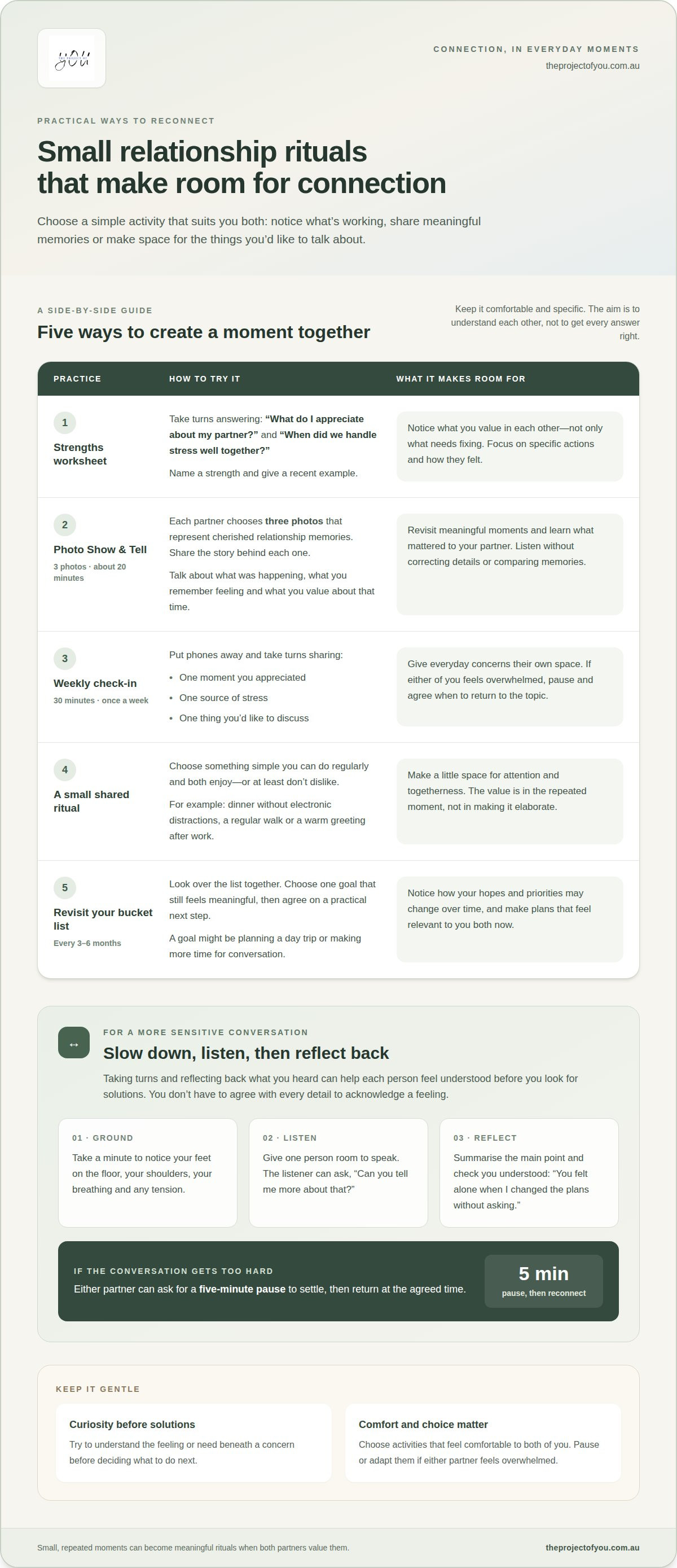
Useful relationship activities include a strengths worksheet, Photo Show & Tell and a weekly check-in. These give you structured ways to notice what’s working, share memories and make room for concerns. The Gottman Institute’s relationship research offers a useful perspective: small, repeated moments of connection can become meaningful rituals when both partners value them.
A couples worksheet can help you recognise what you value in each other, rather than making every conversation a review of problems. Take turns answering prompts such as, “What do I appreciate about my partner?” and “When did we handle stress well together?” Then name a strength you see in your partner and give a recent example. One of you might recall how the other made space for a difficult conversation after work. Focus on specific actions and how they felt, not broad labels or criticism.
When a disagreement keeps returning, try looking beyond the immediate issue. Each partner can describe what it brings up and what they hope the relationship can offer in that moment. A dispute about household tasks, for example, may also involve wanting to feel considered. This doesn’t erase the practical problem; it helps you hear the need beneath it before deciding what to do next.
For Photo Show & Tell, each partner chooses three photos that represent cherished relationship memories. Set aside about 20 minutes to share the story behind each image: what was happening, what you remember feeling, and what you value about that time together. One photo might capture a quiet weekend, another a family celebration. Listen for what mattered to your partner, rather than correcting details or turning the memory into a comparison.
A regular relationship check-in gives everyday concerns their own space. Set aside 30 minutes once a week, with phones put away, and take turns sharing one appreciated moment, one source of stress, and one thing you’d like to discuss. A calm routine can make it easier to raise small concerns before they become the whole conversation. If either partner feels overwhelmed, pause and agree when to return to the topic.
Small rituals can support connection when they feel comfortable to both of you. A shared dinner without electronic distractions, a regular walk or a warm greeting after work can become a meaningful repeated moment. Choose something you can do regularly and both enjoy, or at least don’t dislike. The value lies in paying attention to each other, not making every activity elaborate.
To keep shared plans alive, revisit a couple’s bucket list every 3–6 months. Choose one goal that still feels meaningful, such as planning a day trip or making more time for conversation, and agree on a practical next step. Revisiting the list helps partners notice how their hopes and priorities change together.
2. Conversation prompts for sharing feelings and appreciation
Practise active listening by taking turns speaking and reflecting back what you heard. The listener can acknowledge the feeling without agreeing with every detail: “I can see why that felt difficult.” This gives each person a chance to feel understood before you look for solutions.
Try a short grounding step before discussing a sensitive subject. Each partner takes a minute to notice their body: feet on the floor, shoulders, breathing and any tension. During the conversation, keep at least 75% of your awareness on your own body. This somatic awareness can help you notice when stress is rising, so you can slow down rather than react automatically.
Choose one prompt, then give each person room to answer in their own words:
“What did I do recently that helped you feel appreciated?”
“What has felt difficult for you this week?”
“What’s one thing you’d like me to understand more deeply?”
“What small moment together would you like us to make time for?”
Follow-up questions can take a conversation beyond a quick answer. Try, “Can you tell me more about that?” or “What did you need in that moment?” Then summarise the main point: “You felt alone when I changed the plans without asking.” Check whether you understood correctly. Keep curiosity gentle rather than turning it into cross-examination; one question at a time is enough.
For a bonding activity, take a walk together and each share one thing you appreciated that day. You might mention a partner making tea after a tiring commute, or listening while you talked about work. Naikan Reflection offers another prompt: consider what you received from your partner over the past 24 hours. Specific examples make appreciation easier to express than a general “you’re great”.
If a discussion becomes too difficult to continue calmly, try Stop the Tape. Either partner can ask for a five-minute pause, take space to settle, then return to the conversation. Agree on when you’ll resume before pausing. Use the break to notice your breathing or take a short walk, rather than rehearsing rebuttals. Returning matters, because otherwise a pause may feel like withdrawal.
In therapy, guided listening can help couples notice how stress affects their tone, attention and ability to stay curious. If you’d like support practising these conversations, you can book an appointment.
3. Emotional, physical, sexual and intellectual intimacy
Intimacy can take several forms, and partners may value each form differently. Emotional intimacy means sharing deeper thoughts and feelings, which can support trust. Physical intimacy includes consensual touch, such as holding hands or hugging, not only sex. Sexual intimacy involves discussing desire, comfort and boundaries. Intellectual intimacy grows through exchanging ideas, curiosity and learning together.
Different kinds of closeness don’t always rise and fall together. One partner might want to talk after a stressful day, while the other wants quiet or touch. If these needs go unspoken, either person may interpret the difference as rejection. Name your own preference without assuming your partner shares it: “I feel close when we talk before bed. What helps you feel connected?” Then discuss what feels comfortable for both of you.
Reading together can create intellectual intimacy without requiring a heavy conversation. Choose a short story, article or chapter, then take turns sharing one idea that stayed with you. Ask, “What did you find surprising?” or “Did that remind you of anything?” If you disagree about a character’s choice, explore why instead of trying to win the interpretation. This shared activity offers a gentle way to notice how each of you thinks.
For long-distance partners, intentional contact can keep everyday life part of the relationship. Share a meal over a video call, send a message about a small moment or plan a visit together. You might each answer one question on a call: “What’s been taking up your energy?” or “What are you looking forward to?” Vary the format so communication doesn’t become a daily status report. Talk about what kind of contact feels connecting and what feels like pressure.
Physical closeness works best when it’s mutual and freely chosen. Partners can ask, “Would a hug feel good right now?” or agree on a small affectionate ritual. The Six-Second Kiss exercise suggests holding a kiss for at least six seconds each day, if both partners want that contact. An extended embrace can last at least 20 seconds, but either person can stop sooner. These are invitations, not tests of affection.
Sexual intimacy benefits from clear, respectful conversation outside the moment of sex. Each partner can name what feels welcome, what doesn’t and what they’re curious about. Sharing a desire doesn’t mean agreeing to act on it; consent remains specific and can change. If talking about sex brings up shame, grief or past hurt, slowing down can help preserve emotional safety.
Small practices can help you explore which forms of intimacy feel meaningful. Keep a shared note of activities to try, such as reading a chapter together or sending a thoughtful message during the day. Afterwards, ask what felt connecting and what you’d change. The aim isn’t to perform closeness perfectly, but to understand each other’s needs with care.
4. What Can Couples Do To Build Intimacy?
Eye gazing and synchronised breathing can offer a quiet way to practise paying attention together. Choose a calm moment, sit facing each other and agree to try eye contact. Begin with three to five minutes, as suggested for this exercise. You can look towards your partner’s left eye or soften your gaze if direct eye contact feels intense. Either person can pause or look away.
Before you start, agree on simple boundaries. Decide whether to sit close or leave more space, and whether touch feels welcome. Eye contact can bring up vulnerability, particularly when someone feels exposed or unsettled. Keep the exercise optional, not a test of trust or affection. If either partner notices tension, they can name it, take a breath and choose whether to continue.
To add synchronised breathing, one partner can set a comfortable rhythm while the other follows. Begin with at least seven slow, deep breaths together. Keep the breath gentle; neither person needs to breathe deeply or hold their breath. Notice what happens in your shoulders, chest, or jaw. If matching feels uncomfortable, return to your natural breathing and stay present in the session.
Some couples who enjoy the exercise extend it to 20 breaths together. You might count quietly, or simply notice each inhale and exhale. The point is shared attention, not perfect synchrony. A partner who finds eye contact difficult can gaze at the other’s forehead or hands instead. These small actions preserve choice while creating a shared experience.
For a regular practice, try five minutes of eye gazing once a week. Choose a time when neither of you is rushing to work or managing a stressful task. Afterwards, take turns describing one feeling or sensation, such as “I felt calm” or “I wanted more space.” Listen without explaining what your partner should have experienced. Different responses can both be valid.
A short nightly practice can combine two minutes of grounding with three minutes each to answer a prompt. To ground yourselves, notice your feet, the chair beneath you and your breathing. Then each partner can answer, “What would help you feel supported tomorrow?” This gives the conversation structure without demanding intense disclosure. If the prompt feels difficult, choose a lighter one, such as sharing a pleasant moment from the day.
In couples counselling, a therapist may guide exercises such as eye gazing, cuddling, hand-holding or synchronised breathing. A therapist can help you adapt these activities to your comfort, history and boundaries, especially when past experiences make closeness complicated. The aim isn’t to force intimacy, but to explore what helps each person feel safer and more present together.
5. Couples therapy and structured exercises
Couples counselling can help you understand the pattern you’re caught in, rather than deciding who is at fault. A therapist might map what tends to happen before, during and after a recurring disagreement, then help each partner identify their feelings, assumptions and actions. A discussion about weekend plans, for example, may reveal different needs for rest, company or predictability. Seeing the pattern gives you a clearer place to begin.
If you have different communication styles, choose a format that helps each person contribute. One partner might prefer to write thoughts before a session; the other may find a diagram or practical example more useful. Agree on one topic and decide together how to explore it. Adapting the exercise to both of you is more helpful than treating one style as the right way to communicate.
Free or low-cost connection activities in Australia can use materials you already have at home. Each partner can write down relationship values, such as honesty, humour or teamwork, then compare which feel most important right now. Choose one shared value and identify an everyday action that expresses it. If reliability matters, for example, agree on how you’ll communicate when plans change. No special equipment is needed.
Can you safely try couples counselling exercises without a therapist? Simple, present-focused activities may be suitable when both partners freely agree and feel able to say no. Keep the exercise within a topic that feels manageable, and don’t use it to demand disclosure about trauma or private experiences. If either person feels unsafe, controlled or unable to refuse, prioritise individual safety and seek appropriate professional support.
A therapist can tailor structured work when a recurring pattern feels hard to shift alone. In sessions, couples may examine family stories, expectations about commitment or hopes for their relationship, then choose one practical experiment to try between appointments. For example, you could decide how to make a shared decision about an upcoming family event. The next session can explore what each person noticed, without making the experiment a pass-or-fail test.
Concerns in a marriage or long-term relationship may also involve grief, betrayal or changes in family life. Counselling can help you understand how these experiences shape your expectations and sense of trust. A useful starting point is to name what each person wants the relationship to make room for now, rather than assuming you both want the same thing.
The Project of You | Trauma, Couples & Relationship Therapy Australia
The Project of You | Trauma, Couples & Relationship Therapy Australia offers support for people who want to understand their feelings and relationship patterns more clearly. If difficult conversations leave you overwhelmed or disconnected, Nervous System Regulation & Restoration can help you explore ways to feel more settled and present. Individual Counselling also offers space to reflect on your needs, boundaries and responses within a relationship.
No single exercise suits every couple or every season of life. A thoughtful next step is to notice what makes connection feel possible for you and where support could help you move forward with care.
Keep making room for connection
Closeness isn’t measured by how smoothly every conversation goes. It can grow through returning to one another, staying curious about different needs and making space for honest feelings. Emotional connection exercises for couples can be a starting point, not another standard to meet. Choose a practice that suits your energy and circumstances, then notice what it helps you understand about yourself and your relationship.
If you’re unsure where to begin, consider what feels most important right now: communicating with more care, understanding your responses, or finding steadier ground during stress. The Project of You offers support that can help you explore those needs at your own pace, including Nervous System Regulation & Restoration, The Healing Feminine Workshops and Self Love e-Books.
Each honest moment can help you find a more considered way forward, together or on your own.
Frequently Asked Questions
What Are the Best Relationship Activities for Couples?
The best activity is one that helps both partners feel engaged, not judged or tested. Try learning something unfamiliar together, such as following a beginner’s dance lesson or planning a shared garden project. Notice how you make decisions, divide tasks and respond to mistakes. Afterwards, each person can name one part they enjoyed and one thing they’d approach differently next time.
What Can Couples Do To Build Intimacy?
Build intimacy by making room for honest preferences, not just shared activities. Each partner could finish the sentence, “I feel most like myself with you when…” and describe a real example. Then explore what makes that moment comfortable or meaningful. This can help you understand what supports closeness without assuming intimacy has to look the same for both of you.
What if my partner is hesitant to try these exercises?
Let your partner know you want to understand their hesitation, not persuade them to participate. Ask whether they’d prefer a different activity, a shorter conversation or more time to think. You can also share what you hope the exercise might offer you. A clear invitation gives both people room to choose, and an honest “not now” can guide a more respectful conversation.
What daily check-in questions help couples feel closer?
Questions that invite reflection can reveal what matters beyond everyday practical demands. Try asking, “What’s something you’re proud of yourself for?” or “What have you been carrying that I might not see?” You could also ask, “What would you like more space for in your life?” Let your partner decide how much to share, and don’t treat a brief answer as a problem to solve.
What are simple intimacy-building exercises couples can do at home?
Try parallel play: spend time in the same room doing separate activities, such as drawing while your partner reads. Afterwards, share what absorbed you and whether quiet company felt enjoyable. This can suit partners who want connection without sustained conversation. Agree that either person can choose a different activity, so it feels like companionship rather than an obligation.
How often should couples do emotional connection exercises?
There’s no single schedule that suits every couple. Consider how much time and emotional energy you both have, then agree on a rhythm that feels realistic during ordinary weeks. If a practice starts feeling like homework, change its format or take a break. The useful measure is whether both partners can participate willingly and make room for the exercise without resentment.
What should couples do if an exercise triggers conflict or distress?
Once you feel settled, reflect separately on what was difficult and what each person needs before trying a similar activity again. You might avoid a particular topic, change the setting or choose an exercise that asks for less personal disclosure. If distress continues or either partner feels frightened or pressured, seek professional support. Relationship exercises should never require someone to override their sense of safety.



Comments