.png)

Regulating Your Nervous System: A Guide to Inner Peace
- Azita Abdollahian

- 11 minutes ago
- 12 min read
What if the irritability you feel at the dinner table or the heavy exhaustion that shadows your weekends isn't a personality flaw, but your body's way of trying to protect you? Many of us spend our days caught in a cycle of high-alert tension or profound numbness, wondering why we can't just relax. It's a heavy weight to carry when you feel constantly on edge or "shut down" without knowing why. Learning how to regulate your nervous system is not about "fixing" yourself; it's about learning a new language of safety that allows you to move from survival mode into a state of lasting emotional restoration.
You deserve to feel grounded and present in your own body again. We'll look at the "how" and "why" behind your physical symptoms and relationship struggles, using gentle, evidence-informed strategies to build your emotional resilience. By exploring the foundations of polyvagal and attachment theories, you'll discover practical paths to improve your sleep, harmonise your relationships, and finally find that elusive sense of inner peace. This journey isn't about rushing toward a destination, but about creating the space you need to breathe and grow with grace.
Table of Contents
What does it mean to regulate your nervous system?
Imagine your nervous system as a sophisticated, internal surveillance system. It is constantly scanning your surroundings and your internal world to answer one vital question: "Am I safe?" Regulation is not about achieving a permanent state of Zen or forcing yourself to stay calm during a crisis. Instead, it is your body's ability to move fluidly between different states of arousal without getting "stuck" in any of them. It is the capacity to meet life's challenges with the appropriate level of energy and then return to a place of rest when the moment has passed.
When people explore how to regulate your nervous system, they often assume it is a synonym for relaxation. However, true regulation is about flexibility. If you are in a "freeze" state, where you feel heavy, numb, or emotionally distant, regulation actually involves "waking up" your system into a state of safe alertness. This understanding comes from Polyvagal Theory, which outlines a hierarchy of responses. Our bodies naturally seek safety and social connection first. When that feels unavailable, we shift into fight or flight. If the threat feels too great to overcome, we may drop into a state of shutdown. Regulation is the art of navigating back to that top tier of safety and connection.
The role of the Vagus Nerve
Think of the vagus nerve as a vast information superhighway. It serves as the primary link between your brain and your vital organs, including your heart, lungs, and gut. This nerve carries constant updates about your physical state to your mind, influencing how you feel and react to the world around you. When you have high vagal tone, your body can bounce back quickly after a stressful event, such as a tense meeting or a disagreement with a partner. Vagal tone is the measure of your nervous system's flexibility and its ability to return to a state of equilibrium after a challenge.
Dysregulation vs. Regulation
Dysregulation occurs when the system loses its natural rhythm and becomes trapped in a protective loop. You might recognise the signs of being "stuck on high," which often manifest as a racing heart, shallow breathing, persistent anxiety, or hyper-vigilance. Conversely, being "stuck on low" can feel like a heavy fog, often bringing chronic fatigue, a sense of hopelessness, or a feeling of being "checked out" even when you are with loved ones.
It is important to remember that these states are not personal flaws or signs of a broken character. They are intelligent, protective responses from a system that is doing its best to keep you safe. At The Project of You | Trauma, Couples & Relationship Therapy Australia, we believe that understanding these signals with curiosity is the first step toward true restoration. By recognising these patterns, you can begin to work with your body rather than against it.
Understanding your 'Window of Tolerance'
Dr Dan Siegel’s concept of the Window of Tolerance describes the optimal zone where we can handle life’s ups and downs with relative ease. Within this window, you feel grounded, flexible, and capable of processing emotions without becoming overwhelmed. However, when we face chronic stress or trauma, this window often shrinks. You might find yourself easily triggered by things that previously felt manageable. Learning how to regulate your nervous system involves more than just finding a temporary fix; it is about widening this window so you can stay present and connected even when life feels intense.
When we are pushed outside our window, we usually land in one of two states. Hyper-arousal is the "stuck on high" feeling, characterised by fight or flight responses like panic, rage, or a racing mind. Hypo-arousal is the "stuck on low" state, where we feel numb, disconnected, or heavy. Understanding how to regulate your nervous system through this lens helps you move from self-criticism to curiosity. Self-compassion is the essential first step here. Instead of judging your reaction, try to recognise it as your body’s intelligent attempt to keep you safe. At The Project of You | Trauma, Couples & Relationship Therapy Australia, we see this gentle acknowledgement as the foundation for all future growth.
Identifying your triggers and glimmers
Triggers are the cues that push us out of our window, but "glimmers" are the micro-moments of safety that bring us back. A glimmer could be the warmth of the sun on your skin, the scent of eucalyptus, or the sound of a familiar voice. By tracking your bodily sensations, you can catch dysregulation before it peaks. Take a moment to pause and ask: what does safety feel like in my toes, my chest, or my jaw? Noticing these subtle shifts allows you to anchor yourself in the present moment before the storm takes hold. It is about learning to catch the wave before it breaks.
Building capacity for intensity
Regulation isn't about avoiding stress; it is about being able to move through it without breaking. True Nervous System Restoration focuses on building your capacity for intensity. This means you don't just "calm down" after a trigger, but you actually increase your ability to hold complex emotions without becoming overwhelmed. Daily rituals, like a morning walk or a mindful tea, are simple ways to anchor your system in the "Social Engagement" zone. If you feel like your window has become too small to manage alone, you might consider how professional support can help you expand your capacity for peace.
Top-down vs. Bottom-up: Two paths to peace
Have you ever tried to talk yourself out of a panic attack, only to find your heart racing even faster? It's a common frustration. When we explore how to regulate your nervous system, we usually find ourselves looking at two distinct directions of travel: top-down and bottom-up. Top-down strategies are mind-to-body. They involve using logic, cognitive behavioural therapy (CBT), and reframing to help calm your system. While these are incredibly helpful for managing daily stress, they often hit a wall when you're in a state of high arousal or deep shutdown.
Bottom-up strategies, conversely, are body-to-mind. These techniques use breath, movement, and touch to signal safety directly to the brain's survival centres. You can't simply "think" your way out of a freeze state because the part of your brain responsible for logic, the prefrontal cortex, essentially goes offline when you feel threatened. This is why a truly restorative approach at The Project of You | Trauma, Couples & Relationship Therapy Australia requires integrating both paths. For those seeking long-term healing, trauma-informed therapy provides a framework that honours both the wisdom of your mind and the stories held within your body.
When talk therapy isn't enough
Traditional talk therapy is a wonderful tool for gaining insight, but it has limitations when the "reptilian brain" is in charge. If your system is stuck in a loop of stored tension, simply retelling the story can sometimes lead to re-traumatisation rather than release. Somatic experiencing allows you to process these physical sensations without needing to find the perfect words for your experience. In the Australian context, it's vital to find a therapist who understands this somatic-emotional link, helping you move through transitions with a sense of grounded agency rather than just intellectual understanding.
The power of co-regulation
We are profoundly social creatures. Our nervous systems don't exist in isolation; they are constantly "talking" to the systems of those around us. This is the essence of co-regulation. Have you noticed how the presence of a calm partner, a steady friend, or a compassionate therapist can almost instantly settle your own frantic system? This biological dance is a cornerstone of healthy attachment. By fostering this sense of shared safety, couples counselling can help partners become each other's "secure base." When you learn how to regulate your nervous system alongside someone you love, the path to peace becomes a journey you no longer have to walk alone.
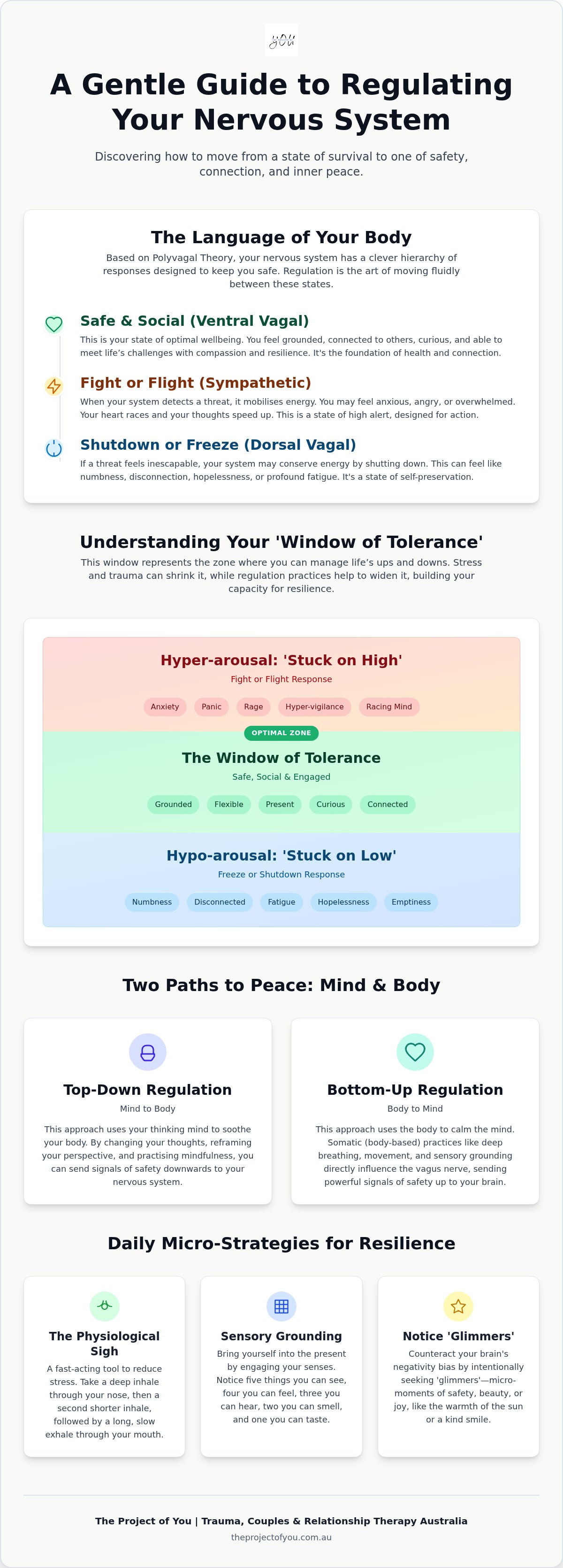
Daily micro-strategies for nervous system regulation
What if you could shift your internal state in just sixty seconds? Learning how to regulate your nervous system doesn't require hours of silent meditation or a complete lifestyle overhaul. Often, it's the small, rhythmic choices we make throughout the day that create the most profound shifts. These micro-strategies act as anchors, helping you stay connected to the present moment when the world starts to feel overwhelming. Consider integrating these gentle practices into your daily routine:
The Physiological Sigh: Take a double inhale through the nose followed by a long, slow exhale through the mouth. This resets the diaphragm and signals to your brain that the immediate threat has passed.
Sensory Grounding: Use the 5-4-3-2-1 technique. Notice five things you can see, like the silver-green leaves of a gum tree, or four things you can feel, such as the texture of dry bark or a cool breeze.
Temperature Shifts: Splash cold water on your face. This stimulates the mammalian diving reflex, which naturally slows your heart rate and settles a racing system.
Somatic Movement: If you feel a buildup of tension, try shaking your arms, dancing to a favourite song, or gently shifting your weight from side to side. This movement helps discharge survival energy that might otherwise stay trapped in your muscles.
Safe Touch: Practice the butterfly hug by crossing your arms and gently tapping your shoulders, or simply place a hand on your heart to offer yourself a moment of soothing, compassionate connection.
Creating a 'Regulation Toolkit'
It's helpful to practice these micro-strategies when you are feeling relatively calm. This builds the muscle memory you'll need when stress actually hits, making the tools more accessible when your logic centre goes offline. Titration is the practice of taking small, manageable steps toward healing. By organising your day around pockets of peace rather than a relentless drive for productivity, you allow your system the necessary time to recover and settle. Think of it as building a reservoir of resilience that you can draw upon when the waters of life become choppy.
Using digital resources for support
While technology can often feel like a source of over-stimulation, it can also be a bridge to deeper self-understanding. A structured self love ebook can offer a gentle path for independent growth, providing the framework you need to externalise internal chaos through journaling. Setting clear boundaries with your devices, such as tech-free hours before bed, ensures that your digital world supports your well-being rather than draining it. Journaling, in particular, allows you to move thoughts from the swirling depths of your mind onto the page, creating a sense of clarity and distance.
Moving from regulation to restoration
Understanding how to regulate your nervous system is a vital first step, but there is a deeper level of healing available to you. While regulation helps you manage a difficult moment, restoration is about creating a baseline of safety that persists even when you aren't actively using a "tool." It's the difference between patching a leak and reinforcing the entire structure of your well-being. Your nervous system is remarkably plastic. It's capable of profound change, and with the right support, you can move from a life of constant vigilance to one of genuine ease and connection.
Sometimes, the noise of daily life makes it difficult to hear what your body is truly saying. If you find yourself repeatedly falling back into survival mode despite your best efforts, it might be an indication that your system needs a more significant period of dedicated care. Seeking individual counselling provides a safe, structured space to explore the roots of your dysregulation with a professional who understands the complex interplay of trauma and attachment. This partnership allows you to navigate the path to peace with a steady hand to hold.
Immersive healing in Australia
For many, a dedicated nervous system retreat offers the circuit breaker needed for deep-level resetting. By stepping away from the familiar triggers of work, home, and digital demands, your system is finally given permission to drop into the "Rest and Digest" state. This isn't just a holiday; it's an intentional immersion into safety. In our The Healing Feminine workshops, we also harness the power of group co-regulation, allowing you to heal within a community of others who truly understand the weight of your journey. There is a unique medicine in being seen and supported by others on a similar path.
Next steps on your journey
As you finish reading, I invite you to pause and ask yourself: what is one small thing my body needs right now? Perhaps it’s a glass of water, a deeper breath, or simply a moment of stillness. If you feel ready for deeper support, consider speaking with your GP about a Mental Health Care Plan. This can provide a pathway to access subsidised psychological support in Australia, making professional care more accessible. Whether you join us for a retreat or reach out for a one-on-one session, know that you don't have to navigate this path alone. The Project of You is here to guide you toward the restoration you deserve.
Your path to lasting restoration
Your journey toward inner peace isn't a race to a finish line, but a gentle return to your body's wisdom. We've seen that regulation is about the fluid ability to navigate challenges without getting stuck in survival loops. By understanding your Window of Tolerance and integrating somatic practices, you're building a resilient future. Learning how to regulate your nervous system is a profound act of self-compassion that improves your sleep, health, and relationships.
As a qualified Clinical Social Worker and Psychotherapist, I've witnessed how evidence-informed trauma care transforms a life of vigilance into one of grounded ease. Whether you start with micro-strategies or join a specialised Nervous System Restoration retreat, your system is capable of change. You don't have to walk this path alone.
You deserve to feel safe in your own skin. Every small step today is a path toward the lasting emotional restoration you've been seeking. Trust in your body's capacity to heal; it's waiting to find its way back to peace with you.
Frequently Asked Questions
How do I know if my nervous system is dysregulated?
Dysregulation often manifests as a persistent feeling of being "on edge" or, conversely, completely "shut down." You might notice physical signs like a racing heart, shallow breathing, or digestive issues that don't have a clear medical cause. Emotional indicators include heightened irritability or a sense of numbness and disconnection from loved ones. If you find it difficult to return to a state of calm after a stressful event, your system may be struggling to find its natural rhythm.
Can I regulate my nervous system naturally without medication?
Yes, many people learn how to regulate your nervous system through natural, evidence-informed somatic practices and lifestyle adjustments. Techniques such as the "Physiological Sigh," cold water exposure, and sensory grounding work directly with your biology to signal safety to the brain. While medication can be a helpful tool for some, these "bottom-up" strategies focus on building your body's inherent capacity for resilience and restoration. At The Project of You, we integrate these natural methods with clinical psychotherapy for holistic healing.
How long does it take to heal a dysregulated nervous system?
Healing is a deeply personal journey that doesn't follow a fixed timeline. While micro-strategies can provide immediate relief, shifting a long-term pattern of dysregulation usually takes consistent practice over several months. The duration depends on your history of chronic stress or trauma and how often you engage in restorative practices. Immersive experiences, like a nervous system retreat, can often accelerate this process by providing a dedicated space for your system to finally drop into a state of deep rest.
Is deep breathing always good for anxiety?
Surprisingly, deep breathing isn't always the best first step for everyone. For some, focusing intensely on the breath can actually feel threatening or increase anxiety; this is especially true if you are in a state of high hyper-arousal. In these moments, "external" grounding techniques like noticing the colours in your garden or feeling the texture of a fabric may be more effective. It's about finding the specific tool that feels safe for your body in that particular moment of distress.
What is the fastest way to calm the vagus nerve?
One of the fastest ways to stimulate the vagus nerve and signal safety is through the "mammalian diving reflex." Splashing cold water on your face or chest can trigger an almost immediate slowing of the heart rate. Other rapid techniques include humming, chanting, or using the "Physiological Sigh," which involves a double inhale followed by a long, audible exhale. These methods work by directly engaging the parasympathetic nervous system to counteract the fight-or-flight response in a matter of seconds.
What happens if I ignore my body's stress signals for too long?
Ignoring chronic stress signals can lead to physical and emotional exhaustion, often referred to as burnout. Over time, a system that is constantly "on guard" may contribute to long-term health challenges, such as chronic fatigue, persistent digestive issues, or a weakened immune system. Emotionally, you might find your "Window of Tolerance" shrinking, making you more prone to outbursts or total withdrawal. Addressing these signals early is vital for preventing the transition from temporary stress to deep-seated trauma.
Can relationship problems cause nervous system dysregulation?
Relationship distress is a significant source of nervous system dysregulation because we are biologically wired for connection. When there is conflict or a lack of emotional safety with a partner, your system may perceive this as a threat to your survival. This can trigger a cycle of irritability or withdrawal that makes resolving the issue even harder. Couple counselling focuses on creating a "secure base" where both partners can co-regulate, helping each other return to a state of safety.
How do I explain my need for regulation to my partner?
Try explaining your needs through the lens of biology rather than personality. You might say, "My nervous system is feeling a bit overwhelmed right now, and I need a few minutes to ground myself so I can be fully present with you." Framing it as a physiological requirement for safety helps remove blame and fosters curiosity. This approach invites your partner to become a supportive ally in your journey toward restoration, rather than feeling like they are the cause of your distress.


Comments