.png)

PTSD Therapy in Australia: A Compassionate Guide to Healing and Nervous System Restoration

What if your body is simply trying to keep you safe, even though the danger passed years ago? For many people, living with trauma feels like being permanently stuck in a "high alert" mode that no amount of logic can switch off. You might recognise the exhaustion of trying to rationalise your way out of a racing heart or the way a sudden flashback makes the present feel entirely unsafe. If you've been searching for effective PTSD therapy Australia, you likely know that traditional talk therapy sometimes only scratches the surface of what is a deeply physiological experience.
At The Project Of You, trauma expert Azita Abdollahian teaches her clients it's important to understand that your reactions aren't a sign of weakness, but a testament to your system's desire to protect you. We'll explore how to move beyond "surviving" by understanding the latest evidence-based PTSD therapies and nervous system restoration techniques designed to bring you back to a state of true balance. This guide provides a path toward feeling calm and regulated, helping you reclaim agency over your healing journey and improve the intimacy in your relationships. From somatic insights to the latest regulatory changes in supportive treatments, we'll navigate the options available to help you finally feel at home in your own skin.
Table of Contents
What is PTSD? Understanding the "Stuck" State in the Australian Context
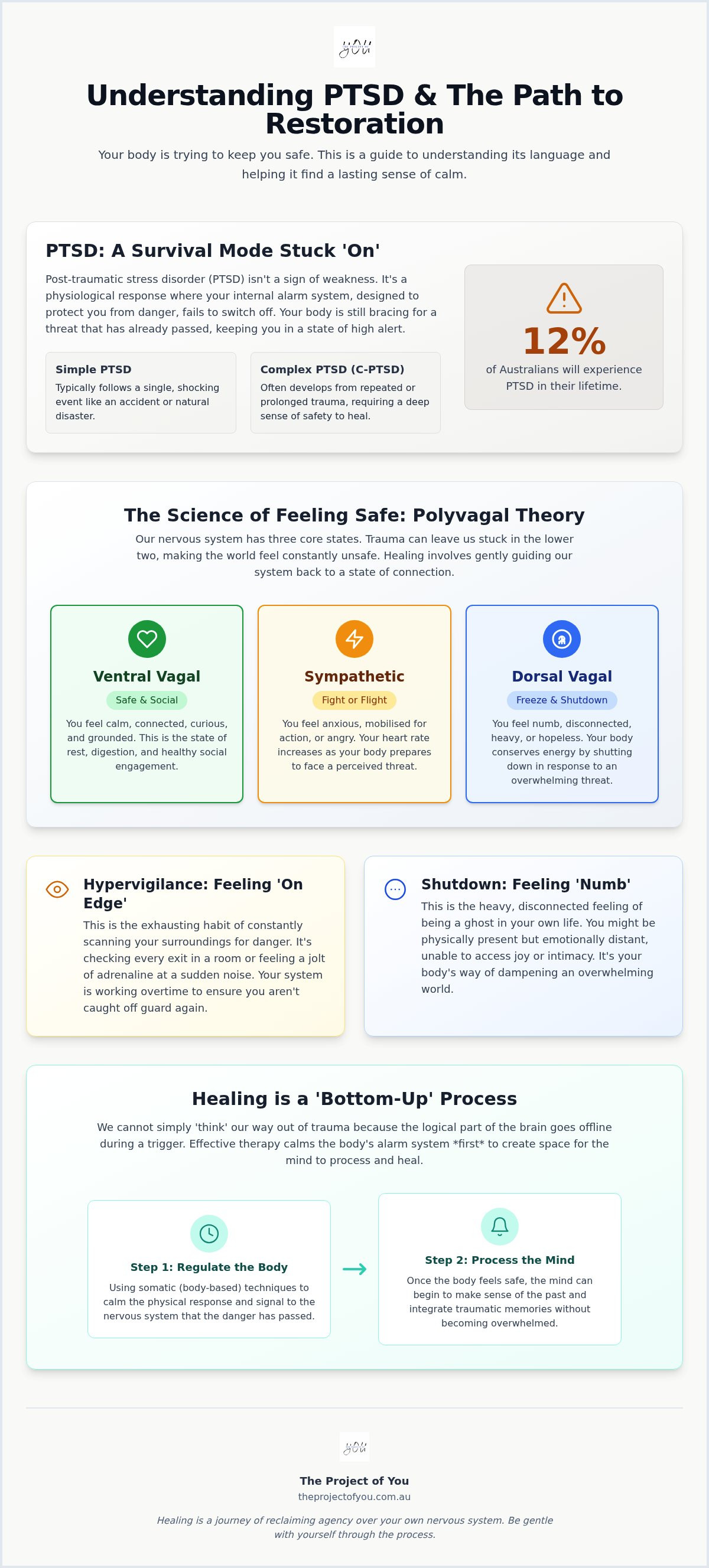
When you're searching for PTSD therapy Australia, you're often looking for a way to make sense of a world that suddenly feels unpredictable. It's helpful to reframe our understanding of the condition. Rather than viewing it simply as a mental health diagnosis, we can see Post-traumatic stress disorder (PTSD) as a physiological survival mode that has failed to switch off. It's as if your internal alarm system is still blaring long after the fire has been extinguished. Your body is doing its best to protect you, but it's stuck in a loop of past peril.
In our local context, these experiences often stem from events that shake our sense of stability. We see this frequently after natural disasters like the Black Summer bushfires or sudden floods, but it also arises from workplace accidents, car crashes, or personal assaults. Statistics suggest that about 12% of Australians will live with PTSD at some point. Whether the trauma was a single, shocking event or a series of ongoing experiences, the result is a system that no longer feels it's safe to rest. This distinction is vital; while "simple" PTSD usually follows a one-off event, Complex PTSD (C-PTSD) often develops from repeated trauma. Both require a foundation of deep emotional safety before any real healing can begin.
The Symptoms of a Dysregulated System
Living with a dysregulated nervous system often feels like being "on edge" without a clear reason. You might experience hypervigilance, which is that exhausting habit of constantly scanning your surroundings. It's the impulse to check for every exit in a crowded shopping centre or feeling a jolt of adrenaline when a car backfires on a quiet street. You aren't being "difficult"; your system is just trying to ensure you aren't caught off guard again.
Conversely, you might find yourself in a "freeze" or "numb" state. This is that heavy, disconnected feeling where you're physically present at a family BBQ or a work meeting, but emotionally you're miles away. You might feel like a ghost in your own life, unable to access the joy or intimacy you once shared with those you love. This disconnection is a biological shield, a way your body tries to dampen the intensity of an overwhelming world.
Why Traditional "Talk Therapy" Sometimes Falls Short
You may have tried to "think" your way out of these feelings, only to find that logic isn't enough. There's a biological reason for this. When you're triggered, the "logical" part of your brain, the prefrontal cortex, essentially goes offline. The emotional and survival centres take the wheel. If a therapist asks you to simply retell your story without first stabilising your body, it can lead to re-traumatisation. You're forced to relive the pain without the tools to manage the physiological storm it creates.
Effective PTSD therapy Australia acknowledges that healing must be a "bottom-up" process. We can't talk the body into feeling safe; we have to show it. This means prioritising nervous system regulation and somatic awareness before diving into the narrative. By calming the physical response first, we create the space for the mind to finally follow, allowing you to move from a state of constant bracing to one of genuine restoration.
The Science of Nervous System Restoration for Trauma
Healing from trauma isn't just a mental process; it's a physiological recalibration. When we discuss PTSD therapy Australia, we're increasingly looking at Polyvagal Theory to understand our "internal surveillance system." This theory, developed by Dr Stephen Porges, suggests our nervous system operates in three primary states. The first is "Ventral Vagal," where we feel safe, social, and connected. The second is the "Sympathetic" state, the familiar fight-or-flight response. Finally, there's the "Dorsal Vagal" state, where the body shuts down or "freezes" to protect itself from perceived life-threats.
In a healthy system, we move fluidly between these states. Trauma, however, can leave us stuck in one, making the world feel like a constant battlefield. The good news lies in neuroplasticity. This is the brain's remarkable ability to forge new neural pathways of safety and connection. By engaging in intentional restoration work, we aren't just managing symptoms; we're retraining the body to recognise that the danger has passed. This approach aligns with the Australian PTSD Treatment Guidelines, which emphasise evidence-based interventions that address the complexity of the trauma response.
Finding Your Window of Tolerance
The "Window of Tolerance" is a term used to describe the zone where we can effectively manage our emotions and reactions. When you're within this window, you can handle life's ups and downs with a sense of agency. Trauma typically narrows this window significantly. Suddenly, even minor stressors can kick you into hyper-arousal (anxiety or rage) or hypo-arousal (numbness or depression).
When was the last time you felt truly at ease in your body? For many living with trauma, that feeling is a distant memory. Understanding how trauma dysregulates your nervous system is the first step toward widening that window again. Restoration therapy focuses on gently expanding your capacity to stay present, even when things feel challenging.
The Role of Somatic Awareness in Recovery
The word "somatic" simply means "relating to the body." In the context of PTSD therapy Australia, somatic awareness involves learning to track bodily sensations without becoming overwhelmed by them. Instead of just talking about the past, a therapist might help you notice the tightness in your chest or the way your breath shallows when a certain topic arises.
This isn't a quick fix. It's a rhythmic, intentional process of building a partnership with your body. We look for small "glimmers" of safety, slowly teaching the nervous system that it's okay to soften. This work is deeply supported by the Gottman Institute’s research into emotional regulation, which highlights how physical self-soothing is essential for maintaining healthy relationships and personal wellbeing. If you feel ready to start this gentle exploration, you might consider scheduling a session to begin your restoration journey.
Advanced PTSD Therapies: Beyond the Standard Medical Model
Sometimes, the standard path of weekly sessions isn't quite enough to reach the deepest layers of a "stuck" nervous system. While traditional approaches provide a strong foundation, many people find themselves looking for more intensive or innovative options to finally shift long-held trauma. This is where advanced PTSD therapy Australia moves into more holistic and immersive territory, looking past the symptoms to the person underneath.
Trauma often rewrites our "relational blueprint," which is the internal map we use to navigate connections with others. When this blueprint is damaged, "safety" can feel like a foreign concept, even in our closest relationships. Attachment-based therapy works to gently redraw this map. By understanding how your history has shaped your current sense of security, we can begin to rebuild a sense of trust and intimacy that may have felt out of reach for years. This process isn't about dwelling on the past; it's about creating a more stable foundation for your future.
Psychedelic-Assisted Therapy: A New Frontier
Australia has recently become a global leader in this space, with the TGA approving specific frameworks for MDMA-assisted therapy for treatment-resistant PTSD. It's vital to understand that this isn't just about the medicine; it's about the clinical containment and the deep therapeutic work that happens alongside it. These sessions can help "quiet" the ego, allowing you to process difficult memories without the usual overwhelming physiological response. You can learn more about the specifics of Psychedelic-Assisted Therapy in Australia to see if this path aligns with your journey toward healing.
The Power of Immersive Healing Retreats
What if you could step away from your daily triggers for a few days? Daily life, with its work pressures and family responsibilities, often keeps the nervous system in a state of low-level bracing. Immersive retreats offer a "circuit breaker" for this cycle. They provide a safe, structured container where you can focus entirely on restoration without the noise and demands of the outside world.
In a retreat setting, the presence of a supportive community and professional guidance allows for a deeper level of regulation than is often possible in a standard 50-minute hour. If you're feeling stuck, exploring Nervous System Retreats might be the transformative step you need to find your way back to yourself. For those still gathering information on the different levels of care, resources like the Black Dog Institute PTSD support pages offer excellent foundational guidance on the various Australian support networks available. Healing is a journey, and sometimes, a change of scenery and a new perspective are exactly what's required to move through a transition with grace.
How to Choose the Right PTSD Therapist in Australia
Finding the right guide for PTSD therapy Australia can feel like a monumental task when you're already feeling exhausted. It's about more than just a list of degrees on a wall; it's about finding a space where your story is held with the reverence it deserves. When you look for "trauma-informed" care, you're looking for a practitioner who understands that safety and choice are the cornerstones of your recovery. They won't push you into areas you aren't ready for. Instead, they'll work with you to build a foundation of stability first.
You'll encounter various titles in our healthcare system. Clinical Social Workers, like Azita Abdollahian, often focus on the "whole of life" context, including your relationships and environment. Psychologists might focus on cognitive patterns, while Psychotherapists often explore deeper emotional roots. Regardless of the title, ask if they incorporate nervous system regulation or somatic work. You want a guide who understands that your body holds the trauma, not just your mind. The therapeutic alliance, that sense of being truly seen and heard, is the strongest predictor of your success.
Navigating the Australian Healthcare System
Most people start their journey by visiting a GP to discuss a Mental Health Treatment Plan. While this provides access to Medicare rebates, such as the $89.50 available for sessions with an Accredited Social Worker, it's important to recognise that specialised trauma restoration often goes beyond the standard 10-session annual limit. At The Project of You, we focus on high-touch, specialised care that prioritises deep, lasting healing rather than a bulk-billing model. This is an investment in your long-term wellbeing, ensuring you have the consistent, expert support required for complex recovery.
Questions to Ask a Potential Therapist
Before you commit to a path, have a short conversation to see if the fit feels right. A good therapist will meet your questions with curiosity rather than defensiveness. You might ask: "How do you handle moments when I feel overwhelmed in a session?" or "What specific techniques do you use to help regulate the nervous system?" You could also ask how they incorporate your relationships into the healing process.
Pay attention to how you feel during the call. Do they seem patient and non-judgmental? Is there a sense of partnership rather than a cold, clinical distance? Curiosity is a far more effective therapeutic stance than blame, and you should feel that your practitioner is a supportive partner in your development. Trust your gut feeling. If you don't feel a sense of safety in that first meeting, it's okay to keep looking until you find the person who truly resonates with you.
Finding Your Way Back: The Project Of You Approach
At The Project of You, we believe that you aren't a collection of symptoms to be managed, but a person seeking a way back to your own inherent vitality. Azita Abdollahian, our founder and a qualified Clinical Social Worker and Neurofeedback trainer, has built this practice on the understanding that PTSD therapy Australia should be as unique as the individual receiving it. We don't believe in a one-size-fits-all model. Instead, we look at the whole person, integrating the structured clarity of Cognitive Behavioural Therapy (CBT) with the deep, body-based wisdom of somatic restoration. This combined approach ensures that we aren't just talking about change; we're creating the physiological conditions for it to actually take hold.
A significant part of our work involves looking at your relational blueprint. Trauma often leaves a mark on how we attach to others, creating patterns of anxiety or withdrawal that can strain even the most loving partnerships. By exploring your attachment style with curiosity rather than blame, we help you understand why you react the way you do. This isn't about dwelling on what went wrong. It's about building the emotional safety required to foster deeper intimacy and more resilient boundaries in your current life. We want to help you move from a state of constant bracing to one where you can finally feel at home in your own skin and your own home.
A Compassionate Partnership in Healing
What if you could walk into a space where you felt instantly understood? We strive to create a "tea-and-conversation" atmosphere in our clinical work, moving away from the cold detachment often found in medical settings. It feels like sitting with a wise mentor who has not lost their humanity. You are the expert on your own experience; we're simply the guides who provide the map and the tools. Whether we're working through complex grief or navigating the aftermath of a sudden event, our role is to walk alongside you as a supportive partner. You can learn more about Azita and her vision for holistic recovery to see if our values align with yours.
Our Specialised Services for PTSD
We offer a range of pathways to support your restoration journey. This includes individual counselling for deep personal work, as well as intensive retreats and workshops designed to provide a circuit breaker for your nervous system. For those who can't attend in person, our digital resources and self-love e-books offer a way to stay connected to your healing process between sessions. We also specialise in psychedelic-assisted therapy for treatment-resistant cases, providing a safe and contained environment for deep processing. If you feel ready to move from surviving to thriving, we invite you to book an online session and take that first, brave step toward a more regulated and joyful life.
Reclaiming Your Sense of Safety and Connection
What if the constant bracing you feel today could slowly soften into a state of ease? Healing from trauma is a rhythmic process of retraining your body to recognise that the danger has passed. We've seen that moving beyond survival mode requires more than just talk; it requires a focus on nervous system restoration and an understanding of your unique relational blueprint. Finding the right PTSD therapy Australia is a vital step toward reclaiming your agency and improving the intimacy in your relationships.
Led by Azita Abdollahian, a qualified Clinical Social Worker and Psychotherapist, our team at The Project of You specialises in an evidence-informed, trauma-sensitive approach. We act as your compassionate guides, using our expertise in nervous system regulation to help you navigate the complexities of the human condition with curiosity rather than blame. There's a path forward that leads back to your most regulated and joyful self, and it begins with a single, intentional choice.
Begin your journey to nervous system restoration with a compassionate consultation You don't have to navigate this transition alone. There's a way through the fog, and we're here to help you find it with grace and heart.
Frequently Asked Questions
What is the most effective therapy for PTSD in Australia?
The most effective approach is often an integrated one that combines evidence-based clinical methods with somatic regulation. While the Australian PTSD Treatment Guidelines highlight Cognitive Behavioural Therapy (CBT) and EMDR, many find that adding nervous system restoration is the key to lasting change. This "bottom-up" approach ensures the body feels safe enough to process the mind's memories. At The Project of You, we tailor these modalities to suit your unique relational blueprint and physiological needs.
How is PTSD diagnosed by Australian health professionals?
Australian health professionals use the Diagnostic and Statistical Manual of Mental Disorders (DSM-5-TR) to diagnose PTSD. Typically, you would visit a GP first to discuss your symptoms and history. They may then refer you to a psychiatrist or a psychologist for a formal assessment. This process involves looking for specific clusters of symptoms, such as re-experiencing traumatic events, avoidance, and persistent hyper-arousal that lasts for more than one month and impacts your daily life.
Is psychedelic-assisted therapy legal for PTSD in Australia?
Yes, since 2023, authorised psychiatrists in Australia can legally provide MDMA-assisted psychotherapy for PTSD in controlled clinical settings. This is a highly regulated process designed to ensure patient safety and therapeutic support. It isn't a standalone "cure" but a way to facilitate deep emotional processing during intensive therapy sessions. The Project of You offers this modern approach as part of our commitment to providing advanced healing options for those who have found standard treatments limited.
What is the difference between PTSD and Complex PTSD (C-PTSD)?
The primary difference lies in the nature and duration of the traumatic experience. While "simple" PTSD usually follows a single, shocking event, C-PTSD typically develops after prolonged or repeated trauma, often occurring in childhood or within relationships where there's an imbalance of power. C-PTSD often includes additional challenges with emotional regulation, a negative self-concept, and persistent difficulties in maintaining healthy relationships. Both conditions respond well to trauma-informed care that prioritises nervous system restoration and attachment-based support.
Can I recover from PTSD without reliving my traumatic memories?
You can certainly begin the healing process without immediately diving into the details of your traumatic memories. In fact, many people find that "bottom-up" therapies, which focus on calming the body's stress response first, are far more effective than traditional talk therapy. By prioritising nervous system regulation and somatic awareness, we can help your body feel safe in the present moment. This creates a stable foundation, allowing you to process the past without the risk of being re-traumatised by the story.
How much does PTSD therapy cost in Australia?
Costs vary depending on the practitioner's experience and the level of care required. While Medicare provides rebates of $89.50 for Accredited Social Workers under a Mental Health Treatment Plan, these often don't cover the full fee. Specialised PTSD therapy Australia usually requires a private investment. At The Project of You, we focus on high-touch, specialised care and intensive retreats, which offer a deeper level of support than standard, rebate-limited sessions typically allow for complex trauma recovery.
How do I know if my nervous system is dysregulated?
You might notice your nervous system is dysregulated if you feel constantly "on edge," struggle with sleep, or find yourself frequently overwhelmed by small stressors. This state of hyper-arousal is your body's "fight or flight" mode staying active. Alternatively, you might experience hypo-arousal, feeling numb, disconnected, or "frozen" even when you're with loved ones. If your "Window of Tolerance" feels very narrow and you find it difficult to return to a state of calm, your system is likely stuck in survival mode.
What should I do if I am in an immediate crisis?
If you're in an immediate crisis or at risk of harm, please contact emergency services by dialling 000. You can also reach out to 24/7 support services such as Lifeline on 13 11 14 or Beyond Blue on 1300 22 4636. These services provide immediate containment and support when things feel unbearable. While we offer deep, long-term healing work and nervous system restoration, we are not a crisis service and encourage you to use these vital resources for immediate safety.


Comments